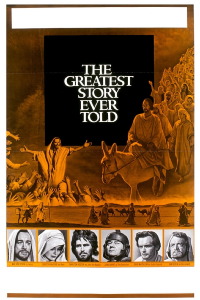
Review of The Greatest Story Ever Told (1965) by Lee M — 28 Feb 2016
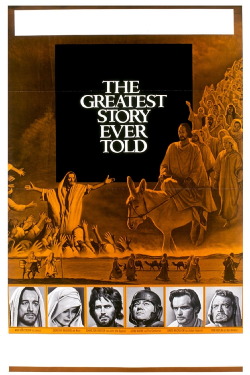
With a large budget and an ensemble cast, The Greatest Story Ever Told had a lot of hype behind its story of the life of Jesus Christ.
To kick things off, I can certify that the title of this film is most misleading. Despite not being a religious person, I am a fan of a good epic, and since The Greatest Story Ever Told came out during the heyday of religious epics thanks to the success of films like Ben-Hur (1959) and King of Kings (1961). Considering that The Greatest Story Ever Told doesn't have nearly the same legacy despite its ensemble cast, it's clear that there had to be something wrong with the film. It doesn't take too long to establish what.
Depending on which version of The Greatest Story Ever Told viewers are watching, the running time can vary between 137 minutes and 260 minutes. Either way, audiences are in for a long feature aimed at telling a large story. George Stevens manages to achieve this, but he can't make it sufficiently entertaining in the process. The Greatest Story Ever Told has ambitions which are too epic for their own good as George Stevens has the intentions to create a brilliant spectacle with this film, but neglects the need for characters in the process. With a cast packed with actors notorious of the time, George Stevens scatters his focus among the countless characters of the story with an attempt to recognize the relevance of all of them within the biblical mythology of the story. But by the end of the film, the only memorable supporting characters are likely to be those viewers recognize as being familiar actors. And the cinematography is so focused on emphasizing the large scale of everything that it rarely takes the time to focus on the facial expressions of the actors, limiting the extent of emotional insight viewers can collect from them. I don't know what the importance of most the characters in The Greatest Story Ever Told was, but it hardly mattered because the experience was one which got boring very fast.
Aside from the cast, the one thing that really compelled me to watch The Greatest Story ever told was the idea that as a religious epic there would be some kind of spectacle. With a budget even larger than that of Ben-Hur, The Greatest Story Ever Told clearly has the funds to achieve something incredible yet managed to do the exact opposite. Despite the four Academy Award nominations The Greatest Story Ever Told received for its visual traits, I maintain the only one it deserved at all was the musical score which carreid a nice spirit that sounds occasionally like it influenced the work of Howard Shore on the Lord of the Rings trilogy (2001-2003). As nice as the scenery is, viewers are treated shots of the same Western landscapes again and again which look way better in a John Ford film. They mainly serve to bridge scenes together as a transition. And though the production design and costumes may be detailed, after a while, The Greatest Story Every Told suddenly stops finding any use for them. After its visual grace has been bestowed upon viewers, The Greatest Story Ever Told's main narrative drive turns out to be the many monologues of Jesus Christ who preaches to the crowd in a series of speeches, burdened by an emotionally distant atmosphere. The faithful may find their spirits raised by having many biblical tales realized on screen, but for viewers in search of genuine entertainment value there is little more than a lifelessly slow film which stretches on for too long without sufficient spectacle to carry it. In actual fact, many scenes contrast the notion of a spectacle through all use of lighting which is way too dark to actually comprehend. It's as bleak as the story itself.
After sitting through many hours of biblical rambling and repetitive imagery, it ultimately proves not to be worth the experience. The climax of The Greatest Story Every Told is as emotionally removed as it's beginning, even though its the crucifixion of Jesus Christ himself. To see the man put to his death without any feeling is quite a difficult feat to achieve when you have the funds George Steven had, but he found a way. And to add insult to injury, the scene comes to a close with John Wayne of all people. For some reason, widely recognized actor John Wayne has a cameo as a Roman Centurion. In his one line "Truly this man was the Son of God", John Wayne reminds audiences of just how incapable he is of stepping outside of playing cowboys and soldiers. In the same monotony as the entire film, John Wayne's miscast part has him standing and speaking like a statue with such little sense that it's just laughable. It's almost a cruel joke on audiences to do this, but as everything else in the film is just as powerless I'll just call it the final nail on the coffin of The Greatest Story Never Told.
Interestingly enough, The Greatest Story Ever Told was criticized upon its original release by many who found that the ensemble cast served as a distraction from the solemnity of the narrative. As the film is now 51 years old, viewers are likely not to recognize the majority of the actors if they did not grow up during the 1960's era. There are certainly a collection of familiar faces that are hard to ignore, but in this generation they very much get buried amid the countless nameless faces. Still, the lack of characterization proves that the familiar faces are among the few things to enjoy about the film since the one-dimensional characters leave little more than surface value to be .
In his English-language film debut, Max Von Sydow proves to fit the profile of Jesus Christ with intrinsic ease. The internationally acclaimed actor is heavily recognized for his versatility, and The Greatest Story Ever Told challenges him to take on an iconic role with limited material left to support him. There is no great insight provided into the mind of Jesus Christ, but Max Von Sydow naturally manages to capture the solemnity of the man. Max Von Sydow delivers his words with a poignant understanding of what they all mean and a gracious passion for what kind of a person Jesus Christ really was, serving to provide natural talent to bolster the dull script and render him a mildly engaging screen presence. The Greatest Story Ever Told may not provide sufficient challenge to an actor as accomplished as Max Von Sydow, but either way he provides a modicum of spirit.
And Charlton Heston is a face who can hardly be forgotten due to his Academy Award winning legacy as the titular character in Ben-Hur and for playing Moses in The Ten Commandments (1956). He naturally carries a holy feeling to him, and though the tone of the film doesn't allow him to deliver his words with the booming brute strength that he is acclaimed for, he still carries a holy feel. Charlton Heston's recognition in religious cinema provides something to look out for in The Greatest Story Ever Told, and his natural charisma creates sparks in a film which desperately needs them.
The Greatest Story Ever Told offers sporadic moments of imagery, strong music and half-decent performances from Max Von Sydow and Charlton Heston. Yet ultimately, the need for spectacle quickly becomes forgotten in favour of an overlong, slow and emotionally empty experience which lacks the strength to live up to its title.
This review of The Greatest Story Ever Told (1965) was written by Lee M on 28 Feb 2016.
The Greatest Story Ever Told has generally received positive reviews.
Was this review helpful?