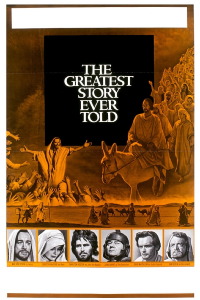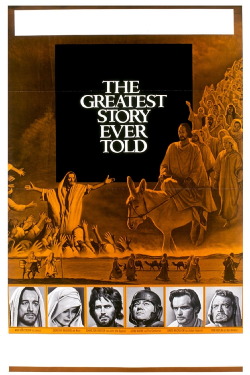
Review of The Greatest Story Ever Told (1965) by Greg W — 11 Jan 2012
3: Comparing this to DeMille's The Ten Commandments, which I watched just beforehand, is rather instructive. Stevens is obviously a far more gifted and tasteful filmmaker. The cinematography is natural and rather beautiful.
The landscape is expansive and impressive. Granted, it is filmed apparently largely in Canyonlands National Park in southern Utah, when it is supposed to be around Jerusalem, Bethlehem, Galilee, Sinai, etc, but it does look wonderful.
The views from island in the Sky and along the Colorado and Green river banks are unmistakable. I literally have walked exactly where Jesus walked in the film and watched the sunset from a few feet away.
Pretty funny. Stevens is vastly more tactful regarding the more incredible supernatural acts, such as the loaves and fishes miracle and the walking on water. He doesn't shoe us these acts, but rather simply tells us that they occurred.
This makes them more powerful and more plausible, as it is left up to our imagination and isn't depicted literally before our eyes. The costumes, performances, script, etc are all much more naturalistic and sophisticated.
It seems true to life, whereas The Ten Commandments was anything but. Jesus' teachings really are incredible. I can't imagine anyone actually successfully living by them. You would have to be an absolute saint and hardly be human at all.
Maybe Gregory Peck could do it, but presumably even then only on screen. It often seems like his teachings were meant for another world, as it seem impossible they could be meant for this one. In some ways they seem to hearken back to the garden of Eden, or even before it, when peace on earth and good will toward men could have been possible.
This has never really existed of course and never will, no matter what Gene Roddenberry thought or hoped. Much of this originates in the Ten Commandments of course, which makes a comparison of the two films even more apt.
Some of the films differences also must lie in the source material, i.e. the old vs. the new testament. It's hard to believe they are contained within the same volume, the Bible. Max von Sydow's performance, and manner in which Stevens filmed it, is incredibly powerful.
When he is restoring Lazarus to life and stares straight into the camera, and hence into the viewers eyes, while explaining that everlasting life will be given to those that believe in him, one tends to believe him.
It seems genuine and is deeply affecting. The manner in which this "story" is spread by but a few that actually saw the event occur afterwards is striking as well. It is simply one earnest individual passing along the tale from person to person.
He is very enthusiastic and thus infects others, who did not personally witness the event, with his enthusiasm and belief. And then someone writes it down. Thus, a religion is born. The title of the film is very appropriate as well, as it is perhaps the greatest story ever told, in more ways than one.
It is both an engaging tale and a narrative that has had a great impact on civilizations the world over in the past two millennia. I'm betting both Scorsese and Mel Gibson saw this, or at least they should have.
This review of The Greatest Story Ever Told (1965) was written by Greg W on 11 Jan 2012.
The Greatest Story Ever Told has generally received positive reviews.
Was this review helpful?