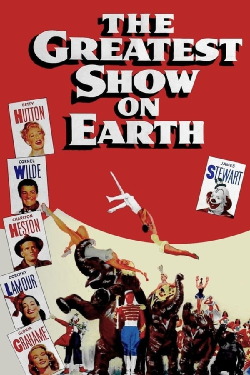
Review of The Greatest Show on Earth (1952) by Paul Z — 04 Mar 2009
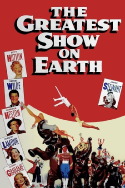
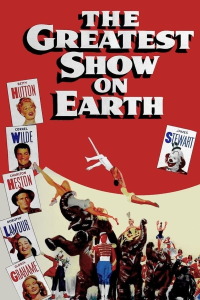
Cecil B. DeMille, the conceited, egotistical, huge-headed tyrant whose viewpoint of cinema measured quality only by quantity, surprised me with The Greatest Show On Earth, despite its conveniently big-headed title. Though this epic is unabashedly American, the extensive, laborious circus scenes are not simply spectacle. They're actually very reminiscent, to me at least, of Fellini, not just in the capturing of a large-scale slice of a culture but also in its pacing.
It fills in its blanks unexpectedly well. The three main characters are caught up in the routine romantic triangle, of course, and Bob Hope and Bing Crosby have gratuitous cameo roles as circus spectators, and Edmond O'Brien has a similar unbilled appearance, all simply to add to DeMille's relentless braggadocio, but other subplots involve performers played by Dorothy Lamour and the magnificent and super-sexy Gloria Grahame, and a mysterious clown who never removes his makeup, played by James Stewart, delivering my favorite performance.
Backstage melodrama rotates with its Felliniesque sequences of realistic circus performances in over-the-top costumes by the great Edith Head and others. Towards the end, which gives new meaning to "The show must go on," a great scene entails a colossal crash of the two trains that lug the circus from town to town. The real Ringling Bros. and Barnum & Bailey's of the time, with its quantity of over a thousand people, hundreds of animals, and 60 carloads of gear and tents appears in the film, which I imagine made it easier on the film's own crew, and DeMille got to sit back and watch in leisure his production grow in scale.
This review of The Greatest Show on Earth (1952) was written by Paul Z on 04 Mar 2009.
The Greatest Show on Earth has generally received positive reviews.
Was this review helpful?