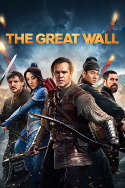
Review of The Great Wall (2016) by Spangle — 04 Jun 2017
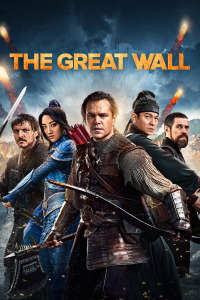
A film about how the Chinese built the Great Wall to keep out a legion of monsters known as Tao Tei, one could easily expect this film to be easily disposable and outright stupid. Yet, under the sure-hand of director Zhang Yimou, this possibly stupid film takes a unique turn into being a stellar realization of old legend (is it really a legend?) that can be mocked for being so clearly untrue, but still contains excellent themes, great action scenes, and a great imagination that always manages to get the film out of problems that could derail other film of the type. Sure, the Chinese may have not built the wall or flown on primitive hot-air balloons, but as a historical science fiction film, The Great Wall is a tight, well-acted, and thoroughly entertaining piece of blockbuster cinema.
In many ways, The Great Wall hearkens back to the days of the old-school blockbuster. Back in the 1980s and 1990s, things did not need to be plausible. Kurt Russell could kick ass in any number of science fiction scenarios or a boy could meet an alien or some moron could recreate dinosaurs in a theme park. Yet, nowadays, films with such inventive and imaginative plots as The Great Wall are mocked and chastised for how dumb they sound before they are even released. It is a shame that, as a result, we get more-and-more blockbuster films that just try and show real events - my God, Marvel making us watch United Nations meetings and terrorist bombings when we could just watch Tao Tei monsters eat people instead is a travesty - and, as a result, these films just feel as though they are lacking that extra punch. The extra punch is that of creativity and The Great Wall's unique plot and setting is there to deliver in a mostly successful blockbuster that features the imagination and insanity lacking in today's blockbusters. Though flawed nonetheless with some bad writing, conveniences, and dumb characters, Zhang Yimou finds a way to make blockbuster cinema exciting once more in The Great Wall.
He does this by relying upon scope and awe. With shots highlighting the absurd size of the wall to shots of those aforementioned hot-air balloons descending upon the capital of China, the film is obviously gorgeously shot and designed, but is more-so a visual spectacle. Though the film comes in at a very tight 90 minutes, Zhang Yimou infuses a sense of awe and sheer enormity with the film's expansive visuals that are designed to try and communicate the incredible scope and ambition of the film. This is a blockbuster with a sense of style and size that is largely lacking in the more contained and focused blockbusters of today. Here, Yimou constantly reminds the viewer of the vast size of everything involved with audacious battle sequences of the Tao Tei climbing the Great Wall or climbing palace towers. While the former comes in a gorgeously designed action scene where everything is obscured in smoke to increase the fear factor of the moment, both that scene and the latter one in the palace are akin to World War Z's scene of zombies climbing a wall. Similarly to that, the scene is awe-inspiring in its grandiose nature and a visual feast.
However, as with any film by Zhang Yimou, this film is hardly just audacious action set pieces. Instead, at its heart, this film can be seen as a wuxia film. Perhaps Yimou's best film, Hero, is a wuxia film and many of the action scenes here show that very same style. As Commander Lin (Jing Tian) battles with some Tao Tei in the capital, she uses her sword in incredible fashions as she literally flies and dances her way through the battlefield. Using William Garin (Matt Damon) as further back-up, Lin is a high-flying spectacle of the highest order throughout this film and is the main connecting thread to Yimou's aforementioned peak as a director. As with Hero, the scenes where he is able to go full wuxia are gorgeously constructed and choreographed with it no longer resembling a battle. Instead, it becomes a dance to the death with one of them wielding a sword used for ballet-esque destruction.
Similar to Hero or even classic Japanese cinema such as Akira Kurosawa's Ran, the film's reliance upon color is always purposeful and gorgeous in equal measure. The comparison to Ran is all the more apt due to the fashion in which Yimou utilizes the coloring of the armor worn by the Chinese soldiers to denote key themes or ideas about the person's role in the army. In Ran, Kurosawa took a very similar path with each son wearing a color - blue, red, or yellow - that denoted their defining characteristic. Here, soldiers are assigned either purple, yellow, blue, or red gear. General Shao (Zhang Hanyu) as the leader is assigned black as is Peter Yong (Lu Han). For the former, black is seen as a color of power and, as General, Shao has considerable power. For Peter, black is the color given to young men expected to follow in the path of their ancestors.
This review of The Great Wall (2016) was written by Spangle on 04 Jun 2017.
The Great Wall has generally received mixed reviews.
Was this review helpful?