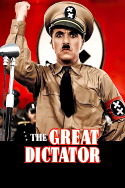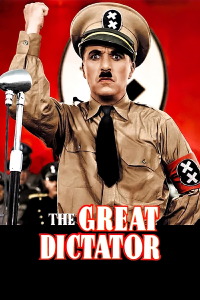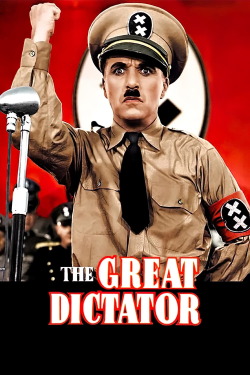
Review of The Great Dictator (1940) by Ryan H — 18 Jun 2012
Watching this film without knowing the context is great. You get Chaplin's dry humor mixed with political satire, much like Modern Times but in talky form. There are some sillier moments that seem to be a little too much, but that's when you put the context in and realize what it's there for.
Chaplin started making The Great Dictator in 1939 and finished in 1940. This was before the US involvement. Remember, the US didn't take full combatant involvement until 1941 when Pearl Harbor was attacked.
So perhaps what he was doing he was trying to be silly and light hearted so that people could swallow the tough pill that we he was giving them. I don't exactly remember which ones, but I remember some jokes carried on a little longer than usual.
But you have his silent film creep up plenty of times in this film. It seems like we are seeing the tramp early on in the film, but that outfit doesn't stay on long. He doesn't say much in the opening, which was probably a teaser for the audience wondering if they would actually hear his voice or not.
The joke of the airplane being upside-down was classic Chaplin-style humor, then bringing back the pilot he saved was definitely part of his story structure. Even though he was switching to talkies, he wasn't going to change what kind of filmmaker he was.
Especially with Modern Times being his most recent film, the last monologue really connects the two. We are getting to a point in our times that we have modern industry that could make life more intriguing and interesting, but instead we use it against each other.
Chaplin knew we should be interfering with Germany. How could we just sit back and watch the Jews get all of their freedom taken away? The Barber awakens to a world that doesn't accept him because of his beliefs, where this is a world that should be mixed with people who can live however they want, and let others live how they want.
Why do we have to be horrible to each other? It seems like he's a little interested in Hynkel (Hitler) and Garbage (Goebbels). He could have delved into them more, but I don't think he cares too much.
No, what he wants is for Americans to realize what the Jews were going through at that time, and there were people who were causing it. Chaplin does a brilliant job of showing the conflict between Hitler and Stalin.
When you have two dictators wanting control, only one will truly want to come out on top. They can sign treaties all they want, but it won't do any good. He even shows the argument I'm sure people were having "well why don't the Jews just fight for themselves?" Hannah tries to take control and fight the Stormtroopers, but even with the town on her side they still come after her.
No one can stop them. The Jews believe one day they will go away, but little do they know it gets much worse after the ghettos. Even when Hannah runs away to Osterlich she isn't free. They live on a farm, but both Hynkel and Napolini are about to invade and take over their way of life.
It's like the haunting poem about first they took them and I didn't speak, then when they were all gone no one was there to speak for me. It was time to raise up and give these people back their freedom.
The film is quite remarkable when you set it to the time period. A true masterpiece and one of the best films of all time.
This review of The Great Dictator (1940) was written by Ryan H on 18 Jun 2012.
The Great Dictator has generally received very positive reviews.
Was this review helpful?