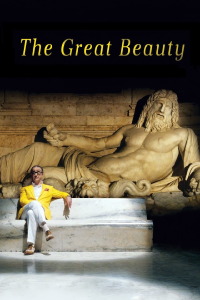
Review of The Great Beauty (2013) by Steve J — 19 Sep 2013
To borrow the opening lines of Andy Williams' hit song Love Story: "Where do I begin? To tell the story of how great a love can be?".
La Grande Bellezza (The Great Beauty) is not a conventional film with a concrete beginning, middle and end. It's more like a series of visual and poetic vignettes about love, life and longing told through the eyes of a weary writer approaching the twilight of his days.
The themes of which are weighty and simple and cut through the superficial blah, blah, blah of everyday chitter chatter: we live, we love, we cease to be; we want, we need, we seldom get, and often don't.
Or, to quote the protagonist himself, "We're all on the brink of despair. All we can do is look one another in the face, keep one another company and joke a little.".
Rome is the setting. And Rome is the metaphor for life. It satisfies and saturates our senses - architecturally, historically, culturally, culinary, aesthetically, sexually - and yet, it often leaves us feeling empty, in need of something else, something substantial, something more.
And what is this something? In a word: love. In a few more words: a sense of belonging, meaning, purpose.
"People ask why I don't write another novel," confesses the one-book novelist to a friend. "Look at these people (referring to a crowd of Bacchanalian revellers). A wildfire. This is my life. And it means nothing.".
During the two hours traffic of our cinematic stage, our eyes are invited to feast upon a series of seemingly abstract yet strikingly beautiful and at times intensely moving images: a spot-lit giraffe standing aloft in the stony grounds of a rustic castle; a walled-garden dotted with dancing couples bathing in the dying light of an autumnal evening; and a flock of flamingos seeking respite on a desolate balcony before taking flight and migrating west.
And the simplest and most moving image of all: a large brick wall displaying thousands of photographs charting the changes in an artist's face as he blossoms from baby to child and from teenager to man.
Despite a lack of narrative (which, admittedly, irks somewhat), what saves this absorbing exploration into the human condition becoming a pretentious experiment in search of a full stop, are the intricate layers of subtlety, depth and humour with lace conversation:
Writer: What are you going to do tonight?
Widower (who has found new love): Nothing. Polina is going to finish the ironing, we'll have a glass of wine, watch some telly and then go to bed. What about you?
Writer: I'll have a lot of wine. (Pause) And when you get up, I'll go to bed.
And little pearls of wisdom:
"It was nice not making love to you.".
"In the days to come, when you feel the void, you can always count on me.".
"You're 53, with a life in tatters, like the rest of us." Get. Over. It.
Towards the end of the film, the protagonist embarks on a lengthy dinner conversation with his literary agent (a formidable woman of diminutive stature) about death, despair, disappointment ... and other despondent themes beginning with d.
Just when they (and the audience) are on the verge of reaching for a razor blade of Sweeney Todd sharpness, his perky agent politely asks, "How did you like the soup?" To which he responds slowly and after much thought, "Good. It was good.".
They nod, they smile, they sup said soup.
"It was good." A fitting end to a lengthy review about a mighty fine and beautiful film.
4/5.
This review of The Great Beauty (2013) was written by Steve J on 19 Sep 2013.
The Great Beauty has generally received very positive reviews.
Was this review helpful?