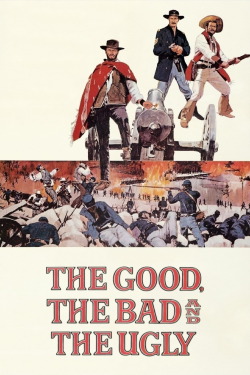
Review of The Good, the Bad and the Ugly (1966) by David C — 16 Mar 2014
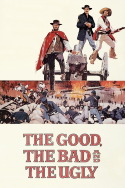
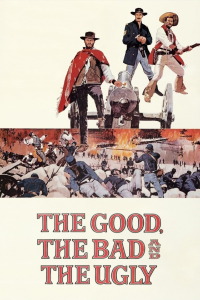
This is not just an epic Western, it is high art. Every shot seems to be precisely-framed and every quip seems rich with meaning. The camera lingers on Tuco "the ugly" (Eli Wallach, channeling a young Toshiro Mifune in a manic, wild-eyed performance) as he shifts his gaze restlessly and drains a bottle of red liquor in front of a crucifix. It sounds too obvious written out, but it the moment and in the setting it fits to a tee and can startle you with its painterly beauty.
A few moments later Tuco untruthfully explains his relationship with his brother before just as untruthfully claiming a side in the fratricidal American Civil War. There's a precise and intentional balance and symbolism to these moments, and to the film as a whole, but they are so slyly integrated that the tricks can pass unnoticed. For example, two wounded Union officers, both figures of sympathy, echo each other, but they also balance out two sadistic men in blue uniforms: the "bad" Angel-Eyes and his brutish enforcer.
But more on Tuco, because he's really the star of the show. He and Eastwood's nameless "good" guy trade wry observations about the "two kinds of people in this world." All people can be divided into two categories, they seem to believe. But Tuco, as the title of the film reminds us, belongs to a third category. He and Eastwood are neither friends nor enemies, and the film's knack for exquisite balance reappears when first one and then the other drags his partner through the parching desert.
Ennio Morricone's score lifts certain scenes, especially the final act in the cemetery, to a dreamlike plane. That scene seems to exist in an eternal moment that builds and builds as Tuco runs through the graves. Then it slams on the brakes, only to start again from nothing and build and build, rhapsodically an seemingly unendingly, to another sudden breaking point. No final shootout in the annals of Westerns, even the much-anticipated culmination of "High Noon," feels more momentous, and this is thanks in great part to the music of Morricone.
As good as the first two movies of Sergio Leone's trilogy are, this is by far the richest and the most artful, and it continues to reward with each viewing.
This review of The Good, the Bad and the Ugly (1966) was written by David C on 16 Mar 2014.
The Good, the Bad and the Ugly has generally received very positive reviews.
Was this review helpful?