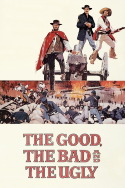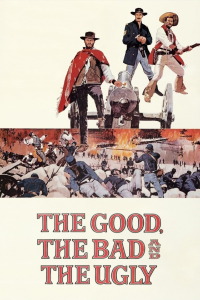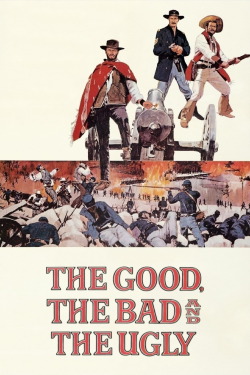
Review of The Good, the Bad and the Ugly (1966) by Dave M — 05 Nov 2012
There must come a time, in the life of every great commercial filmmaker, when utilizing elements of narrative and sucessive formulas of entertainment is just not enough. Regardless of the intention of the product and how it is developped both in idea and as a result, the creator of the work unintetionally develops a deeper, almost accidental grasp of the world on which his creations unfold. That's what we can say, for example, of sequels like "The Empire Strikes Back" and "The Dark Knight". In both of them, we were unexpectedly taken into a revision of every single element composing those worlds, and a sudden feel of awe and involvement came to the audience as we witnessed how the world became grander and more immersive, and not just in the screen. Perhaps that's what makes a sequel successful, I'd say. The groundwork doesn't have to be that good, it can merely be the notion of the emerging world... but then comes the 'dwarf', smiling at you and signaling how, in spite of unplanned schedule, you are making art with your formulas... It's just inspiration, my friends, and that's something art simply cannot fight.
Why am I saying all this? It's obvious that Sergio Leone, already a brilliant technical director, looked forward to encompass the artistic crudeness and reality of his stories. The third installment of "The Man With No Name", is arguably the most ambitious and fulfilling western film out there. Not that there are not formulas in here. They are still present, only that they're not just elements of a simple storyline with human clichà (C)s. This time, I would say Leone is trying to explore the formulas, and get the most out of them. We even get an insight into the political and historical background of the era! An entire sequence involves two of the main characters fighting for the Northern army. We even get to meet Lee Van Cleef as, not only a bounty hunter, but a captain on the same army.
Leone is also getting into the characters' psychological nature... someway or another. The Mexican-American Border is cursed, no doubt about it, filled with dread and outcast spirits, and Ennio Morricone's score manages to transmit that directly to the viewer. His trumpets cry in despair, almost like the millions of souls on that cemetery on which the final duel takes place.
This is a movie that was made in an era where films were unnecesarily long and detailed, and yet, it managed to make me feel like after watching "The Dark Knight". This is what would happen when a film product is comissioned to a person whose artistic ambitions know no limits. It is the result of a director searching for the human nature and the authenticity of the world... it's what happens when a product becomes art.
This review of The Good, the Bad and the Ugly (1966) was written by Dave M on 05 Nov 2012.
The Good, the Bad and the Ugly has generally received very positive reviews.
Was this review helpful?