Review of The Godfather Part III (1990) by Pete H — 09 May 2011
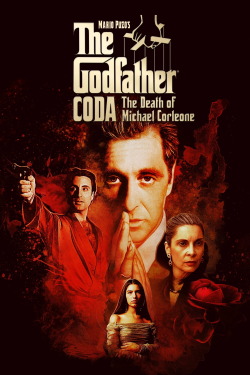
Widely damned as an unworthy successor to the previous two films, THE GODFATHER PART III, while falling far short of their standards, is still an intriguing film, interesting if only for the sheer novelty of its existence; here, years after the first two canonical works, comes a new part of the story with the full involvement of the original director and the original writers--one of whom wrote the novel that kicked off the whole thing. And the root story is compelling enough that it keeps us watching, even when it lets us down. The story, briefly summarized, involves Michael's (Al Pacino) attempt to rehabilitate himself by giving enormous sums of money to charities and to the Vatican. He aims to completely legitimize the family businesses--something he hollowly promised 25 years earlier--but, as he says in the film's most famous line "Just when I thought I was out, they PULL me back in!" Needless to say, there is a great deal of plotting and bloodshed.
A decent premise, if a bit of a repeat of the second film, but Francis Ford Coppola (the director/co-writer) and Mario Puzo (co-writer/series creator) muck it up by burying us in the details of Michael's financial dealings with the Vatican and his attempts to acquire control of a firm called Immobiliare, which the Vatican partially owns. This is handled awkwardly, with a lot of headlines and news-feed soundbites (not unlike the massively clumsy film of ATLAS SHRUGGED), and it fails to engage the attention. More interesting is the rise in power of Michael's nephew (the bastard son of his late brother Sonny) Vincent (Andy Garcia), who, like his father, is devoted to the family, but is impulsive and violent. Michael still gives him a chance, even after his potentially destructive feud with local boss Joey Zasa (Joe Mantegna). When Vincent falls for Michael's daughter Mary (Sofia Coppola), his own first cousin, things get even knottier.
But even the more family-based aspects of the plot don't really ignite, partially because of Coppola's erratic direction, and partially because of the weak script. The script's weakness is certainly understandable; Coppola and Puzo were given roughly six weeks to write it, and it shows. There's a great deal of repetition in the dialogue, and scenes often seem directionless; the whole of the film lacks much forward thrust, so that when the final cycle of revenge-killings take place at the film's climax, it's hard to care much precisely because, for the most part, one-note characters are being killed, for reasons which are generally vague.
Coppola's direction may partially reflect the heavy pressures on him; his career was at a low ebb at the time, and the failure of TUCKER: THE MAN AND HIS DREAM was reputedly a major factor in his decision to make this film. And despite the Oscar nomination he received for directing, the film drags a good deal of the time, with matters coming to life mostly when there is less chatter: the Atlantic City massacre, the final revenge-killings (which may not be so dramatically satisfying, but make for good cinema), the quiet, melancholy coda...these moments are worthy of the first two films (and the shot of a body being tossed down the center of a spiral staircase is one of the best shots in any of the three films). But for most of the film, Coppola is unable to raise the stakes very high, and despite the nearly three-hour running time, the film ultimately feels somewhat insubstantial (that Coppola's contract for the film mandated a running time of at least 140 minutes clearly didn't help).
The acting is generally decent, but few of the cast really shine: Al Pacino seems "off" as Michael much of the time, and the combination of pathos and menace that worked so well in the first two films is largely gone here (a moment where he laments his order to have his brother Fredo killed is one of the few exceptions). Pacino rarely seems to hit the right tone for the role, and while he still does acceptably, this rendition of Michael can't really carry the film. Andy Garcia got a lot of praise for his performance as Vincent (and an Oscar nomination), but viewed in retrospect, he doesn't rise much above the general malaise of the film. His performance is solid, and with a better script Vincent could've been a truly memorable character. But Garcia's subtleties are lost in these circumstances.
Sofia Coppola took a great deal of flak for her performance, and would even win Razzies for it; that she was the director's daughter didn't help matters. She's not that great, to be sure, often coming off as somewhat awkward and flat, but she hardly deserved a Razzie; she was miscast, but had it not been for the accusations of nepotism, her performance would simply be seen for what it is: acceptable but mediocre. Diane Keaton, returning as Michael's estranged wife Kay, has a solid amount of screentime, but Kay has so little to do from a story point of view (she defends their son's ambition to be an opera singer, then is just...there) that she sort of fades into the background. Talia Shire comes off better as Connie Corleone, who takes an increasingly active role in the family machinations; having endured much tragedy in the previous films, she has become as hard-boiled as her brother, and Shire communicates this well. (That she is the director's sister does not seem to have bothered anyone, even when the first film was released.).
In other, smaller roles, Donal Donnelly makes the best impression as the corrupt Archbishop Gilday; his frailty and soft voice are intriguingly at odds with his calculating nature. Eli Wallach, as the family friend Don Altobello, seems to act as if he was in a comedy, and his goofiness makes one wonder if Wallach realized the film's shortcomings and decided to ham it up; if so, it doesn't quite work, but his performance is one of the more interesting ones. Joe Mantegna doesn't get enough to do as Joey Zasa; George Hamilton, as Tom Hagen replacement B.J. Harrison, and Helmut Berger, as the Swiss banker Keinszig, are similarly underwhelming. Raf Vallone is good as Cardinal Lamberto, who briefly--very briefly--becomes Pope, but he too appears only fleetingly.
Dean Tavoularis' production design is as solid as ever, as is Gordon Willis' dark-toned cinematography; Carmine Coppola's score (the director's father), based on Nino Rota's score for the first film, is quite good, filling in some of the emotional gaps that the story leaves. The editing (Barry Malkin, Lisa Fruchtman, and Walter Murch), is solid, but aside from the climax, lacks fire. I suspect the Oscar nomination it received was due more to a weak year than anything else; for God's sake, they nominated GHOST, too.
THE GODFATHER PART III is a tricky film to judge, a film full of flaws that is, nonetheless, recommended viewing. It can be said that the film, in its own qualities, is like the final chapter in Michael Corleone's life: it aims for greatness and fails, largely because of its own ambitions, and becomes mired in a muddle of corruption and bitterness, concluding in tragedy. And one couldn't ask for a more fitting final shot.
This review of The Godfather Part III (1990) was written by Pete H on 09 May 2011.
The Godfather Part III has generally received positive reviews.
Was this review helpful?