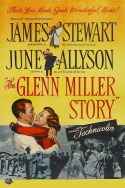
Review of The Glenn Miller Story (1954) by Edith N — 24 Dec 2010
The Challenge of the Biopic.
There are some decided difficulties to any biopic, but especially those of the era in which this particular one was made. The one specific to the time period is the simple fact that you could only put so much in a movie. This was, let's face it, still under the Code. I have no reason to believe there was any reason to put them into the movie, but if he had been gay or a drug addict, it would not have been possible to show it. A more likely issue is that, if any of his friends had been in mixed marriages, that couldn't have made it onscreen, either. Of course, the other reason they couldn't have put in theoretical drug addiction is that almost all the principals were still alive. You have to be careful about lawsuits even when presenting the truth sometimes.
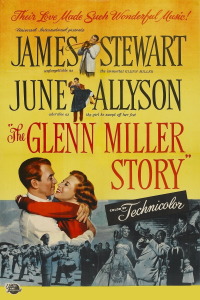
Glenn Miller (Jimmy Stewart) is your standard struggling musician. He's constantly pawning and retrieving his trombone from Friendly Pawn Shop Owner I Didn't Catch His Name. His problem is that he really wants to be a composer, and all anyone wants to hire him to do is just play the trombone. He and his best friend, Chummy (Harry Morgan), do end up getting a gig with Ben Pollack's "orchestra," as they were called, and touring. When he stops in Colorado, he calls up Helen Berger (June Allyson), a girlfriend from college he still thinks of as "his girl" despite the fact that he hasn't talked to her pretty much since then. He doesn't seem to think communication is necessary or important. Yet somehow, she's willing to go along with this, and indeed even ends up marrying him. He develops His Own Style and goes on to become one of the best-known musicians around. And then he enlists in the military during World War II . . . .
Actually, we think we know what happened to him, it seems. It was common practice, for sensible reasons, to dump all unused bombs before returning to base and landing. An RAF pilot's log describes jettisoning bombs after an aborted run and says a small plane got in the way. Now. Why this wasn't more commonly known, I cannot say. I mean, no, you wouldn't want to broadcast that information during the war. For a whole list of reasons. Now, Wikipedia says the theory is disputed, so maybe that's it. It just kind of gets me that a log would show that and that no one would, it seems, try to track down whose plane it was. (The issue seems to be that where the plane was flying is disputed.) The idea that you can just not know does seem worse than any alternative. I heard not that long ago that there will never be another Tomb of the Unknown Soldier, because now, we can test the DNA. Yet there will always be those listed as MIA. There will always be uncertainty.
Really, the adjective that's coming to mind for me on this one is "bland." There are some genuinely amusing moments, but there isn't anything which really captures the imagination or emotions. I'm sure Glenn really loves Helen, but I'm not entirely sure why she loves him back. She tells him at one point that the first time he ever told her he loved her was in the wedding vows, and he says that he thought she knew. Then later in the film she says it's the first time he's told her since the wedding. He buys her a string of pearls from the same pawn shop where he keeps getting money for his saxophone. They're being sold for $100--$80 for Glenn. Yet somehow, they're just really, [i]really[/i] expensive fake pearls. How good do they have to be to actually be worth that, even at pawn shop prices? Basically, I spent all my time worrying about why she married him and what the deal was with the pearls.
As it happens, I have been in the room where Glenn Miller recorded his radio show. This was many years ago. I was in eighth grade, and I was in an orchestra that went to New York to play at Carnegie Hall. We stayed at the Pennsylvania Hotel, and one of our two rehearsals while we were in town was in the Grand Ballroom. A guy from the hotel stood up in front of us before the rehearsal and pointed out the phone number of the hotel. He then got the experience of a hundred and twenty teenagers looking at him blankly and Kendall Moore's mom, who was one of our chaperons, getting all excited in the back of the room. I think he thought that, because we were musicians, we'd know who Glenn Miller was. He didn't realize we were the wrong kind of musicians entirely for that. Big bands called themselves orchestras; we were actually in one.
This review of The Glenn Miller Story (1954) was written by Edith N on 24 Dec 2010.
The Glenn Miller Story has generally received positive reviews.
Was this review helpful?