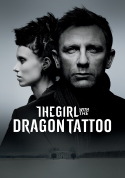
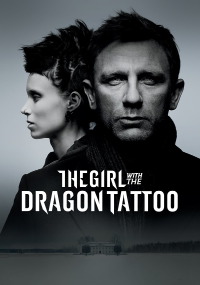
Review of The Girl with the Dragon Tattoo (2011) by Chris G — 24 Mar 2013
Man, they didn't just mess Rooney Mara up for this, they messed her up, up, down, down, left, right, left, right, B, A, start. I now understand why Kate Mara's show is called "'American' Horror Story", because they didn't want people to confuse it with this, Mara's sister's "Swedish Horror Story". So yeah, that cute little Rooney isn't looking so cute anymore, but hey, I guess she's attractive to some people, because everyone is after her in this film, but then again, we are talking about Sweden here, and Sweden in a David Fincher film no less, so you know that there are going to be some disturbed individuals, especially considering that we're not simply talking about your regular ol' Mark Zuckerberg, asperger's disturbed, but rather, the good old thriller days for Fincher, complete with murder, torture, rape and whatnot. ...Okay, jokes aside, oh man, this film is awesome, as well as it should be, seeing as how it marks the big comeback to thrillers for Fincher, after years of doing all of these slow... well, masterpieces. No, I'm exaggerating, because "The Social Network" wasn't great, it was just merely upstanding, but either way, the point is that Fincher can pretty much do no wrong no matter what he's doing, yet I am still glad to see him back into straight, hardcore thrillers, and I'm sure Daniel Craig is too, seeing as how he needs an awesome psychological thriller to help people in forgetting "Dream House". Shoot, I say that like people need this film to forget "Dream House", but either way, the fact of the matter is that this is a thriller that's well worth remembering. Still, as excellent as this film is, not even the greatest, possibly asperger's syndrom-ridden filmmaking mind can fully wrap his head around pulling off a flawless film, so, of course, this film isn't without its problems, and perhaps too many for its own good.
Its length sprawling and its plot highly layered, this film takes a whole hour-and-a-quarter to get around to the meeting of our leads, and up until then, while no point in this film's heavily branched focal structure is less than excellent, momentum takes some damage from focal unevenness that jars you back and forth between our two primary narratives, and doesn't exactly improve too considerably when the two narratives in question finally meet, because as tight as this film's storytelling generally is, the structure of this plot on paper bloats itself with too much material to cover all that organically. Shoot, even when you take focal consistency issues out of consideration, the film is still too bloated for its own good, taking on a hefty collection of rleatively major plot aspects that isn't too terribly often all that excessive, but just excessive enough for the film to feel a bit overblown. At over two-and-a-half hours, this isn't exactly the briefest of American thrillers (I say, "American" because, seriously, Asia, tighten your stuff up), and the script makes sure that you don't forget it, not quite bloating the film so intensely that the narrative feels aimless after a while, but nevertheless bloating the final product past the point where something like David Fincher's atmospheric tightening can do anything to fully obscure excessiveness, which further retards momentum, whose issues still don't end there. Like I said, Fincher, arguably the greatest mainstream film director alive, can do no wrong, so, when you get down to it, the biggest problems with this film's narrative can be found within the writing efforts of the great Steven Zaillian, whose script is, on the whole, very strong, but still so flawed in its structuring of plot that it even establishes pacing issues that Fincher can't entirely work past, the biggest of which being inconsistency that leaves the film to often cool down and meditate upon the depths of this intricate plot, perhaps for a bit too long, then, without warning, slip into the hurrying that does about as much damage to the final product as anything. The film wastes no time in telling you what to expect by presenting a hook that doesn't even last a whole minute before swiftly jarring into something as frenetic as the opening credits sequence that is rich with ink-blotch gore and Trent Reznor's, Atticus Ross' and Karen O's even heavier cover of Led Zeppelin's "Immigrant Song", tempts me to ask if I could accompany you if you plan to watch this film while on acid, - not for the acid, but to see the look on your face during the film's first three minutes - and is offputting enough in its suddenness, which isn't to say that offputting hurrying ends there, because as comfortable as this film generally is in its flow, momentum is constant, and after a while, Zaillian gets to be a bit forceful in his keeping pacing up, thinning out exposition and hurrying the film along almost repetitiously. By the time we come to a climax that devolves into a frantic final act that dashes all over the place trying to wrap everything up, you realize just how far momentum has fallen throughout the film's course, and while the final product's momentum never falls so far that upstanding excellence is battled back, the bonafide greatness that this effort very well could have achieved goes lost. That being said, make no bones about it, this film is never less than excellent, and is more often than anything truly upstanding, not quite to where it achieves all-out masterpiece status, but certainly to where you'll find yourself gripped thoroughly, partially by, of all things, fine technical value.
As exceptionally well-edited as "The Social Network" was, Kirk Baxter's and Angus Wall's efforts got to be a bit overbearing in their frenetic snappiness, but with this film, whether it be because they have tightened up on their skill, or simply because frantic editing fits with this film much more than it did in "The Social Network", Baxter and Wall feel much more assured in their editing, which gives you an even greater appreciation for their slickly stylish and snappy tastes that augment the kick to this film's atmosphere, helping in defining it, much like Ren Klyce's sound editing, and sound mixing with David Parker, Michael Semanick and Bo Persson, which aren't quite as pronounced as the footage editing skill, but still near-hypnotically emphatic of this distinguished environment enough to compliment the film's immerisveness and, of course, score work. Leaning more toward their mainstream flavor with this score than the melodic grace that balanced the energetic technicality of the score for "The Social Network", Trent Reznor and Atticus Ross return to the David Fincher filmmaking team with musicality that sometimes slips into the noisy overstylizing that I've never liked about Nine Inch Nails or its kin, yet never gets so lost in its style that you find yourself unable to see what all the hype over this film's score is about, as Reznor and Ross once again turn in strong score work that uniquely and organically marries snappy and sometimes even smoothly ambient style with resonant traditional musicality in a fashion that crafts a slickly dynamic score, modified to both entertain thoroughly by its own right, and bond with the structure of the film in order to augment tonal weight. Musical style is quite rich in this film, which owes much of its being defined by distinct sounds, every bit as much as it goes defined by its distinct visual style, because if this film is nothing else, it is visually stunning, as Jeff Cronenweth once again delivers on expert framing that tightly plays with scope in a fashion that immerses you into this film's environment comfortably, as well as on breathing life into David Fincher's gorgeously bleak vision through crisply well-detailed definition that does fine justice to lighting and coloring that is gritty, yet elegant in a fashion that is highly unique, richly dynamic and all around consistently breathtaking. Technically and artistically, this film accels quite a ways, being yet another striking testament to the fine stylistic quality of a David Fincher film, whose distinct artistic value greatly compliments substance that is once again strong enough without stylish augmenting. Stieg Larsson's posthumously unveiled story concept for this first installment in the mega-hit "Millennium" trilogy wasn't exactly groundbreaking, but there is a reason why so many have gravitated toward this world, as it is backed by a refreshingly unapolgetic audacity that marries bleakly gothic grit with thrilling complexities, thus making for an intricate plot concept that presents quite the challenge for any filmmaker, or at least any screenwriter. If nothing else reflects this, it's the fact that a writer as skilled as Steven Zaillian can't even take on this plot without getting sloppy to the point of slapping down unevenness and other issues that not even an uparalleled master director can battle back enough in storytelling execution for the final product to achieve the greatness that it could have achieved, which isn't to say that this film doesn't come close to achieving greatness, partially thanks to what is done right in Zallian's script, which delivers on an abundance of snappy dialogue, as well as on plot structuring that, while much too often flawed, is assured enough to unravel this mystery thriller's complex plot tightly enough to keep you gripped, or at least to stand as refreshing in a lot of way. Everyone and their grandmother feared that this film would be too much like its Swedish counterpart, but rest assured that the momentum structuring of this plotting is, like this film's stylistic, envrionmental and even casting flavor, distinguished enough for the final product to stand its own as quite different from Niels Arden Oplev's good, but inferior effort, while Zaillian's delivering on clever characterization fleshes out the depths of this character study with just enough color to earn invested in the more human aspects of this opus, which are, of course, further carried by strong performances.
While it doesn't exactly turn in promises of acting of the caliber of "The Curious Case of Benjamin Button", or even of "Fight Club", this film's story concept holds the potential for plenty of strong performances, and considering that we're talking about a film by David Fincher, - who deserves a bit more attention for his fine tastes in getting inspired performances out of components of a cast that is typically studded with star talents - you can expect strong acting, which isn't to say that this film is quite as consistently well-acted as you might hope it would be, as material still has a few spots of limiting, though not to where you can't appreciate the confidence within the actig that is across the board in this cast, from which our well-cast leading man Daniel Craig stands out, albeit not nearly as much as our leading lady, or even so much that he stands as truly excellent on the whole, but certainly just enough to deliver on his usual smooth, yet humanly balanced charisma, complimented by a few subtle layers that help Craig in bringing Mikael Blomkvist to life. Craig isn't exactly show-stopping, but his effortless charisma and reasonably committed presence make him a worthwhile lead whose engagement value is kept from getting too lost in the wake of the powerhouse of intrigue that is Blomkvist's co-lead, and yet, with that said, we're not talking about "The Guy With the Lifestyle Magazine Company", so the real show-stealer here is the best performance of the film, and maybe even by an acress of 2011, Rooney Mara, who is handed an iconic and highly challenging role that she conquers effortlessly, not just putting on a crazy disguise and flawless accent to obscure her presence, but seamlessly adopting the presence that defines the Lisbeth Salander character through a chilling charisma and convincing layers that leave her to be surrounded with an aura of mystery and intrigue that leaves her to quickly and firmly become the titular girl with the dragon tattoo who everyone knows and is compelled by. Noomi Rapace certainly brought a great performance to the table, and has earned her recognition as an up-and-a-coming star because of her memorability in this film's Swedish counterpart, but Mara tops Rapace, leaving an icon to be born again, stronger than ever, and carrying this film, though never to where you forget the fact that, when it's all said and done with, this is David Fincher's show. About as good as anyone in the business, Fincher, as a director, is a master of both style and substance, and while Steve Zaillian's story structuring is too messy for Fincher to battle back the freneticism that undercuts the final product's greatness, like he did with something like the sometimes somewhat overly busy, yet exuberant "Benjamin Button", the directorial telling of this tale is what makes the film accel as far as it does, going up against constant momentum that may be balanced for only so long before a bit of exhaustion sets in, but is still thinned out just enough for you to stick with this thriller through thick and thin, thanks to Fincher's playing with focal structure in an effortlessly assured fashion that gives things a broad sweep that keeps dynamicity up, when not staying intimate enough with atmosphere and characterization to bond you with the envrionment and notice its subtle layers just enough to keep the usual montony found within thrillers with this much consistency in momentum and heftiness in length at bay, though never to where things slow down too much. I must admit, films like "The Game" and, yes, even "Se7en" dulled down a bit for me at times, and even "Zodiac", as great as it is, gets to be a bit carried away with its steadiness at times, so of course I went into this film fearing relatively bland spells, but ended up finding a thriller that is never bland, but instead consistently and thoroughly entertaining - nay - gripping, thanks to Fincher's effortlessly assured plays with atomspheric storytelling, whose strengths hardly end with simply battling back dull spells. It's great to see Fincher back at the helm of a thriller again, but you've got to love his recent dramatic work, which is more infused with an artistry, scope and depth that Fincher brings to this film by marrying foreign-esque tastes in audacious grit with American technicality and style in order to craft a kind of neo-noirish, maybe even neo-gothic atmosphere, and such ingenious, almost innovatively distinct artistry strips disturbances - such as brutal murder, chilling torture and, yes, even the frustrating brutal mutilation of an innocent and adorable little kitty cat - of manipulativeness, leaving behind only genuine supplements to a form of tension that is ever present throughout this thriller, but never overbearingly dominant to the point of obscuring the more psychological and intellectual aspects of this complex mystery, whose rise-and-fall atmosphere structure is rarely, if ever less than effortlessly airtight enough to resonate with the viewer, who is likely to feel genuinely immersed into the mystery that stands at the center of this layered thriller, and will keep even those who are fully aware of this infamous story's outcome on the edge of his or her seat, eager to see just what the next story breakthrough will be. Make no mistake, the structure of this film's script is just too darn flawed for the final product to transcend its shortcomings, including natural ones, and achieve bonafide greatness, but in the long run, Fincher's directorial performance, the best of any director of 2011, has enough kick to it, backed by inspired acting, writing and technical style, to craft 2011's best film, a flawed but ultimately thoroughly gripping film that stands on the edge of masterpiece status.
To close this case for now, focal.
This review of The Girl with the Dragon Tattoo (2011) was written by Chris G on 24 Mar 2013.
The Girl with the Dragon Tattoo has generally received very positive reviews.
Was this review helpful?