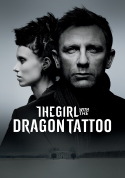
Review of The Girl with the Dragon Tattoo (2011) by Callum H — 26 Jan 2015
My respect for David Fincher as a director is tested most when I come across a film from the man which I don't find nearly as satisfactory or compelling on both a technical and storytelling level than the rest of his exploits, most of which I greatly enjoy. Seven was an entertaining and riveting escapade, The Social Network featured an all star cast and an impeccable screenplay from Aaron Sorkin, and Gone Girl's unpredictability and social commentary lends itself to great acclaim. The Girl With The Dragon Tattoo, a remake of a literary adaptation, is his least impressive work to date (out of the four I've seen), featuring overbearing editing, another atrocious work from Trent Reznor and Atticus Ross, a lack of engaging material and the issue of multiple endings. It's a bit of a mess in much of its form, and it rushes itself. It's also somewhat incoherent in its plot at various points, and unlike Inherent Vice, I'm not willing to put that down to director's intention.
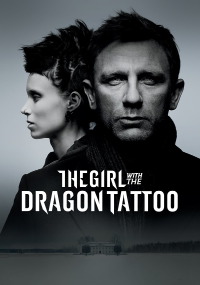
All that said, Dragon Tattoo is still a reasonably entertaining, gripping criminal drama that encapsulates evil, deceit and death, and uses interesting and resonant characters to explore such. Led by Daniel Craig who plays disgraced journalist Mikael Blomkvist, Dragon Tattoo centres around Blomkvist's attempts to unravel an intriguing plot about a missing girl's disappearance from a famous and rich family forty years prior. As Blomkvist's research and investigation into who may have taken or killed the girl intensifies, he recruits a troubled and supposedly "mentally incompetent" computer hacker, Lisbeth Salander, played by Rooney Mara. The two work together to attempt to uncover the truth on the matter, as well as to seek revenge for the public humiliation of Blomkvist.
Constructed with darkness and minimal lighting at the forefront, the thing that Dragon Tattoo has going for it best is undeniably its cinematography, lighting and atmosphere. It is a film which encapsulates the dread of its story with pristine clarity, and forms a mood that is devoid of emotion but utterly enthralling. Fincher fully realises the worlds he is creating, and the intimacy of some locations contrasts with the broad scope of others, and he never forgets to provide detail in all of those aforementioned shooting sites. Basically, he constructs living and breathing worlds full of people that seem somewhat realistic. Like that of the rain in Seven or the rich lighting in The Social Network, Dragon Tattoo has a black and white colour palette and snow; for someone who has a strange infatuation with cold weather in film (particularly rain, as I believe it fleshes out any location or situation and makes it feel more real or alive), this is the dream.
To boot, Dragon Tattoo also possesses some exquisite performances, namely that of Rooney Mara's as Salander. Her dedication to her role is utterly palpable, not just due to her willingness to go nude or embrace a large quantity of piercings, but because of her dark nature. She's completely embellished in the performance she's giving, and whilst it's perhaps not as memorable as other memorable Fincher performances, such as Kevin Spacey in Seven or Rosamund Pike in Gone Girl, it is absolutely applaudable. Daniel Craig's work here is also immensely impressive, his performance of the character Blomkvist amiable and brave. The latter perhaps not to the extent of her co-stars, but still commendable all the same. The rest of the ensemble is note-worthy, Stellan Skarsgard and Yorick van Wageningen in particular giving riveting performances worthy of individual credit.
Where the issues start to enter the forefront is namely in terms of the score, which whilst not as perpetually irritating and neutral as The Social Network, is undeniably simplistic and plain. Composers Trent Reznor and Atticus Ross are often not capable of producing anything more than atmosphere for their Fincher projects, their works for Gone Girl and The Social Network never enunciating emotion or activity, but just humming in the background (or droning loudly, consuming the entire soundscape). The same can be said for Dragon Tattoo, but it's slightly less irritating in this situation, a semblance of thematic consistency and logic in place. That said, something like this is not exactly impressive or worthy of an Academy Award nomination. For those who wish to attack me on my position towards the simplicity of this score when I enjoy the works of Hans Zimmer, a man who composes generally repetitive works, I believe it's down to the fact that at least his work somewhat crescendos or develops. That and he possesses thematic consistency and the ability to reprise his ideas without blatantly reiterating them without change from the prior inclusion Much of Dragon Tattoo just stays at the same volume, lacking fluctuation or variation. It's boring and blatantly lazy. No, it's not difficult to hold down a key on the ambiance setting on a keyboard. It's not a hard job. The Social Network and Gone Girl were far worse in terms of general composition (I still don't get why In The Halls of The Mountain King was ever used for The Social Network, especially when it doesn't contain the size, scope or organic nature of the orchestral recording), but this isn't necessarily good.
But whilst I generally expect Reznor and Ross' efforts to yield little more than repetitive structures that don't contain a smidge of thematic consistency, I didn't expect to find that much of the editing within a Fincher film could be so irritatingly quick. Whilst cinematographer Jeff Cronenweth's work is predictably brilliant, the editing is far less fluid than it usually is, illustrated by this clip; whilst Fincher effectively captures the different point of views on a visceral level for this scene, his usual trademark for dialogue sequences, the editing is a bit too frantic and quick for the specific situation, and until the final shot of the scene, we don't get a hold which feels natural and relaxed. This is a small example for a huge film which contains many situations featuring such an issue, and although many won't notice it, I did. It's not overtly bad (I mean, we're not talking about Lee Smith's for The Dark Knight for crying out loud), but for a Fincher film, it's a drop in quality.
All that said, Dragon Tattoo is still an intriguing, albeit underwhelming criminal drama that is gloomy and mostly engaging. Its first act feels unfocused; the second act is impressively staged, acted and scripted, but the final act drags far too long, and whether or not the book stretches to such a finale is no matter; it felt overlong in this context. A case of The Return of the King complex, unfortunately, where the film doesn't seem to know where it wants to wrap up. Seeing as I haven't read the original literary material, I hold no biased for where I desire the story to start or end, so my opinion is based off little more than Fincher's interpretation of the material. That, and Steven Zaillian, the screenwriter's. It's a competent investigative story that has the individual pieces and often utilizes them to brutal or harrowing results, but can never seem to form a complete picture out of them.
So whilst Dragon Tattoo is not the most pristine Fincher film available, lacking the finesse that one desires from this talented individual, it is yet still an impressive feature that maintains an audience member's interest all throughout. It's cold, dark and atmospheric, and for one seeking a film of such a like, there are few better to recommend. And whilst I do not find it as compelling as everyone else, that doesn't mean I didn't enjoy my time here, as I did. An entertaining venture, this film falls short of being a triumph by any standard.
This review of The Girl with the Dragon Tattoo (2011) was written by Callum H on 26 Jan 2015.
The Girl with the Dragon Tattoo has generally received very positive reviews.
Was this review helpful?