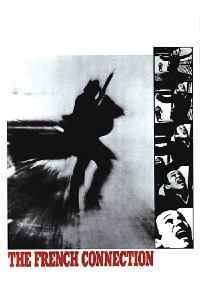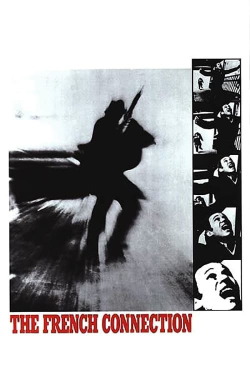
Review of The French Connection (1971) by Visitorq S — 26 Feb 2011
The French Connection has a shrewd, hardened language no one can put in writing. Literally. Despite They Shoot Horses screenwriter Ernest Tidyman's arbitrary screen writing credit and even his subsequent Oscar, there was no script to the picture. It was all impromptu dialogue from Friedkin's experiences witnessing dozens of people injecting themselves with heroin under the tongue, in the vagina, between the toes, and the real-life Popeye and Cloudy busting those people.
Friedkin bloodies the Old World charm of Marseilles with a cold, brutal murder barely two minutes into the film. There's the gunshot, and the man's face is covered with blood in a quick close-up as he drops out of frame. The killer steps over the prone body, breaks off a piece of bread from the loaf the man carried, and chews it as he departs. On the streets of Brooklyn, Friedkin introduces us to Popeye, staking out in a bright red Santa Claus suit when he and Cloudy chase a drug pusher. When the pusher falls running through a vacant lot, Popeye pounces on top of him. Cloudy has to pull Santa off, shouting, "Don't kill him!" The wry morbidity in both these scenes visually establishes the fatalistic cynical brand of Friedkin's humor as well as his street reality. They also present a world in chaos in which tranquil cobblestone streets are red with death and Santa Claus busts pushers. Friedkin gives not just new definition to the thriller genre, but unique. The gray shadings have never had such high resolution before. For example, back at the station after booking the dealer, we've seen the doughy, dirty, unshaven Popeye in action, and in a couple of three-word absolutes, we hear his philosophy, which is as crass, pitiless and bigoted as they come.
Popeye and Friedkin's New York is a cesspool, ugly and sinister, but they've been hardened to it, desensitized. Popeye and the street have become one, both comfortable in their anger. The action entirely tells the story and reveals the characters. Morality is less important than physical danger. Nobody launches into a diatribe on the evils of drug use. Just as Hackman fiercely portrays, Eddie Egan lived and breathed his job. No wardrobe. No relationships. Juxtaposing images of violent drug-related death, brutal shakedowns and internal fights between cops against Popeye's determination, Friedkin embodies the idea within the narrative while simultaneously maintaining the chase like speed of it all.
The shooting process itself was not only spontaneous in the sense that it was intended as documentary-style but to the twenty-fifth power: With Hackman and Friedkin at one another's throats throughout, over thirty takes were squandered of the beginning street interrogation scene before Friedkin later realized just how unfettered this process had to be for the actors, cinematographer Owen Roizman and the nature of the dialogue. So he gave the actors a whole courtyard, a notion of the scene, and just let them wail on it. One take. Two cameras. He chose the best moments and sparked one of the most brilliant strokes of realism, and one of the film's very few quotes, which was Hackman's Poughkeepsie line, having absorbed it from his character's real-life basis, the very simplistically clever double-talk interrogation technique. It's never explained to us. We get it the way you get what someone says in the jerky urban rhythms of a rush-hour street life. No one explains anything. It's all gut.
Everything---including the famous car chase which, for its raw encapsulation of the central theme of relentless pursuit, remains not only a benchmark in but untouchable example of action cinema---was shot with available light. It's a matter of movement, choosing the right lenses and trying to keep some kind of matching control on one's lighting because you're going in and out of dark and light areas. Literally half of the effectiveness of the movie, without any question, comes from the sound and editing. At the same time, literally half of the movie has no dialogue at all! It's a story told in pictures, movement. It's universal.
You feel the same things that are being felt on screen. You just quake a bit. It's all present-tense. Suspense creates fear and fear becomes a high. Fear and tension harmonize one another even when Friedkin compels us to scrutinize in unsettling detail the testing of the heroin for potency. He plugs the screen with maximum close-ups of the flame heating the mineral oil, a needle grazing the white powder, the mercury rising in the thermometer. They're scary images challenging our fear of death, the fundamental, basest fear. As a primevally aural windfall to this moment, the gristly-haired chemist watches the mercury rise declaring the powder "U.S. government certified" to "junk-of-the-month-club sirloin steak" to "absolute dynamite, eighty-nine percent pure junk" with increasing admiration.
The fascistic undertones of the Popeye Doyle character echo those of Clint Eastwood's Dirty Harry, yet this film remains ambivalent toward its protagonist. The scene in which Frog One eludes Popeye's tail with a sleight-of-hand trick on the subway is doubly important because not only has Doyle been outsmarted by a foreigner in his own town, but it compounds his frustration and serves to highlight that he is not a super cop. And Friedkin does not tell us this, he shows us.
It's Friedkin at his down-to-earth finest. He's not so much worried about the right or wrong of the story as he is with the authenticity, the candor, of the images. His world is inhabited by the faces of people who look like they belong to this grainy environment. The only message is what we care to read into it. If you embrace his reality, his visualization, you give it credibility. If not, you nevertheless give it credibility because you are, actually, saying this vitiated reality is too much, too forceful.
This review of The French Connection (1971) was written by Visitorq S on 26 Feb 2011.
The French Connection has generally received very positive reviews.
Was this review helpful?