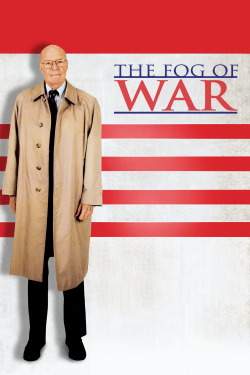
Review of The Fog of War (2003) by Casey B — 12 May 2004
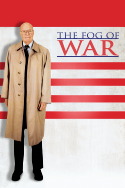
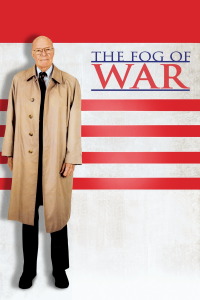
[size=3]At a time when there are stil wars being fought throughout the world, it is perhaps necessary for the human race to examine their own attitudes about the death and destruction that war inevitably causes. Errol Morris' documentary [i]The Fog of War [/i]contains difficult and complex questions about how war should be viewed, and they come from an unlikely source: former defense secretary Robert S. McNamara, who was often described as the "author" of the Vietnam War. In an interview with Morris, McNamara remembers the various experiences that have shaped his life...but this film is not a dutiful, respectful biopic that merely moves chronologically through the important events in McNamara's life. [i]The Fog of War [/i]is divided into eleven sections, each with a life lesson that McNamara has learned through his experiences. We see what an extraordinary life McNamara led: he was not only defense secretary during most of the Kennedy and Johnson adminstrations, but also served as a statistical advisor during World War II and eventually became president of the Ford corporation in 1960. [i]The Fog of War [/i]would probably not be as compelling if McNamara were not so engaging a storyteller: he is intelligent, articulate, captivating and surprisingly reflective and open about his own shortcomings. Yet although McNamara attempts to distance himself from some of the horrors he oversaw, the film is not simply his apologia for the Vietnam war. Recorded tapes make it clear that McNamara felt American troops should pull out of Vietnam and was opposed by President Johnson, but [i]The Fog of War [/i]does not completely absolve McNamara of responsibility. As a re-telling of some of the crucial moments in American history (such as the Cuban Missile Crisis), [i]The Fog of War [/i]is remarkably insightful and complex. Many American films reduce history to an epic struggle between individual personalities, failing to recognize larger political movements. It could be argued that [i]The Fog of War [/i]is guilty of this as well, but the value of the film is that it reminds us that political leaders are also human beings filled with doubt and anxiety. By humanizing history without simplifying it, Morris makes us aware of how precarious any peaceful relations throughout the world are. Perhaps the most chilling moment in the film comes when McNamara admits that the Cuban Missile Crisis was solved through "luck", and that "rational human beings" were prepared and willing to begin a Nuclear War. Apart from its insightful historical value, [i]The Fog of War [/i]is also quite profound in its portrayal of an aging man looking back on his own accomplishments and being forced to judge his own life. McNamara is occasionally elusive, but for the most part he is willing to admit that he has made mistakes...mistakes that have cost lives. It is simplistic to say that McNamara emerges as just an average guy, for it is clear that he is exceptionally intelligent. What is also clear is that McNamara has spent many years examining his own attitudes toward war...the "rules" of war, the morality of war, and the necessity of it. As an elderly man, McNamara has achieved a wisdom he may or may not have had when he served as defense secretary. He now realizes that war is horrific and ugly...but he also recognizes that it will probably be a reality for years to come. As Lesson #11 states: "You can't change human nature."[/size].
[size=3](BASIC)[/size].
This review of The Fog of War (2003) was written by Casey B on 12 May 2004.
The Fog of War has generally received very positive reviews.
Was this review helpful?