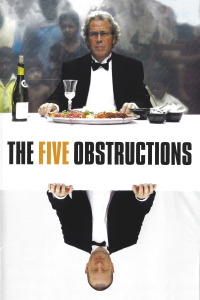
Review of The Five Obstructions (2003) by Aran S — 29 Nov 2004
In 2000, Lars Von Trier ([i]Dogville[/i], [i]Dancer in the Dark[/i], [i]Breaking the Waves[/i], [i]Zentropa[/i]), the aging [i]enfant terrible[/i] of the Danish cinema, invited longtime mentor, friend, and fellow filmmaker, Jorgen Leth, back to Denmark (Leth lives in semi-retirement in Haiti). Leth directed a 12-minute, austere black-and-white film in 1967 called ?The Perfect Human.? ?The Perfect Human,? seen in excerpts follows two characters, an unnamed man and woman, as they pursue everyday activities, like dressing, grooming, and eating. A voice-over narrator asks a series of existential questions, most of which remain unanswered. The short film, filmed against a white, featureless background, is (apparently) considered a gem of minimalist, avant-garde, Danish filmmaking.
In their first meeting, Von Trier enthusiastically confesses to having seen the short film at least 20 times. He mischievously proposes that Leth remake his film, five times, each time with a different set of formal constraints; thus the title for this documentary, [i]The Five Obstructions[/i]. Leth at first objects, then agrees to Von Trier?s open-ended terms. Given their long-term relationship, Leth clearly recognizes that Von Trier penchant for cruelty and sadism will likely be turned in his direction. Von Trier claims he wants nothing less than to ruin ?The Perfect Human,? and with it, to break through Leth?s detached façade, to find the imperfect, empathetic human being underneath that façade. So begins an intellectual gamesmanship, with the audience?s shifting sympathies at stake.
In the first obstruction, Von Trier generates several, apparently arbitrary rules. Leth must remake.
The Perfect Human? in Cuba, on real locations (no set building is allowed), the questions left unanswered in the original film must be answered, and most cruelly, each shot can only be 12 frames in length (approximately ½ a second). Leth complies, but not without a bedside confessional in Cuba expressing his doubts and frustrations with Von Trier?s rules. He seems, if only momentarily, prepared to abandon the project. What emerges, however, is a short, almost musical film, with the halting movements of the characters acquiring a kind of formal grace.
Back in Denmark, Von Trier expresses his satisfaction with the final product, but swiftly determines that the first set of obstructions aided Leth?s creativity, rather than acting as constraints. Still hoping to break through Leth?s detachment, he sets an even more formidable second set of constraints. Leth must re-film ?The Perfect Human? in ?the most miserable place on earth,? and he must take the role of the actor. In addition, Leth must abide by a third rule: he must not show ?the most miserable place on earth.?
Leth chooses the red light district in Bombay, India as his location, but decides to break (or rather bend) one of Von Trier?s rules. Leth films the second remake of ?The Perfect Human? on a crowded Bombay street, with local residents separated from his makeshift set by a transparent screen. Leth, and by extension Von Trier, are at their most cruel here, with Leth replaying a key scene from his short, a meal scene, in formal evening wear, dinner table, and an expensive meal (as the indigent local residents look on). Leth says little about the impact of filming in Bombay, but he does admit to severe anxiety before the filming begins (he thinks about, but rejects, taking anti-anxiety medication).
After seeing the second remake, Von Trier expresses serious dissatisfaction with Leth, ostensibly for rejecting one of Von Trier?s rules. He immediately insists Leth return to Bombay to re-film ?The Perfect Human,? but Leth, standing his ground, refuses. In frustration, Von Trier gives Leth the third obstruction: no rules at all. Leth can re-film ?The Perfect Human? without any guidance at all. In response, Leth seems lost, unfocused, and seems to recognize that there?s a symbiotic relationship at play here between the two filmmakers.
Leth shoots the third film in wintry Brussels, employing a well-known European actor, Patrick Buchau (known in the United States for a recurring role on [i]The Pretender[/i], a now-defunct television series). This third remake, the most polished of the five, is also the least satisfying, primarily because it resembles a sleek, but empty, automobile commercial. Leth employs several stylistic tricks, including the all-too popular split screen device, to re-imagine ?The Perfect Human? as a [i]neo noir[/i], with the female character relegated to the femme fatale role.
Back in Denmark, Von Trier expresses satisfaction with the third remake, and renewed frustration that the obstructions have done little to limit Leth?s creativity. In fact, there?s more at play here. Von Trier feigns frustration and withholds approval in an effort to push Leth to greater, more profound acts of creativity (how great, how profound, are left to the audience to decide). With the fourth obstruction, Von Trier attempts to create an untenable scenario for Leth, to create a ?cartoon,? a medium both men apparently detest. Eventually, however, Leth uses this new obstruction to create a new version of ?The Perfect Human,? but based on recycled footage. To that effect, Leth employs Bob Sabiston, an animator from Austin, Texas who worked on Richard Linklater?s [i]Waking Life[/i]. Like Linklater?s film the fourth remake, with its shifting, multi-colored backgrounds, textual overlays, and rotoscoped figures, is a playful, hallucinatory excursion into the almost infinite malleability of the source material and the imagination of the two filmmakers.
Von Trier?s fifth and last obstruction is best left for audiences to explore on their own. Suffice it to say that Von Trier?s hidden, unspoken motivations for the four other remakes of ?The Perfect Human? (if accepted at face value), and his temperamental, demanding treatment of his former mentor. Von Trier emerges less as cruel, dictatorial filmmaker, than as a surprisingly empathetic friend and ?son? to his father figure, Jorgen Leth. There?s less insight here into the creative process than into the characters of both Von Trier and Leth. Both men emerge as complex, sympathetic, and ultimately engaging, figures. Von Trier?s films, for all their variable quality and obsession with style and technique, do, on occasion, betray a fascination with examining imperfect, often fatally flawed characters. He wants nothing less from his audiences than (almost) complete identification with their experiences. Leth, on the other hand, appears to be a filmmaker concerned more with the formal, intellectual properties of film. One approach to filmmaking doesn?t preclude the other, however. It?s unfortunate then that Leth?s films are little known (and little seen) in the United States.
This review of The Five Obstructions (2003) was written by Aran S on 29 Nov 2004.
The Five Obstructions has generally received very positive reviews.
Was this review helpful?