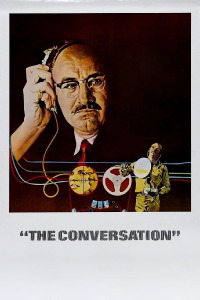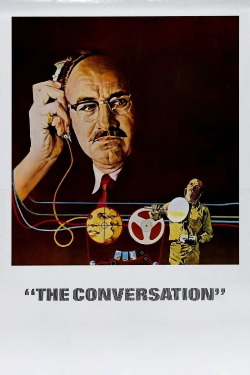
Review of The Conversation (1974) by Matt S — 14 Jan 2010
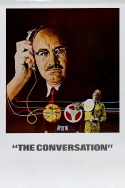
Francis Ford Coppola?s ?The Conversation? is really about two conversations; one between a couple (Cindy Williams and Frederic Forest) in a crowded square and one between Harry Caul (Gene Hackman) and his conscience. Harry Caul is a freelance wiretapper- a man paid to listen in on secret conversations, but he?s not concerned with what is being said but rather the quality of the recording. In fact it seems as if he?s not concerned with anything except his recordings. Gene Hackman plays him as a lonely, curious, seemingly emotionless man focused on one thing and one thing only: his job.
His loneliness is an extension of his job. When you are paid to record conversations without being seen, it?s only natural to be paranoid and that paranoia leads to loneliness. He triple locks his apartment door and has an unlisted phone number (and for good measure, he keeps the phone hidden in a drawer). He has a mistress that he visits on lonely nights. In a wonderful scene we see Harry visit his mistress played by Teri Garr and we realize that even this woman that has shared many intimate nights with him has no idea who Harry is inside. This is a man that triple locks his emotions.
Although Harry is regarded as a genius in his profession, his personal life isn?t as secure as he?d like it to be. His landlord has keys to his apartment completely unbeknownst to him, and his mistress knows that Harry often watches her from a stairwell. He informs his landlord that he?d like the keys to his apartment because there?s no need for him to have any. What about in an emergency such as a fire? Harry responds, ?I have no personal belongings to worry about ? except my keys.? He is completely shut out of any emotions and feelings to the point that he owns nothing of personal value.
Harry sees this as a strength. His job requires him to listen in on conversations but not be concerned with what is being said. He must be concerned only with the recording. However, his current assignment has struck a chord buried deep inside him. He is being paid to record the conversation of a couple walking in a crowded square. His assistant Stan (John Cazale) assumes it?s because they are being suspected of an affair, but it?s not Harry?s job to assume. When pouring over the recording, he hears something that causes him to begin to listen: ?He?d kill us if he had the chance.?
Harry plays it over and over, obsessing over it. We discover later that an assignment years earlier had led to the murder of three people, including a woman and child. Is his current job going to lead to the same? Slowly Harry?s world begins to spiral out of control. He is followed, the tapes are stolen, and he fears for the lives of the couple. He?s tried so hard to avoid feeling anything in the hopes that he?ll be able to press on free from guilt, but this conversation has hammered his conscience. The final third of the movie is so filled with suspense and tension that we think we?re going to snap along with Harry.
Coppola has made some of the greatest movies ever and one of the enduring traits of his greats is the amount of time he takes to set up character and story. Take for example, the wedding scene in ?The Godfather,? the trip down the river in ?Apocalypse Now,? and the absorption into the world of Harry Caul in ?The Conversation.? Coppola knows that the secret to creating a succesful thriller is for the audience to care about the characters. And while watching ?The Conversation? I wanted to reach into the screen and shake some feeling into Harry Caul. And at the end when Caul is having a paranoid breakdown, we don?t pity him but we understand him.
Gene Hackman considers this movie his greatest performance and it?s one of the most powerful I?ve ever seen. He?s stoic, nuanced, emotionless, and later he is obsessive, paranoid, and crazed. Hackman?s Caul sits with us and causes us to stop and look around and check our phones for bugs and wonder if anyone is listening. The other performances are strong, as well. Cindy Williams and Frederic Forest play the couple Caul is paid to listen to, and Robert Duvall makes an appearance as Cindy Williams? suspecting husband. Harrison Ford turns in a great performance as Duvall?s assistant, and Allen Garfield makes a small supporting role memorable as a competing surveillance freelancer. But Hackman?s performance stands out well above the rest.
The acting, along with the directing and editing, make ?The Conversation? one of the best thrillers I have ever seen. Coppola and his editors (Walter Murch and Richard Chew) intercut pieces of the conversation with the couple to shots of Caul trying to interpret what is being said which adds to the mystery of the story. The script (written by Coppola) is airtight with sparse dialogue and a surprise ending that I didn?t see coming until it was made clear. And the final scene in the movie is heartbreaking and maddening all at once. Caul has ransacked his apartment searching for listening devices and all that remains are bare walls and floors mirroring his personal life. But he still has his saxaphone ? his one link to any emotion and all we can do is listen.
This review of The Conversation (1974) was written by Matt S on 14 Jan 2010.
The Conversation has generally received very positive reviews.
Was this review helpful?