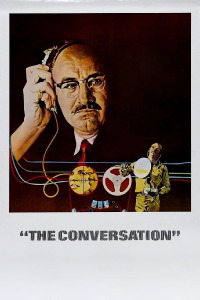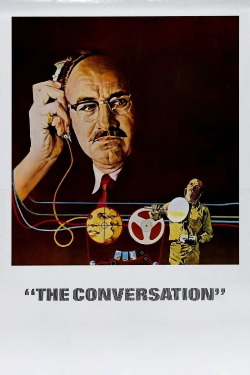
Review of The Conversation (1974) by Alvin Y — 30 Aug 2012
The Conversation, Great Movies.
Francis Ford Coppola's 1974 classic is an ingenious, meticulous examination into the nature of voyeurism, as well as a harsh criticism of the deceitful morality of privacy. At its basic form, however, The Conversation is a film that carefully follows a man who is curiously trapped within his own secretive existence of solitude. Harry Caul is nothing more than an observer; we do not witness any noticeable personal interests outside of his profession, aside from his occasional musical performances. But notice how Harry is always playing along to another band (contrast this to the solo at the ending), and never performs for an audience. There is no audience for Harry, a man who is entirely absorbed within his occupation, and allows his neurotic obsession to control his personal relationships. Harry treats himself like he treats his clients, he divulges no personal information, displays no easily distinguishable characteristics, and remains blissful in his peaceful state of ignorance. Whenever he is not entirely engulfed within his work, Harry disappears into his apartment, satisfied with his general indifference towards any truly beneficial, active existence. Harry has thoroughly convinced himself that it is inappropriate to become involved in his client's affairs. After all, Harry's job is not to take responsibility for himself, or to investigate any potential consequences resulting from his surveillance intrusions. Harry's job is to take orders, display no personal interest in the content of his recordings, and deliver the results completely unconcerned for anyone's potential safety or security. It is only after Harry accepts his need to take responsibility that he is able to take interest in his client's mysterious, dangerous affairs.
As Harry slowly drags himself into the precarious business of strangers, the film's intentions become increasingly suspenseful and perplexing. Coppola maintains his deliberately methodical pace throughout the entire film; it is only through our imagination that we are capable of creating and perpetuating such a consistently fascinating atmosphere surrounded by a cloud of tension and mystique. The Assistant Director never physically carries himself as an intimidating antagonist; it is through the complexity of the film's plot and through the continual uncertain environment that we are able to associate this element with his character. Every person that carries himself in a convincingly dubious manner immediately becomes a potential suspect. Harry becomes compulsively obsessed with the fate of his client's targets, completely submerging himself into the substance of the recordings, looking for any potential details that might assist him in solving the mystery. Harry's investigation quickly becomes our task as well, as we begin to subconsciously observe and scrutinize each character involved. The beauty of Coppola's film is the fact that it makes its point by using the audience as proof of the inherent devious nature of privacy. The movie transports us into Harry's world, as we become infatuated with the secretive plot unfolding before us, and we desperately search for clues into the lives of the film's characters. Of course, after intense investigation, Harry ultimately comes to realize that he has violated all of the principles that he had once stood proudly for. Whether or not Harry ended up better off by becoming involved in the dealings of others is a completely subjective matter, but it is a crucial question that the viewer must ask him/herself.
The ending of the film is what interested me the most about The Conversation. The consequences of Harry's obsession become manifest through the destruction of his own privacy, his property and even his faith. Was Harry morally appropriate when he decided to intervene into the relationship and associations of complete strangers? Did Harry do the right thing by taking responsibility for his actions, and reaching out to help another in desperate need? These are the most important questions that the film ultimately asks its audience. The final shots of Harry perfectly capture the ambiguous mood of the film's finale. Harry is sitting alone in his stripped down apartment looking exhausted, humiliated, and defeated. But if you look closely you will realize that he is indeed playing the saxophone to his own beat, for a change. At what costs do we accept the need for our responsibility to others?
This review of The Conversation (1974) was written by Alvin Y on 30 Aug 2012.
The Conversation has generally received very positive reviews.
Was this review helpful?