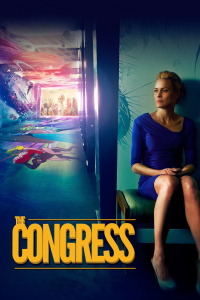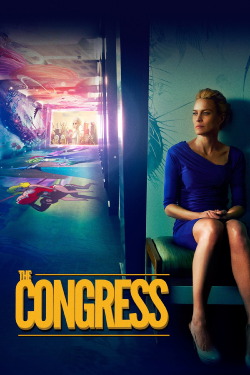
Review of The Congress (2013) by Jason H — 30 Aug 2014
After I watched this the first time, I was dying to watch it again, captivated by the beauty while also not understanding exactly what I saw. After a second viewing, I can say I understand both the plot and the deeper meanings fairly well, well enough to conclude that The Congress may not be as great as I hoped, but still easily ranks as one of the most intriguing and ambitious (an overused word, as describes even commercial films when they try to say something intelligent; this film is ambitious among the most ambitious) films of recent years.
Another film of last year I would put up with it in terms of innovativeness is Upstream Color. It even draws comparisons to Charlie Kaufman's Synecdoche, New York, one of my favorite films, in that it's big and expansive in scope and likely to puzzle, so many will insist on seeing it twice. Having done that, I can say that it is comprehensible and doesn't make the mistake of leaving everything up to your imagination. I also have to say that the pieces don't quite fit together and the film's standpoint on the issues it raises are conflicted, possibly unintentionally so. More on that at the end of this review under the spoiler warning.
Do I like it simply for being ambitious? Absolutely not. Bonus points should not be handed out simply if a film has ambition. I disapprove of critics when they see a film, don't understand it, and avoid giving any sort of indication of what they think it meant, or do but aren't making sense, yet give it a high grade and call it an enigmatic masterpiece (see this year's Under the Skin. Not much lies under its skin). Enigmatic films can work, such as, in my opinion, Uncle Boonmee Who Can Recall His Past Lives, if their purpose is directed at provoking something beyond intellect, but when a film tries to work on intellectual terms and doesn't, I consider that a failure. This film is trying to work on an intellectual level because it has clear symbols (the fishtanks and kites), features bits of abstract dialogue, and focuses heavily on a sci-fi plot, and overall succeeds in feeding us enough of this information that we can piece it together without resorting to subjective analysis, or merely what we felt it to mean. My analysis follows under the spoiler warning.
This film does sci-fi as well as any other. The conflicts that technology presents resonate metaphorically as they exist in our world today, only without the technology itself to motivate it. It does satire well in its first half against the Hollywood star-making system but I have to say it breaks off in the second half when the film's scope broadens outside that of a production company and dives into technological, alternate-reality, transcendent-consciousness territory. It's interesting on another level, but is somewhat of a sidetrack. Half of this film is animated, and that half is really something to experience.
Robin's character is somewhat well developed. We know what she wants and understand her conflict, but I got the feeling that the film wants her to pass as a deep character with internal flaws, but these aren't apparent, and while her slight air of melancholy is played wonderfully by the actress, Robin Wright, we aren't sure what that motivation is, and one monologue that tries to reveal a deeper side ends up making little sense.
It was exciting for me to see this film, as I was not expecting it to occupy so much of my thought. Even though I've expressed a mixed opinion, I'd highly recommend it to big movie watchers, but if you're not one it's hard to know what you'd think, although I think everyone will catch something and it's beautiful nonetheless.
SPOILER-HEAVY ANALYSIS: You may want to consider the film's meanings for yourself before considering my interpretation. In the ending, Robin choses to be her son in the animated zone because the world can no longer offer her free choices and her identity. I understand the fish tanks to represent entrapment in this world, as we are hindered by our choices and ailment, the reason why the fish tank metaphor is so visually apparent in the scene where the doctor is checking her son's hearing. Her son is hindered by his condition from being the pilot he dreams of being, but he's able to become that thanks to Miramount's technology. Lastly, in the animated zone when the kite flies into the jet engine, she is liberated in that the world poses no boundaries, no restrictions, only complete freedom. Now, my problem here is that, if so far you're in agreement with what I've said, where does the film stand on Miramount's technology? We expect Robin's fears of the technology crushing our souls and ending free choice to manifest, but they do not. Instead, the technology allows for her to be liberated from her choices even of aging, which she fears, and to find her son. First the technology is anti free choice and therefore serves to work as a commentary against Hollywood producers, and then it is pro free choice and therefore contradicts its negative statements about Hollywood producers, as they are what ends up liberating her. And also, I am confused as to what this film's idea of the truth is. Why is reality such a dismal place? Dismal for the people whose souls belong to the animation zone, yes, but for the others? I welcome anyone to challenge these criticisms.
This review of The Congress (2013) was written by Jason H on 30 Aug 2014.
The Congress has generally received positive reviews.
Was this review helpful?