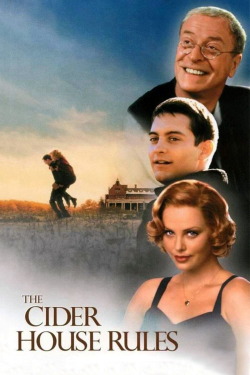
Review of The Cider House Rules (1999) by Edith N — 17 Jan 2008
What kind of education are these kids getting? Is this not considered important? We see three adults working at the orpahanage--one doctor and two nurses. No teachers. Clearly, they learn how to read, or at least we know Homer has. We also, however, know that Homer has had no formal schooling. He hasn't been to high school. He knows as much science as can be expected of someone who's been trained by a doctor pretty much his whole life, but does he know any math? Does he know any history? Do the nurses teach classes between deliveries or something? After all, there isn't room at the orphanage for all the kids to stay there when they've grown up. Do the boys learn trades? Do the girls learn home ec? (This is set in the 1940s, after all.) I know we're supposed to marvel in Homer's innocence, but he didn't know there was such thing as a drive-in theatre. However, I come away instead marveling at his [i]ignorance[/i].
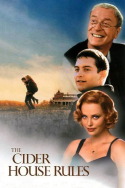
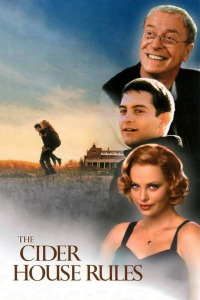
Homer Wells (Tobey Maguire) is born in an orphanage; he is not, however, an orphan. As with most of the kids in the orphanage, he is born to a mother who does not want him, who gives him into the orphanage's hands. He is nearly adopted twice, but he ends up living his life in the orphanage. Dr. Wilbur Larch (Michael Caine, who won Best Supporting for it) is, essentially, his father in all senses but the biological. He decides that he must train Homer to be a doctor, even though Homer doesn't know if that's what he wants out of life. However, Dr. Larch has come to think of Homer as his heir.
But then, Homer decides he needs to strike out on his own. He leaves with a couple who have come to the orphanage to get the woman--Candy (Charlize Theron)--an abortion. (Dr. Larch believes that it is better for him to perform safe abortions, even if it's illegal, than to leave them to the butchers calling themselves abortionists in those days.) The man--Wally (Paul Rudd)--is a pilot during WWII who's left his mother alone with the family orchard; he gives Homer a job as a picker, and Homer stays on past picking season as sort of a spare hand. Of course, Homer falls in love with Candy, who cannot cope with being left alone while Wally is away at war. Homer is also forced to reconsider his own moral stance on abortion.
I don't want to get into that debate here, because no one ever seems to convince anyone else. However, circumstances make Homer really think about his own stance from the perspective of a woman with an unwanted pregnancy instead of his (also pretty valid) stance as an unwanted child. It is this forced change in perspective that gives the movie its power. What the actual change in perspective is [i]about[/i] is somehow less important. We see Homer come to terms with his own life, see him make decisions he might not have made without it. This movie is not "about" abortion. Abortion is a tool to drive the story forward, because what we are really interested in is Homer's chance to grow up. Homer is kind of on a storybook quest, really; he is a young man out to seek his fortune, as Michael Caine tells us at the beginning.
Let's face it. I'm pretty much forced to use the word "mawkish" to describe the sentimentality of the movie, and I'm not 100% sure what it means. The focus on poor little Fuzzy (Erik Per Sullivan)--the only kid in the orphanage, apparently, to escape a horrible Dickensian name--is a bit much, even though he is an awfully cute kid. (As is Hazel [Sky McCole-Bartusiak] as a little girl who got adopted.) However, it is a lovely film--beaten out for Art Direction by [i]Sleepy Hollow[/i], but still awfully beautiful. And I'm fond of the lovely, lyrical music. And I like Tobey Maguire a heck of a lot. Still, we've seen much better movies, and we're probably going to have much better movies pretty soon.
This review of The Cider House Rules (1999) was written by Edith N on 17 Jan 2008.
The Cider House Rules has generally received very positive reviews.
Was this review helpful?