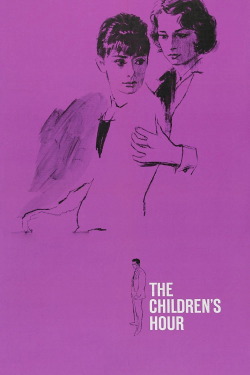
Review of The Children's Hour (1961) by Phil P — 03 Mar 2009
When the collective conscious thinks of homosexuality, it thinks only of the sexual aspect of it, which causes a double standard. This could be blamed on the semantics used when describing and discerning it from homosexuality. Gays are said to have "lifestyles" as opposed to "lives," and where straight people are said to have a "moral standard," gays have an "agenda." The more "straight" people mingle and work with, give birth to, and recognize the historically positive results of homosexuals in society, there will be more of a face given to the gay, bisexual, and lesbian community. They will see that they are of the same natural world, doubts, and needs as the rest of us.
There was an overwhelming sadness and helplessness in homosexuals in the film's time and place, and the film is a bit of a let-down in that regard. Despite being very well made, it is disappointingly and maddeningly hindered by the ignorance, touchiness, and censorship of the time. It never truly touches on any idea of acceptance of the sort of sexuality, but rather glints with the frustrating social reaction to it and the characters' defense against the malicious gossip.
Shirley MacLaine and Audrey Hepburn give wonderful performances as two sweet young teachers who have known each other since they were in school together. They have put together a parochial school for girls in old-fashioned New England. MacLaine's aunt, an aging out of work actress, stays with the two of them, and teaches acting to the girls. Following two years of engagement to a highly regarded gynecologist played by James Garner, Hepburn is at last longing in anticipation for their wedding. An aristocrat's granddaughter is also going to the school. The little girl is a difficult, scheming little brat, intimidating the other girls. Above all, she blackmails poor little Veronica Cartwright, whom she caught at stealing a bracelet.
To exact revenge on Hepburn and MacLaine for punishing her for a wrongdoing, the little brat makes up a story about the two women being mixed up in a love affair. Her fabrication is derived from splinters of a tiff between MacLaine and her aunt, which were by chance overheard. The brat tells her grandmother that she saw Hepburn and MacLaine kissing each other. Her grandmother believes her, and without delay notifies the other parents. Consequently, all girls are removed from the school, without giving the two women any reasons. Questioning one father frankly, Hepburn at last gathers the true cause of this abrupt, totally unreasonable and infuriating, action taken by the parents. Through all of this and its aftermath, we are intended to be frustrated by the injustice toward the two teachers in all of this, however the content of the hellish girl's lie is not essentially intended to be perceived as intolerant, or the social reaction deplorable.
The buzz is dispersed through the local media, outright devastating the names of the two teachers. No more than James Garner still maintains connection to the two women, MacLaine, who has taken all this a lot harder than Hepburn, place in her care that she, if truth be told, has felt more than camaraderie with her, and, subsequent to listening to the little brat's lie, becomes conscious that she is in love with her. And, though this is done with a lot of feeling and impact as one could well expect from director William Wyler and the pen of Lillian Hellmann, what follows is just not enough. We feel sympathy for her position but the story does not intend for us to necessarily understand it.
I don't blame Wyler or Hellmann for this. This film was made during the twilight of the era when Hollywood was still under the repression of the Catholic Legion of Decency. Wyler, in fact, had attempted thirty years before to make an adaptation of Hellmann's play called These Three, but the homosexual element of the plot, the most essential part of it really, was prohibited. Where Hellmann's original play may have succeeded earnestly in its own medium, Wyler did come as close as he could to realizing its full potential on film. If only he had waited another five, ten years.
This review of The Children's Hour (1961) was written by Phil P on 03 Mar 2009.
The Children's Hour has generally received positive reviews.
Was this review helpful?