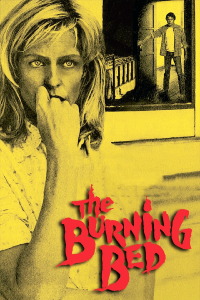
Review of The Burning Bed (1984) by Julie G — 12 Nov 2010
No, Really, Don't Stand by Your Man.
This is twice now I've watched something where Farrah Fawcett killed someone in a made-for-TV movie. And both times, it was Based on a True Story. The interesting thing about it, probably the only interesting thing about it, is that one woman was pretty well driven to it by an abusive ex-husband (I don't think they got remarried), and the other was just nuts. One woman got off by reason of mental disease or defect, as they say on [i]Law & Order[/i], and the other is probably going to get denied parole next month. So yeah. On the other hand, one did kill an abusive ex-husband. The other killed one of her children and tried to kill the other two. The comparison of the two movies is about the only thing I've ever seen which suggests that Farrah Fawcett had any range.
On 9 March, 1977, Francine Hughes (Fawcett) took her two kids out to the car, went inside, poured gasoline around her husband's bed, and set him on fire. She then drove herself and her kids to the police station so she could confess. The movie is told as a series of flashbacks; she is telling her lawyer, Aryon Greydanus (Richard Masur), about her life and what led her to that fateful night. She and her husband, Mickey (Paul Le Mat), married young and apparently kind of against her will. He seems to have started hitting her right away, and she quite sensibly decided that she didn't have to put up with that. However, her mother and her in-laws told her that she did. "You have to take the bitter with the sweet," she is told. And even after she finally divorces him, he still manages to suck her back in, not least because he just takes the kids at one point when she's unable to prevent it.
His family swears the movie is biased, and it may well be. I'm just kind of curious as to why they thought it wouldn't be. They say she hit him, too, and that's always possible. I'm also not going to deny that men are abused by their wives far more often than anyone wants to admit. However, the situation she finds herself in is a real one. Real women do get told that they should stay with their husband for the sake of the children. I think it is less true now, certainly less true in obviously abusive situations, but Francine Hughes became kind of a folk heroine for just not taking it anymore. Now, of course, the advice is to walk away, not to set your husband on fire. Setting people on fire is bad under any provocation. (Indeed, burning to death is high on my list of Worst Ways to Die.) However, going too far because you can't take it anymore may well be what folk heroes are for.
Conversely, I don't know why anyone would expect his family to say the portrayal was fair. The Mickey Hughes in this movie is a monster. What's more, his parents (Grace Zabriskie and James T. Callahan) are no prizes themselves. It's not that parents shouldn't take their children's sides. It's that even parents should reach a point when they can't be blinded anymore. They should reach a point when they should do something to prevent their child from hurting people--and that should be as soon as their child starts hurting people and is old enough to know the difference between right and wrong. Mickey and Francine's children routinely run into their grandparents' house to get away from watching their father beat their mother. (The children, of course, are completely blameless and never shown to be anything else.) Flossie Hughes commits perjury and says she never saw her son lay a hand on Francine, that no son of hers would do a thing like that. Even though everyone they know saw him do it.
Fawcett does a good job portraying a woman mostly swept up in events she can't hope to control. From the beginning of their relationship, it's obvious that Francine and Mickey are a horrible mismatch--though of course Mickey shouldn't be in a relationship with anyone. She does have a support system in Gaby (Penelope Milford), but by the end of things, Gaby is just surprised that Francine isn't the one who ended up dead. Everyone else in Francine's life is telling her to stay with Mickey, and Fawcett seems as willing as her character to go along with that. ([i]How[/i] long was she with Ryan O'Neal?) Personally, I am left wondering if the reason there isn't a frame at the end of the movie telling you to call 1-800-799-SAFE is that no such number existed at the time, just as The Trevor Project has only been around for a few months, since gay kids started committing suicide in a more visible way.
This review of The Burning Bed (1984) was written by Julie G on 12 Nov 2010.
The Burning Bed has generally received positive reviews.
Was this review helpful?