Review of The Brother from Another Planet (1984) by Edith N — 16 Nov 2009
How Young We All Were!
Both the star of this movie and one of the Men in Black from it are people who would go on to decent careers. You have to squint more with David Strathairn than with Joe Morton, who does not seem to have changed substantially in the last quarter century. They're within two years of age of one another, but you could pretty much drop this Joe Morton into the middle of Eureka, and no one would wonder what new and exciting youth serum had been discovered and tried on Henry. Whereas it is hard to see Edward R. Murrow in the David Strathairn presented here. It's odd, really, how faces work that way. As another example, Dean Stockwell kind of had three phases to his career, and you can't reliably tell he's the same person going back and forth from any of them unless you pay attention to specific features. How many of the people from this movie are people with small but steady careers who are just left unrecognizable by the passage of time?
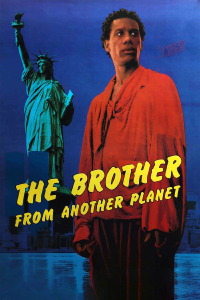
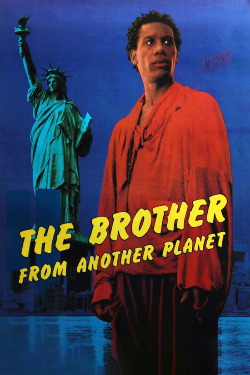
The listed name for the character Joe Morton plays is The Brother. He does not seem to have a name beyond that. He cannot speak. When he is asked where he is from, he points up. We only really see him make an effort to communicate with one person, lounge singer (and implied former Motown-ish recording star) Malverne Davis (Dee Dee Bridgewater). He makes friends easily, and his ability to just make appliances work earns him the money he needs to live in Harlem, but as Roger says, people project their own images onto him. They tell him what he is thinking, and he goes along with it, probably at least in part because communicating with these people is so difficult for him. What the audience knows and the characters do not is that, when The Brother points up, he's being pretty literal about where he's from. About the only place we can see that is different physiologically is that he has three large toes. This is the case with his species, which, as the title points out, is not from Earth.
One of the scenes which could come off the most ham-handed is actually one of the least. The Brother is in a museum with Little Earl (Herbert Newsome), the son of a woman he's staying with. They get along mostly because neither expects the other to say anything. Indeed, Little Earl may well not have any lines at all. And there they are, listening to a woman tell a tour group about Harriet Tubman, because you can't talk about slavery in the US without it. Contractual obligation. Anyway, The Brother listens to this--he can understand at least two languages, it seems--and looks around some at the exhibit. One of the items is, of course, "Am I Not a Man and Brother?" This is a famous image--produced, if not sculpted, by Josiah Wedgwood of pottery fame, who actually treated his employees like tools. Anyway, if either spoke, we'd probably get one of those tedious points about how our culture only quite recently stopped holding slaves, but since neither do, it is left for the viewer to think it instead.
It would be too easy to have a perfect Harlem. It's true that the guys from Indiana don't get mugged--but no one's willing to give them directions at first, either, or even talk to them. The Brother, obviously, doesn't talk to them, but he does listen. We see the body of an overdose victim. We see hookers and dealers and junkies, oh my. Not everyone in Harlem welcomes The Brother with open arms, either, and a white social worker (Maggie Renzi?) is willing to roll for Bureaucratic Obfuscation to keep the Men in Black away. There's a brief but pointless scene on the subway where Fisher Stevens (who would go on to [i]Early Edition[/i]) points out the distances between the cultures--but he's perfectly willing to talk to a strange, silent black man on the subway, so the moral clearly isn't White People Are Evil. The movie mostly deals with poor black people, because Harlem, but no group is totally vilified or totally sanctified.
The fact is, it's hard to act without talking. Kevin Smith says that Silent Bob doesn't talk much because he, Kevin Smith, cannot act. Except Silent Bob and The Brother are much harder to make sympathetic. (Though Silent Bob does have the advantage of playing against Jay!) The audience is a little more able to get inside The Brother's head than those around him--again going back to Little Earl, though, the boy is the only person who really gets what "up" means. True, everyone in the neighbourhood knows those two Men in Black are up to no good, but not everyone around the neighbourhood is, either. There's something a little uncertain about this man. He's spooky. Oh, sure, he's handy to have around, but you still don't necessarily want him in your home. Morton plays the character with such stillness. The Brother is watching everything. He's not necessarily paranoid about the Men in Black, but we see him identify them with those dogs in that picture--again, without a word.
This review of The Brother from Another Planet (1984) was written by Edith N on 16 Nov 2009.
The Brother from Another Planet has generally received positive reviews.
Was this review helpful?