Review of The Brood (1979) by Mel V — 01 Oct 2005
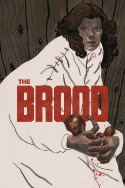
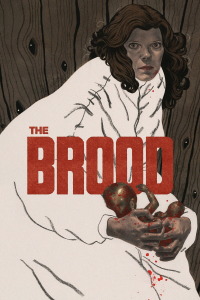
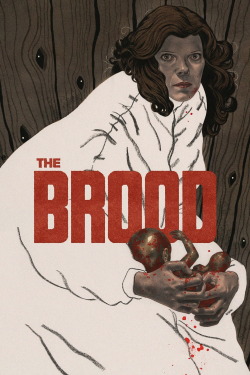
Written and directed by David Cronenberg, [i]The Brood[/i] may be, as academic scholars, film critics, and horror fans will likely attest, Cronenberg?s first indisputably great film. Cronenberg wrote [i]The Brood[/i] under a personal cloud, a bitter, acrimonious divorce and the subsequent custody battle with his ex-wife. Taking the material of personal experience, Cronenberg created something close to art, in effect, reversing the old saying, ?Life imitating Art.? In interviews, Cronenberg called [i]The Brood[/i] a riposte to the saccharine, sentimental [i]Kramer vs. Kramer[/i] released the same year. [i]Kramer vs. Kramer[/i] was feted at the annual award ceremonies, including the Academy Awards. [i]The Brood[/i] was given a limited release, in keeping with its genre status (and depiction of violence). More than twenty-five years later, [i]The Brood[/i] is, by far, the more original, complex, and disturbing film.
[i]The Brood[/i] opens with two men, sitting across from each other, on a darkened stage. The older man, Dr. Hal Raglan (Oliver Reed, surprisingly subdued), role-plays father figure to the obviously distraught younger man, Mike Trellan (Gary McKeehan). Raglan goads Mike into anger and rage. Mike, in turn, breaks out in boils. Dr. Raglan uses this exercise to demonstrate his radical ideas about psychiatric treatment to an auditorium. Raglan believes that negative emotions can be expunged from the psyche, taking physical form, ultimately releasing the patient from those emotions and their debilitating consequences. In an effort to disseminate his ideas, Dr. Raglan has written a best-selling book, ?The Shape of Rage,? and opened an exclusive, private clinic, the Somafree Institute of Psychoplasmatics.
All is not right, however. One audience member, Frank Carveth (Art Hindle), gets up in disgust at Dr. Raglan?s demonstration. In fact, Frank?s wife, Nola (Samantha Eggar, chillingly persuasive), is one of Dr. Raglan?s ?star? patients. Although Frank is barred from visiting Nola while she undergoes treatment, their young daughter, Candice (Cindy Hinds) isn?t. Candice is allowed weekend visitations with her mother. Noticing bruises and scratches on Candice?s back, Frank becomes alarmed, but when Frank confronts Dr. Raglan, he fails to obtain a satisfactory answer. Nola?s alcoholic mother, Juliana (Nuala Fitzgerald), offers no help beyond babysitting Candice when needed. Frank decides to employ the services of an attorney, who cautions him of the possibility of losing a custody battle, unless he has evidence to prove Nola an unfit mother and Dr. Raglan?s treatment as ineffectual or dangerous. Meanwhile, Nola?s therapy takes a dark, dangerous turn, where she re-experiences physical abuse at the hands of her mother while her father, Barton (Henry Beckman), stood by indifferently (it remains unclear, however, whether all or some of Nola?s memories are ?real? or fabricated).
Frank?s investigation of Dr. Raglan and the institute leads to Jan Hartog (Robert A. Silverman), disgruntled former patient with a peculiar growth on his neck, providing Frank with the first hint of the physical manifestations connected with Raglan?s treatment plan. In parallel, something begins to attack (and kill) people associated with Frank and his family. These child-like killers (the ?brood? of the title) wear uni-colored winter coats, slip into buildings and apartments relatively unnoticed and wreck havoc on their unsuspecting victims, usually with blunt instruments. First one, then two, then three bodies are found, with the local inspector (Michael Magee) doing little to protect Frank and Candace or investigate the institute. Who or what are the killers? Where do they come from? How is Nola involved? How is Dr. Raglan?s radical, unorthodox treatment involved in the murders?
These questions are, of course, answered before the end of the film, but not before Frank confronts what academic scholars like to call the ?monstrous feminine? in probably one of the most unsettling scenes ever put on film. Cronenberg forcefully reminds us that horror isn?t simply about jump scares or shock cuts punctuated by gore or bloodletting, but about compelling us to confront our own fears, anxieties, and discomfort with the all-too-malleable, permeable human body. In [i]The Brood[/i], Cronenberg targets the discomfort (and revulsion) connected to biological reproduction and, Cronenberg being Cronenberg, turning the biological into the grotesque. Not content with obtaining a visceral reaction from his audience, Cronenberg also takes his ideas into the psychological and social realms, ultimately turning his attention to critiquing the psychiatric profession (assuming Dr. Raglan and his institute are meant as universal stand-ins) and to comment on the grim connection between childhood abuse and the psychological damage that lasts across generations.
Horror fans, however, may find themselves disappointed with [i]The Brood[/i]. Not only is [i]The Brood[/i] deliberately paced, emphasizing dialogue, character interaction, and layered revelations, when the ?brood? attacks (first singly, then in twos, and finally, as a group), Cronenberg refuses to linger on the violence. Instead, Cronenberg prefers to slowly build suspense before the attack, cut to one or two shots of the attack itself, and end the scene with a single shot of the bloody aftermath. These scenes are made the more disturbing not for what they show (nothing contemporary audiences haven?t seen before and more graphically), but for the nearby presence of Candace or in one scene, a roomful of frightened children, making children witnesses to violence, and inevitably, victims of that violence. Cronenberg?s closing shot makes that subtext sadly clear, lingering on a traumatized, mute Candace that also suggests she shares Nola's unusual abilities.
This review of The Brood (1979) was written by Mel V on 01 Oct 2005.
The Brood has generally received positive reviews.
Was this review helpful?