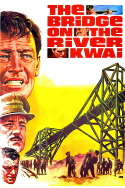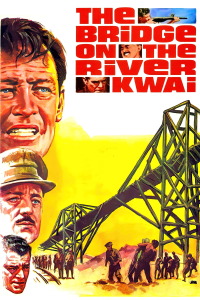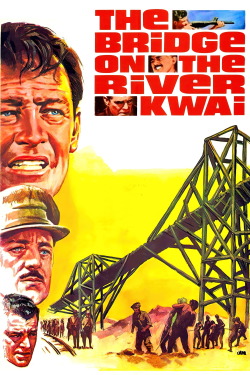
Review of The Bridge on the River Kwai (1957) by Robert H — 22 Jan 2015
"Bridge on the River Kwai" is two big movies in one, and they're both fantastic. Both tell fantastic tales of duty and self-sacrifice through big personalities brought to life by incomparable actors. But there are no idealized heroes here; everyone is as much wrong as they are right, and they are as motivated by pride and stubbornness as much as principles. While a power-tripping General Saito (Sessue Hayakawa) tests Colonel Nicholson (Alec Guinness)'s commitment to the international rules of war, a crack saboteur (Jack Hawkins) dragoons a deserter (William Holden) into doing a soldier's duty. These stories are ingeniously structured and interwoven so that all threads come to unexpected and compromised conclusions. A character may appear to win his battle, but if so, we may be certain that he will lose his war, and vice versa. Nicholson manfully (as the British might say) makes his point about the treatment of prisoners, and it is stirring to see him submit to severe mistreatment for the sake of an idea. But his real objective is not to uphold the rule of law, but to wound the pride of his foe, Saito, and to establish himself as the most influential-albeit imprisoned-figure in the camp. Once done, he zealously carries out the task Saito always intended for him, and in the fullness of his pride he does it better than he otherwise might have. Meanwhile, the would-be deserter Shears escapes from the prison camp and nearly escapes from the army as well, but the saboteur Warden traps him with the rule book. Nicholson and Shears are each prisoners, and each is used as a means to an end, but their arcs are also inversions of one another. Nicholson faces down his captor, but the determination that brought him that victory is also what leads him to undermine the army he loves. Shears submits to Warden and to the inescapable logic of the army he longs to leave, but in the end his personal sacrifice is a net gain for the cause. Lest the army come out smelling like a rose, victorious and free of compromise, Hawkins plays Warden as a cold man who in a second would sacrifice not only the charming audience surrogate Shears, but a group of female Thai porters as well. His Pyrrhic destruction of Nicholson's magnificent if misguided bridge is the occasion of the film's final word: "Madness!" There is a great deal of madness on display, but it is conveyed through wide-awake plotting and characterization.
David Lean's direction and Jack Hildyard's cinematography convey sweltering heat: the heat of the jungle, of Saito's tent and Nicholson's box, of Shears's beach and Warden's bungalow. But there is also a conscious distance separating audience from action. Whether framing a huge, explosive set piece with dozens of extras or a tense huddle over a table, the cameras are detached observers rather than participants. We see the big picture and think about why people act the way they do in their particular settings. We know them better than they know themselves, and understand each truth before it dawns on them. "Kwai," then, is a thing that hardly exists now: a big-budget war film that is observational and cerebral, not just gritty and melodramatic. Nor is it a simple matter of good versus evil. Though not at all a complicated movie to follow, its moral complexity is such that British audiences (and even some of the British actors) could feel it was anti-British, while Japanese audiences found it anti-Japanese. The movie is critical of all blind zealotry, and no wonder: screenwriters Carl Foreman and Michael Wilson had to go uncredited as a result of a Hollywood blacklist. Despite being an an uncomfortable watch for partisans and flag-wavers of all stripes, "Kwai" was a huge hit with audiences and critics, winning the 1958 box office and heaps of awards. Not everything has held up in the nearly 60 years since. The day-for-night shots, standard at the time, are particularly unconvincing. But the challenging messages and the flawed characters still hit hard and loom large, and the dramatic finale remains one of the great benchmarks of cinema.
This review of The Bridge on the River Kwai (1957) was written by Robert H on 22 Jan 2015.
The Bridge on the River Kwai has generally received very positive reviews.
Was this review helpful?