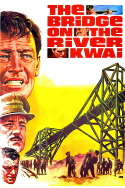
Review of The Bridge on the River Kwai (1957) by Simeon D — 16 Apr 2010
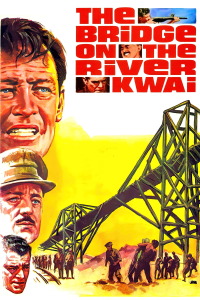
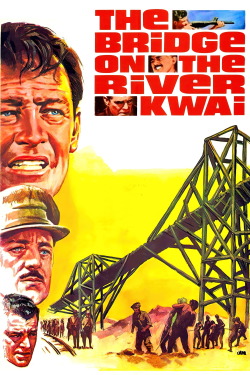
David Lean delivers this WWII epic with hardcore humanism and sumptuous substance to create a majestic cinematic spectacle that emotionally moves and entertains. Alec Guinness stars as Colonel Nicholson, an ultra-conservative British military leader who has just been captured by the Japanese, along with many other soldiers under his command, and sent to a prison camp in Thailand. Nicholson's attempt to keep leadership over his soldiers are unsympathetically regarded by a American Naval Commander (William Holden) and the head of the prison camp, Colonel Saito (Sessue Hayakawa), who just wants all of the prisoners to build a bridge over the River Kwai. Eventually Nicholson's and Saito's disagreements turn into a rivalry, but Nicholson prevails and he is allowed leadership over his men as they build the bridge. Nicholson's and Saito's relationship turns into a friendship, and as Nicholson helped build the bridge, the American Naval Commander escaped the prison camp and found himself at a British military hospital where he's given orders to go back to the prison camp, accompanied by two soldiers (Jack Hawkins and Geoffrey Horne) and blow up the bridge. Nicholson's pride of the bridge he built and the attempt to destroy it carry The Bridge On The River Kwai with thrills and drama that play out as a complex tale that asks "What is right?" and "What is wrong?". There are a few cliches that simmer themselves over the conflicts, and they are welcomely acceptable as small rays of happiness in an otherwise dismal film. British stereotypes are accurately portrayed as conservative, self possessed, humor loving individuals who abide by the rules, the Japanese stereotypes are even more accurately portrayed by their self awareness, honor, and pride, and the American stereotype is even more accurately portrayed as rebellious, impulsive, witty comrades. What is fascinating about these stereotypes is their accuracy and preciseness without any exaggeration of the truth or racism. Every character, no matter what nationality or area of conflict in the film, can be sympathized for.
David Lean, who is better known for his other Academy Award winning epic Lawrence of Arabia, marks his place as one of the top English directors with his exploitation of war and location. The jungle is a difficult place for a film to be set in, and Lean masterfully uses it to his advantage by establishing a sense of danger and hopelessness along with remarkable cinematography. Because of a serious lack of WWII war films in jungles, I'm suspicious that The Bridge On The River Kwai might have been a slight nod to the Korean War, which had just ended several years before the release of the film. As a WWII prison film I could name about ten better ones, but this sets a new standard for all jungle-prison films (including Deer Hunter and Rescue Dawn); the film shows intelligence, brutality, and wit without having any missteps or becoming too dark. The first half of the film is amazing. It brandishes classic quotes, amazing acting, and a powerful story. The second half of the film did linger a little passed the point of comfort and there is some 1950s Hollywood entertainment that doesn't add anything to the film except some slight boredom, but but the final scenes have such an emotional impact that this can be dismissed.
Sessue Hayakawa and Jack Hawkins were the highlight of this film for me. They were fun to watch and they made their villainous characters likable, even though their heavy accents did make them hard to understand. Alec Guinness, who won an Academy Award for his lead role, is good, but I wouldn't go as far as to give him an Oscar. Guinness is a very talented actor who is extraordinary in this, but he didn't stick to his character well enough to deserve an Oscar. William Holden was surprisingly great as a stereotypical American and his powerful performance invokes as much of the emotion from the screen as possible. Geoffrey Horne, who plays a typical young soldier whose morals overcome his orders, adds more sympathy towards the soldiers with a heartfelt performance.
The Bridge On The River Kwai, equipped with David Lean's direction and strong performances from the lead cast, is a spectacularly original story that can rightfully be considered as one of the greatest films of all time. 100/100.
This review of The Bridge on the River Kwai (1957) was written by Simeon D on 16 Apr 2010.
The Bridge on the River Kwai has generally received very positive reviews.
Was this review helpful?