Review of The Black Pirate (1926) by Elijah B — 12 Jan 2009
Matt Kelly just reviewed this film and I was about to write my own review, but I'd like to point something out to him, first. I don't mean to sound like a pig, but Matt, if you would have watched the special features on either the Kino or Image editions of this film (no difference between them, except for the distributor; David Shepard produced both copies), you would realise that the camera work in the 1920's was more dynamic than it is today. All you have to do is look at Murnau's The Last Laugh, made two years before the Black Pirate, to see that this film's restricitions in movement were due to the technicolor equipment. All of the fades and transitions had to be done within the camera itself and it was probably much easier and less costly to the films producer (Fairbanks, credited under his pseudonym Elton thomas) to hurry this film to the market. Fairbanks took great pride in his box office reputation and that is why he took this gamble to make the film in Technicolor.
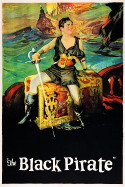
Now, on to my review. I just bought a used copy of the Image Entertainment release, as pictured above. Like I said earlier, there is no difference in this copy versus the Kino copy. I bought this out of sheer loyalty to a dear friend of mine who produced this copy for DVD and Video. The Kino reissue boasts that the previous DVD release has been remastered by Bret Wood. I typically like Wood's restorations, but I know David personally, and I felt in some small way, that going for his original release copy would be a heart-felt benefit. This is my favorite Fairbanks film out of everything else he has done (yes, I place this even above "The Mark of Zorro"). The innovations used in this film are so remakrable you would almost expect to hear the actors speak. This, as far as I know, was the first big commercial success (feature length) of the Technicolor company. They had made a previous feature film with anna May Wong called "The Toll of the Sea," but it was independantly produced by Technicolor. The big studios had not yet totally embraced the idea of two-strip color. Fairbanks was at United Artists (long before they merged with MGM) at the time and I don't know why he made the gamble to make a big action picture with the experimental color process. However, it went over well and it has become a classic.
When watching the film, it may be helpful to remember that the only other commercial (meaning the big studios) uses of two-strip color were brief sequences which were used for publicity purposes. The prime example is Lon Chaney in "The Phantom of the Opera" (1925). Originally, it boasted practically half the film in color, varying from different processes such as the German color process, Handscheigl, as well as the two-strip Technicolor. All that remains of the original color scenes in "Phantom" today (to my knowledge) is the famous Bal Masque sequence. The Appolo's Lyre scene had reconstructed color in the Photoplay Productions restoration, so it gives an idea of what the completed sequence would have looked like at it's original release. Of course, the Photoplay resotration is only of the 1929 re-release, which was severly edited by more than an hour of footage from it's 1925 theatrical release.
As far as The Black Pirate is concerned, we are all very fortunate that a color print survived the years and that Film Preservation Assosciates has made it widely available, for the first time. All other releases of the film are taken from various other prints which exist in black and white. My guess is that these other prints originated from the Killiam preservation prints, which had only one or two scenes remaining in color, with all others tinted and toned. Special thanks to David for introducing me to this film as well as to my very first silent film (at age 3 or 4).
It's funny. when I finally got to meet him face-to-face, he asked what got me interested in silent movies and even though my father introduced me to the silents, my first silent film was a video produced by David. So, in a sense, he has been my mentor all of my life. I cannot thank him enough.
This review of The Black Pirate (1926) was written by Elijah B on 12 Jan 2009.
The Black Pirate has generally received positive reviews.
Was this review helpful?