Review of The Black Hole (1979) by Christina S — 26 Oct 2007
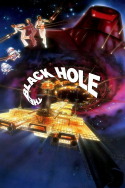
Hoping to cash in on the success of a modestly budgeted science fiction/adventure film called [i]Star Wars[/i] (just [i]Star Wars[/i] as [i]A New Hope[/i] wasn't added as a subtitle until years later), Walt Disney Studios greenlit their own genre entry, [i]The Black Hole[/i], or to be more accurate, had the screenplay retooled and expanded to focus on the visual effects that made [i]Star Wars[/i] a box office hit in 1977. Disney's first PG-rated live-action film, [i]The Black Hole[/i] cost $26 million dollars to produce (not including advertising and marketing costs), almost four times as much as [i]Star Wars[/i] cost just two years earlier. While [i]The Black Hole[/i] didn't exactly bomb, making $36 million dollars at the box office, it received mixed to negative reviews, primarily for its clichéd, muddled storyline, thin character development, and a misguided ending that tried to emulate [i]2001: A Space Odyssey[/i] for its metaphysical ambiguity.
Deep space, 2130 C.E. The [i]Palomino[/i], an interstellar research vessel, carries a crew of five, Capt. Dan Holland (Robert Forster), Lt. Charles Pizer (Joseph Bottoms), Dr. Alex Durant (Anthony Perkins), Dr. Kate McCrae (Yvette Mimieux), and V.I.N.CENT. (Vital Information Necessary CENTralized) (voiced by Roddy McDowall), a sentient robot. Also aboard the [i]Palomino[/i] is Harry Booth (Ernest Borgnine), a journalist along for the ride. The [i]Palomino[/i] comes across a black hole and near it, what appears to be a derelict space ship. On closer inspection, Holland and his crew identify the ship as the U.S.S. [i]Cygnus[/i], a ship presumed lost with no survivors more than twenty years ago. McCrae discloses that her father was the captain of the ship. McCrae's hopes of a reunion with her father are raised.
After almost losing control and slipping into the black hole, the damaged [i]Palomino[/i] is forced to dock with the [i]Cygnus[/i]. Within moments, Holland and the others are disarmed and brought to the control tower where they might the [i]Cygnus'[/i] lone survivor, Hans Reinhardt (Maximilian Schell), a brilliant scientist. For company, Reinhart has created several different classes of robots, including a malevolent, red-eyed model he calls Maximilian. Reinhart reveals that he hopes to fly [i]Cygnus[/i] into the black hole with the hope that his anti-gravity device will save him and the [i]Cygnus[/i] from being crushed by the gravitational well of the black hole. Holland expresses skepticism at Reinhart's idea, but Durant sees the brilliance in Reinhart's apparent madness.
Mixing and matching elements from Jules Verne?s [i]20,000 Leagues Under the Seas, Herman Melville?s [i]Moby Dick[/i], Stanley Kubrick?s [i]2001: A Space Odyssey[/i], and George Lucas? first [i]Star Wars[/i] film, [i]The Black Hole[/i] is nothing if not derivative. From Verne and Melville, writers Jeb Rosebrook and Bob Barbash and director Gary Nelson borrowed the fanatical, monomaniacal, idealistic captain who has little regard for human life, unless it?s expended in pursuit of his egotistical dream. From Lucas, Nelson and the writers borrowed the ?cute? robots, even going as far as pairing up V.I.N.CENT. with a cantankerous old robot, BOB (voiced by Slim Pickens) for comic relief (much of it forced). From Kubrick, they borrowed his metaphysical preoccupations and the star gate sequence from Kubrick?s film, but implemented here with far less innovation.
Even worse, Nelson and his writers? throw together ill-defined, underwritten characters into a plot that gets increasingly ludicrous the further away it gets from science-based logic and the closer it gets to Judeo-Christian ideas about heaven and hell. That?s not a knock against Christianity (far from it), but it is a knock on the writers and, by extension Disney, who either ran out of places to ?borrow? ideas from or had none of their own to offer. Either way, it makes for a confused, muddled, and ultimately rushed ending that leaves too many questions unanswered and, thus, leave moviegoers in 1979 hoping for light, adventurous storytelling in the Lucas or Spielberg mode unsatisfied.
Sadly, Nelson?s direction is as lackluster as you?d expect from an undistinguished TV veteran. With the exception of the final set piece and the close to 550 visual effects shots, a credit less to Nelson?s skills as a director and more to the effects crew at Disney led by Richard Ellenshaw (who not coincidentally worked on [i]20,000 Leagues Under the Sea[/i] for Disney twenty-five years earlier), [i]The Black Hole[/i] moves from expository scene to expository scene, with one or two minor revelations about the fate of the [i]Cygnus?[/i] crew, at a lethargic pace that makes [i]The Black Hole[/i] feel like it?s much longer than it?s 98-minute running time. Nelson?s choreography of the battle scenes is just as sluggish and uninventive as you?d expect from a work-for-hire director who really had no business behind the camera for an effects-heavy film. Too bad Steven Spielberg wasn?t available to direct or at least act as a consultant.
What makes [i]The Black Hole[/i] still watchable after twenty-eight years is certainly not the story, the characters, the performances, or the direction, but the production design by Richard Ellenshaw and the visual effects which relied on a mix of technologies from the pre- and post-[i]Star Wars[/i] era. Whether it?s the first sight of the black hole, sucking in matter into its dark core, the [i]Palomino?s[/i] first encounter with the [i]Cygnus[/i], a ship designed to resemble a steel-and-girder aircraft carrier as designed by Gustav Eiffel in a more religious mood, humanoid robots working inside the control tower, a meteor shower that leaves the [i]Cygnus[/i] damaged, or a giant fireball running amuck through the ship?s structure, [i]The Black Hole[/i] will elicit the requisite awe and wonderment expected from a big-budget spectacle. At least there, [i]The Black Hole[/i] doesn?t disappoint. It?s just unfortunate the same attention to quality and innovation is nowhere else in evidence.
This review of The Black Hole (1979) was written by Christina S on 26 Oct 2007.
The Black Hole has generally received mixed reviews.
Was this review helpful?