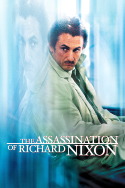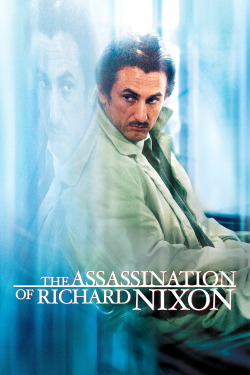
Review of The Assassination of Richard Nixon (2004) by Shawne ~ — 14 Apr 2005
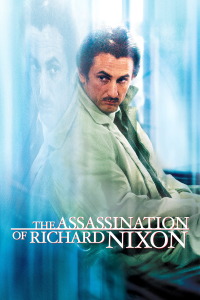
Inspired by a true story from the early 1970s, [b]The Assassination of Richard Nixon [/b]is about Sam Bicke (Sean Penn), a put-upon office furniture salesman whose marriage has crumbled amidst the spiritual thrashing the US would take in what would be the Watergate years. Sam is a man who seems to have failed at seemingly everything he's put his hand to, including his job, his planned business venture with black garage mechanic Bonny Simmons (Don Cheadle), and his attempts to patch up his relationship with estranged wife Marie (a brunette Naomi Watts). Already not the most stable of guys, Sam's string of failures contribute to his growing sense of insignificance, which begins to drive him desperately, inexorably towards the brink of insanity. Soon, fed up with the powers that be, whose lies and games he blames for his inability to catch a break, Sam hatches a scheme to assassinate Nixon (hey, it's not a spoiler, the movie title gives it all away!). The movie's narrative traces the genesis of Sam's plot, as his meanderingly small and yet painful life is played out with the guidance of voice-overs, excerpted from letters he sent to composer and (he believes) kindred soul Leonard Bernstein explaining his motives.
Director Niels Mueller, who co-wrote the screenplay with Kevin Kennedy, delivers a competent, probing character study of Sam Bicke as he descends into psychosis. This was no cookie-cutter madman, or a villain bent on destroying the world, but a strangely sane, bizarrely skewed man--an everyman with a fatal flaw, a twist of darkness. What was admirable about the writers' portrayal of Sam was that they refrained from making a judgement on Sam's character--it wasn't just his natural predilection to psychosis, or merely a result of cruel twists of fate; no, it was a complex mesh of both that saw Sam heading down his lonely, tragic road. For instance, Sam's desperate clinging to his wife and family are at first inexplicably rebuffed by Marie. His boss (and attendant peon) is pompous, loud and condescending, and has a ball disparaging Sam or his moustache, bullying Sam into bringing his wife to dinner. His bank loan application is rejected, after months of agonised waiting. It's all a mess... and yet the writers show us, at every little step of the way, where Sam might have stepped back, but instead chose to do something just a little bit odd, just a little bit strange, just a little bit insane. He follows Marie to work, shows up at the house unannounced, stalks her all day with flowers. In a tiny little detail, we discover that he's actually been separated from Marie for almost two years, which he can't accept. He becomes obsessed with his loan application, showing up at the bank to harrass the staff, clocking out earlier and earlier to get home to check his mail. His ideas are decidely odd as well: he suggests the Black Panthers change themselves to the Zebras to widen their demographic to whites, he's hollowing out a school bus to transport tires... The portrait of Sam Bicke slowly comes together, but when it does and it falls into place, it just about explodes in the movie's climactic, very effective ending.
This movie is all about Sean Penn, though, and while I admire his skill--and he really does pull out all the gruff, five-o-clock-shadow stops in this movie to make Sam look very much like a vagrant loitering suspiciously in the streets of life--Penn has always been a bit too shouty for me. He's quite restrained for most of the film, but in one fascinatingly loud moment, he cranks up the volume on all the TV sets in his office, all blaring Nixon--then he quits. Before long he's shouting, veins popping, "It's all about the [i]money[/i], DICK!", over and over again... and yes, I understand that this scene is necessary as a signpost for dolts who don't understand the myriad subtle hints that this is NOT a normal bloke. But it doesn't mean I have to appreciate it. It's jarring, and gives us loud, mouthy Penn (whom I don't particularly enjoy), and cheapens a movie that's otherwise a very well-crafted snapshot of someone wilfully stumbling into madness.
This review of The Assassination of Richard Nixon (2004) was written by Shawne ~ on 14 Apr 2005.
The Assassination of Richard Nixon has generally received positive reviews.
Was this review helpful?