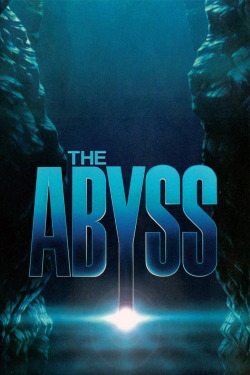
Review of The Abyss (1989) by Spangle — 03 Jul 2017
So this is where Michael Bay got the belief that oil rig workers could be tasked with government jobs that concern the safety of the planet and species. In fairness to Bay, not only is Armageddon a better film (shoot me), but if James Cameron did it, it has to be right. If Cameron said that the world was flat, considering how much time he spends in submarines, it would be hard to deny him that fact. Thus, in cinema, if he says something works in a film, who am I to argue? Taking Close Encounters of the Third Kind, sprinkling in Sidney Lumet's Fail-Safe, blending it with Bay's later film Armageddon, tossing in Robert Zemeckis’ Contact, and dumping it underwater like the end of A.I. Artificial Intelligence, James Cameron's The Abyss is both heavily influenced by other films and, naturally, its style is similarly influential. Though it may be a bit too cliche, sentimental, and wholly predictable, but in its sickly sweetness is Cameron's typical directorial brilliance. With pitch perfect action sequences and rock solid production design, The Abyss is able to overcome its sentimentality and cliches.
This mess of sentiment and narrative cliches is largely found in the relationship between Bud (Ed Harris) and Lindsey (Mary Elizabeth Mastroantonio). With Lindsey the brain child behind the oil rig that is tasked with finding the lost USS Montana and Bud the man who operates the rig, the stage is set for this married couple to rekindle their love for one another. At the brink of divorce, always fighting, and butting heads, Bud and Lindsey's relationship is tested when the oil rig must face off with their Navy pals who are intent on blowing up the nuclear warheads on the USS Montana and with the alien aquatic species they encounter underwater. Cameron sprinkles obvious symbols and sentiment throughout this film with to their relationship, but it mostly all comes together to mean: love conquers all wounds. When Bud was about to drown, he sticks his hand in a rapidly closing doorway, and the door only does not shut because it got stuck on his wedding ring. When Lindsey is about to drown, Bud's love for her and unwillingness to give up on her breathing again is what saves her. When Bud is about to drown after doing a deep dive, it is his love for her that keeps him going and keeps him sane. It is cliche and similar to any number of films with the "they really do love each other" trope. Sprinkled with the awe of meeting aliens and the reuniting of a once fractured couple and this is a sickly sweet concoction that one would expect from Steven Spielberg, but stands as Cameron's first foray into lazy emotional heartstring pulling (see: Titanic).
This couple strife is at the center of many films and, yet, it is just one of Cameron's indulgences in cliches. Though Cameron is a master of action direction, his weak point has always been the story of his films, having to rely upon cliches and simple characterizations as a jumping off point for brilliant special effects and thrilling moment after thrilling moment. The Abyss is no exception, but does begin to run a bit clunky due to these indulgences in cliches. These cliches include the God-like aliens who are there merely to save humanity unless it demands destruction and the military characters that are overly enthused to blow stuff up even when it is readily apparent that their conclusion is way off the reservation. Cameron doubles down with that aforementioned relationship, however, in turning it into a "love conquers all" type of film where love is given dominion over plausibility. Though a film about alien encounters, it can still be plausible until the end when love saves both Bud and Lindsey even when both would have died long before they met one another again. This implausibility and the cliches in their background relationship really undermines the potential emotion of the film with Cameron taking a shortcut to try and conjure up pathos. Unfortunately, with the implausible introduction of love conquering all and the sickly sweet setup, it winds up being nothing more than eye-roll inducing, predictable, and quite hollow.
That said, while the film has some serious narrative flaws, it is impossible to come away from a James Cameron film unimpressed. The man is a master of action and visuals. For the former, the film opens with the USS Montana going down under mysterious circumstances. Slowing building up the tension with radars going down and the lights going out, Cameron sets the scene for the film's science fiction conclusion, but nonetheless laces it with tension from the very beginning. Is it the Russians? Could they do this? Expertly pacing the moment with strong militaristic writing in the scene, Cameron manages to make the film's first few moments some of the most tense in the whole film while perfectly setting up the rest of the feature and, most importantly, not revealing too many of the film's underlying secrets.
This review of The Abyss (1989) was written by Spangle on 03 Jul 2017.
The Abyss has generally received positive reviews.
Was this review helpful?