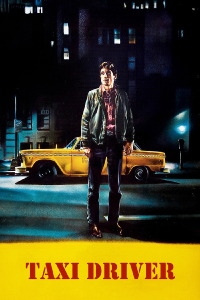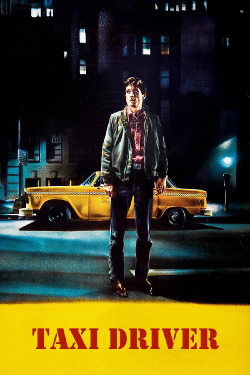
Review of Taxi Driver (1976) by Blake P — 04 Dec 2015
"Taxi Driver's" you talking to me? soundbite has perpetuated the iconic movie quote walls for what feels like a century. Those familiar with it do their best tough-guy Robert De Niro impression whenever the film is brought up, only to laugh along with their listening companions as they go back to small chatter seconds later. But few remember the improbably sadness that comes with the line. The scene in which it appears spotlights a shirtless De Niro, gun in hand, facing the mirror like a narcissistic gangster, exceptionally vulnerable. He is asking no one and will probably never have the chance to ask anyone; a socially stunted outcast his entire life, he has never been important enough to be talked to. He always has to start the conversation, with the other party often walking away to converse with someone more ... normal.
"Taxi Driver" is a tremendously melancholy film, one of loneliness, despair, and the unforgettable consideration as to if simply being alive is enough of a reason to live if no one wants you. The movies, too often, surround themselves with attractive people speaking attractively, doing attractive things in attractive places. But here, those parties are looked at from afar, glamorized but untouchable. It is, instead, about the loners who want to be part of that in-crowd but don't have the social skills, the looks, the personalities, to be included in anything resembling high culture.
The man mirroring the emptiness we can often times feel in this difficult game of life is the iconic Travis Bickle (De Niro), an insomniac taxi driver who works twelve hour shifts and who cannot seem to function living in a post-Vietnam world. He is suffering from the aftermaths of fighting, yet it seems he has always been a persnickety wallflower - his gloom has increased in result to his past traumas. He is passive, mannered, and unable to form real relationships; but the more a situation aggravates him, the more dangerously hot-headed he becomes. His only stability comes from writing letters to his parents, whose existence we question.
Two women provide the heart of the film and change Travis's life for the better or for the worse, depending on how you look at them. The first is Betsy (Cybill Shepherd), a cool, blonde campaign worker who becomes the target of Travis's romantic obsessions. He sees her as the perfect woman, and, unwilling to let her slip into the arms of a co-worker (Albert Brooks) he suspects has sensual interest in her, he asks her out. His slight good looks prompt her to push past his eccentricities, but when a date leads to a pornographic theater, a place Travis has no idea is insulting to take the time to visit, she immediately loses interest. In one of the most disturbing scenes of the film, she rejects him over the phone, the camera panning to an empty hallway to distort the pain Travis so deeply feels. No one is crying with you, the shot says. It's chilling.
His misanthropy toward the world is soon amplified, and, with violence in his heart growing, he stumbles upon twelve-year-old hooker Iris (Jodie Foster), who has run away from home and works under the watchful eye of her pimp, Sport (Harvey Keitel). She doesn't want to be saved - she likes sex work - but Travis sees the tragedy and reacts excessively.
In "Taxi Driver," the supporting actors, though important, are white noise. We see through Travis's eyes so vividly that it is as if everyone is behind a sheet of bulletproof glass. Consider the way Scorsese takes the time to act as voyeur to Betsy and her work friend's conversations, which are so obnoxiously witty that they only heighten Travis's simultaneous dislike and envy of those successful and accepted in life. Consider how Iris does not want to leave the ghetto streets of New York, and how Scorsese photographs the intense shootout that leads to her "freedom" in a subtle red that magnifies just how unjustified Travis's gunning is. The latter tells himself that it's an act of good, but he, deep down, knows that all he really wants is an excuse to inflict violence on the "scum" he so outrightly hates.
Travis Bickle was voted as one of the American Film Institute's most seminal villains, but I don't see him as one - he is neither a hero nor a foe, rather an embodiment of a detached party of humanity. He was not bred to be homicidal; he was made that way, through tireless rejection and an array of relentless cold shoulders. He has grown to despise the world because of what he perceives it has done to him, and what we witness throughout "Taxi Driver" is his eventual inability to keep his anger, his sadness, hidden anymore.
Scorsese brilliantly elevates his disconnection by keeping scenes of conversation flat and in-the-moment, with interludes that depict Travis in his taxi accompanied by lonely jazz music and a floating aesthetic that further disengages him with the life that is buzzing about around him. Friends, family, lovers, roam the streets. To Travis, they are alien - he only knows what it's like to be alone with his thoughts, stewing and stewing until they're overcooked, delusional.
De Niro's untouchable performance is a masterwork in understatement - he is often silent, quiet in the presence of others, alive when by himself. Even when in the public eye, he still can't help but remain to be his own best friend. Would-be friends are a fog. De Niro does so much with expression, with vocal delivery; little things expand Travis's standing as a man alone on Earth - he is almost a higher being, looking down at the world and unsure what to think of it. As Travis, De Niro is as sympathetic as he is frightening. We pity his despair, but we also are unsure of when he's going to snap. This is one of the greatest performances in the history of film. Foster, a teenage heavyweight, is equally remarkable as an impressionable youth whose life goes in a completely different direction than she would have thought thanks to the film's titular taxi driver.
Almost forty years later, "Taxi Driver" still stands as the exemplary Scorsese movie - in-control, unpredictable, observant, and slightly savage. It is very much a New York film, though it doesn't romanticize its "big city" tropes; it accentuates the idea that someone, in the blink of an eye, can get lost in this world, and that living in the shadows of society is no home. Here is one of the finest depictions of alienation in cinema, next to "Red Desert" and to "Blue." Whether we like it or not, we have all experienced what Travis has. Just maybe not so violently.
This review of Taxi Driver (1976) was written by Blake P on 04 Dec 2015.
Taxi Driver has generally received very positive reviews.
Was this review helpful?