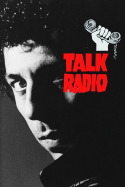
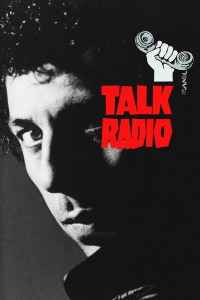
Review of Talk Radio (1988) by Josh G — 08 Oct 2008
I've seen Oliver Stone's Talk Radio several times now. Sometimes whenever I watch the movie, I begin to get this strange feeling as the movie nears its conclusion. I've said before that it must be similar to the way "epiphany" feels: the entire world begins to swirl around you, everything fits together in a perfect harmony, and for a few intangible moments one can understand existence.
I had the same feeling while finishing Gabriel Garcia Marquez's novel "One Hundred Years of Solitude". It probably seems odd to compare Marquez's masterpiece with a throwaway Oliver Stone flick, but it's true.
I've never really explored any deeper than that, though. Never really thought any deeper about the characters than the way the movie makes me feel. After watching it last night, I have come away with a new respect for the film.
Talk Radio is about Barry Champlain, a rude and provocative talk radio host. Barry is just as much a jerk in his private life as he is on the radio -- callously breaking apart his marriage, beggins his wife to return to Dallas to provide him moral support while his show goes to a national feed, then dumping her again when he realizes that he doesn't want her around. He treats his friends like dirt, refuses to listen to authority, and practically yells at the people who call into his show.
In short, Barry Champlain is a jerk. So I can understand how a viewer could watch the film and not be bowled over by it because, hey, the protagonist is really the antagonist -- why should we care?
I think this view of the movie takes an incredibly superficial look at the man and the events that unfold. Of course, I've seen it half a dozen times or more so perhaps allowing the movie to gestate in my mind some has led me to these thoughts, I don't know.
There are going to be spoilers ahead, so for those of you who want to see the movie before reading my spoiler-ific analysis, know both that it's a great movie with some awesome shots from Stone (close-ups on cigarettes being lit near a microphone, rotating sets, etc.)... and that I'm going to be giving out too much information in the next paragraph.
SPOILERS ahead...
I was thinking more about the theme of Talk Radio last night, or what it was that Barry was trying to accomplish. It's easy to see him thinking of himself as a sort of martyr for his cause, which I don't think would be an inaccurate reading of his character... but perhaps, again, too simple of one.
In the early stages of his career (seen in flashback), Barry is eager to take on anybody who calls into the show. A man calls in to call him a liberal, pinko, homo -- Barry laughs uproariously and plays along with him, telling him that he is in fact currently holding hands with his male co-host. At the beginning, I think, Barry thrived on the argument alone. It didn't matter what was said, as long as something was said.
But over the course of two nights that the movie documents, as his show is getting ready to go into national syndication, he slowly realizes that what he's doing, or what he's trying to do, is more than just creating noise. He's trying to get people to talk about things that are important.
When a stoned rocker comes into the studio, blathering mindlessly, Barry simply stares at him with a look of profound disgust on his face. This is not the same Barry Champlain from the flashbacks. Granted, perhaps the transformation could have been pulled off more smoothly, but I think if you're paying attention, it's there.
It all culminates in a a long monologue by Champlain, his eyes bugging out and spit flying with each punctuated word. During this monologue, he is spinning jerkily so that we the audience see the people in the recording studio whiz by every few seconds. It's easy to focus on the jerky movements of the device which is obviously being used to make Eric Bogosian spin, but if you focus on him, the background begins to look blurred and out of control -- just as if you stared at one spot on a passing train, the world would begin to seem to be twirling around you.
It is during the course of this monlogue that Barry articulates the fear that he has of all of the people on the other side of the phone line, people that only want to talk about trivial, stupid things like baseball, orgams, or Holocaust denial. He hates them, but at the same time realizes how much he needs them. It's movingly personal, coming from such an anti-social person as Mr. Champlain.
But the real emotional tide comes just before and during the end credits. Barry Champlain, after finishing the night's broadcast, is shot and killed by an unnamed person. In the final shots of the film, the camera flies around the skyline of downtown Dallas as radio callers are heard speaking about Barry. They reminisce about how much they liked getting riled up by him, even if they hated what he was saying. They talk about how they don't understand how anybody could HATE him. His ex-wife says that she hopes people remember what he said, and not how he said it.
I think that's the key to the whole movie right there. When she says "what he said", it's not what words were used. It's what he intended. What he intended was for people to talk about issues that were important -- in death, he finally accomplished that. Sure, it's probably a little egotistic to call his death an important issue. Maybe it's not as important as national security or the economy, but it's something more real, more important than baseball scores. If even for a few minutes, he got people to stop arguing blindly and instead, just talk. Think. Listen.
Whatever Barry was in life, for the bulk of the movie... however indefensible he was, however unlikeable... I believe that the end justifies it all. Whatever missteps were made throughout the film, when you realize what Barry was reaching for all along, it... well, it may not make up for how much of a jackass he was, but you really do begin to see what it was that he was saying instead of how he was saying it.
Maybe I'm reading too deeply into it. I can imagine that there are lots of people who aren't into Talk Radio, and that's fine. It means something to me, and that's fine with me.
This review of Talk Radio (1988) was written by Josh G on 08 Oct 2008.
Talk Radio has generally received positive reviews.
Was this review helpful?