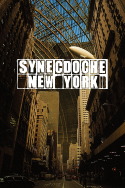
Review of Synecdoche, New York (2008) by Brett R — 06 Dec 2012
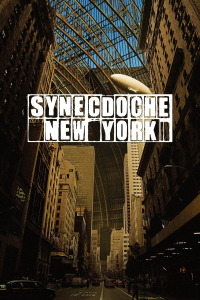
After my first viewing of Synecdoche, New York, I hadn't the slightest idea what to think, but I knew I had just witnessed something substantial. I was convinced it was above me and that it had thoroughly outsmarted me. Or had it? After some time had passed (long before my second viewing), I began to challenge that assumption. Was it smart, or was it pretentious and self-indulgent? Had the master-mind behind Being John Malkovich, Adaptation and Eternal Sunshine of the Spotless Mind finally taken the opportunity to relish in his brilliance by making a film that seemed to cater directly to his immense, unique, even unmatched creative ability? After a second viewing, I find it safe to say that no, it is nothing of the aforementioned statement. It is simply incredible and thoroughly (albeit complicatedly) realized by a man who possess creative instinct like nothing I've ever seen. The film isn't pretentious, just overwhelmingly ambitious. Nor is it self-indulgent. Well, maybe it is. Hell... if it is, then so be it. The brilliance of a mind like Kaufman's is rare, and it's a sheer pleasure to watch what he creates.
I have to admit that even after a second viewing, I still don't perfectly understand its depths. The more I think about these depths, though, the better the movie becomes. Viewer beware: Synecdoche, New York is more than a movie. It's a cerebral, painful, sad, beautiful, sometimes morbid, but always awe-inspiring experience. It takes a lot of patience, mental fortitude and appreciation for the abnormal-at least within the context of "conventional" filmmaking-to watch what plays out on the screen, but it's well worth the time and effort it takes to view and comprehend its meaning. I realize that doesn't necessarily sound like a rave review, but even the unattractive sequences are part of such an extraordinarily creative whole that they don't even phase you.
Kaufman seems to have an affinity for creating characters that possess eccentricities and strange idiosyncrasies. In Eternal Sunshine of the Spotless Mind, Clementine is a compulsive, incredibly spontaneous woman with blue hair who collects dolls made out of potatoes. In Adaptation, Nicolas Cage (playing Charlie Kaufman) seems to lack any discernable form of self confidence, sweats compulsively and seems to be socially inept. In Synecdoche, New York, Caden Cotard (Philip Seymour Hoffman) is a theater director obsessed with and permanently fearful of his eventual demise. Every morning he opens the newspaper to the obituaries first, and then comments to his wife Adele (Catherine Keener) about who has died that day. It is Caden's aforementioned idiosyncratic devices that Kaufman uses as a springboard for the thematic material of the film. Caden's fears, uncertainties, choices and insecurities begin to consume his life... and life is what the film is about.
Where to begin? The plot of the movie is secondary to its overall meaning, so any thorough description of it would be unimportant, if not pointless. In essence, Caden becomes disheartened by what life continues to throw at him, especially after Adele leaves him with their daughter Olive to pursue her art career in Berlin. After learning of a substantial grant being offered to him to create a new play, Caden realizes he must dedicate his efforts to creating something powerful, meaningful and "real." Shortly after coming to this realization, he buys an abandoned warehouse of immense capacity in New York where he will stage his play. Through this process, Kaufman introduces us to motifs, devices and other things that shape the creativity of the story in ways that I cannot describe. Nevertheless, as the play comes to fruition, the true power of the films' narrative takes shape. A replica of New York City is built in the warehouse, and Caden chooses to make a play that replicates the everyday actions, conversations and situations that occur in the reality outside of the warehouse. In order to observe more meticulously, Caden replaces himself with a man to play himself. As he begins to observe the surroundings and everyday actions of the people living in his replicated reality, he slowly begins to learn that everyone, in one way or another suffers at some point in their life just as he does. Throughout the movie Caden struggles with the ideas of death, life, meaning and suffering. While prepping and staging his play, he learns that unfortunate, tragic and unexpected things happen at uncontrollable instances, and all of these things are an unfortunate byproduct of life.
Like I said previously, a paragraph long synopsis of the film does not do it justice. It must be seen. The movie is rife with motifs, metaphors, characters, humor, quirkiness, observation, power and an incredible amount of insight into the mind of a gifted storyteller. While Synecdoche will most likely prove to be Kaufman's least accessible film to date, it's another addition to his great body of work. Eternal Sunshine of the Spotless Mind and Adaptation are my two favorite Kaufman-written films with Being John Malkovich and Synecdoche right behind them. Every Charlie Kaufman movie is unique, creative and incredibly inventive, and Synecdoche does not disappoint. I'm really torn over how to rate this movie. If I were to rate it a perfect 100%, it wouldn't be because it is a perfect film. It would only be because the sheer audacity of the movie was portrayed in way that was powerful, original and exceptionally moving.
This review of Synecdoche, New York (2008) was written by Brett R on 06 Dec 2012.
Synecdoche, New York has generally received positive reviews.
Was this review helpful?