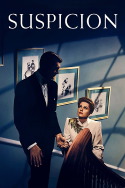
Review of Suspicion (1941) by Spangle — 30 Jan 2017
Honestly, three-quarters into this movie, I had conceded that this one may just be a solid misfire from Alfred Hitchcock. It had suspense, but seemed to be taking too long to get to the point. Yes, Johnnie (Cary Grant) was creepy and a liar, but I needed a pay-off. My mind began to wander and it seemed like I had finally found a Hitchcock film that had missed the mark. However, even in this mixed state of mind, the film was admittedly incredibly suspenseful and filled with tension as you began to wonder, along with Lina (Joan Fontaine), if her husband Johnnie was really a dastardly murderer. What won me over was the third act. It is brilliant. Visceral, edge-of-your-seat entertainment, the third act must rank among the very best final acts of a film in Hitchcock's career. That said, in hindsight, the first and second acts are also often terrific in setting up the clues to the "case" and hinting at the truth.
Deceitful and untrustworthy, Johnnie falls quickly into love with the rich Lina. Unbeknownst to Lina, Johnnie is a gambler, heavily in debt, and broke. Hitchcock immediately sets up the film to make Lina and the audience suspicious, especially after her father dies and Johnnie loses his job for stealing, but fails to tell Lina. He is no good and a thief, but is he a murderer? Lina seems unsure, but her paranoia and suspicion continue to spiral out of control. As a result, though it was lost on me initially, the audience's instincts also spike out of control. Every clue, every move, every action is draped in tension in the final act of the film. Sick from nerves, Lina is bed ridden. Johnnie bringing her milk, after learning of an undetectable and pain free poison found in every home, is filled with suspense. Hitchcock is the "master of suspense" for good reason and he shows it here in this film. As she looks at the glass after Johnnie put it down, it makes the audience want to get up and scream, "Do not touch that milk, it is poisoned!" When films make the audience feel such emotions, you can always tell just how effective its thrills and suspense are.
Cary Grant truly lives up to the billing as well, as his every move and look instills trepidation and fear. He seems like a snake and acts like one throughout the film. When he tries to convince Lina that he loves her and would never hurt her, it never feels genuine. It is almost as if he is convincing himself as well as his wife. His slimy, grimy, and despicable behavior leads to the belief that he is untrustworthy and, even worse, his lack of wealth and seedy nature easily instills the belief that he would kill Lina to get her money. As such, the film is filled with dread and suspense as we wait to see the lengths that he will go to in order to get out of the financial hole. As his wife, Joan Fontaine is terrific. She defines paranoia and fear as she quickly puts together the pieces of the puzzle that merely reinforce her mistrust of her husband. From dead friends, lies, cover-ups, theft, and more, her evidence is piling up. Fontaine perfectly captures this petrified wife character who solemnly realizes that she does not know her husband as well as she thought, as she has no idea if he could kill her.
The terrific final act is truly the cherry on top of this film, however. While the first and second acts are a mix of portions that do not work and Hitchcock firing on all cylinders, the final act truly saves it all. As they drive on an open road by a cliff, the tension and suspense of the moment is honestly overwhelming and leaves you clutching the seat to see what will happen next. It is here where the film's billing as a psychological thriller really pays off as the mental build-up in conjunction with that finale is incredible. This is a film that really messes with your mind and is honestly inconclusive. Though the ending seems to paint one picture, an argument for the exact opposite could be equally true. Johnnie is not a man who is easy to pin down, so his true nature is eternally elusive, so whether he is capable of truly killing or not.
Laced with tension and suspense, Suspicion is a tremendous earlier work in Hitchcock's filmography. While its first and second act are not as effective in the moment, they become great thanks to a phenomenal finale that leaves you guessing. As is typical, constant references to murder and the word itself are littered throughout and it is always compelling to see how Hitchcock keeps you wondering even if it is so apparent that murder plays a key role in this story. But, for him, the build-up and the mystery is key, just as it is here in Suspicion.
This review of Suspicion (1941) was written by Spangle on 30 Jan 2017.
Suspicion has generally received very positive reviews.
Was this review helpful?