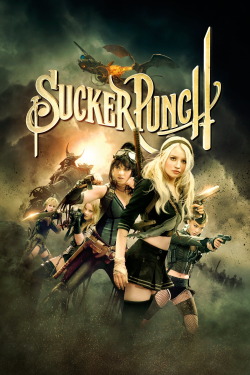
Review of Sucker Punch (2011) by Ross L — 02 Dec 2012
Sucker Punch, in the evident impetus of its conception, puts me in mind of King Kong. Merian Cooper decided to incorporate a romance into his visionary spectacle of the exotic after criticism of the lack of that element in his previous films. Zack Snyder, often pigeonholed for encoding an underlying chauvinism into his visionary spectacles of CG-age stark morality (300 and Watchmen), decided to represent a woman's perspective in his latest hyper-stylish offering. But Cooper could not but echo the fundamental conservative democratic assumptions that defined his worldview, destroying his now-beloved giant ape atop a towering symbol of the triumph of arrogant industrial hubris over wild, primitive nature. And Snyder, though he seeks to render a species of modern feminism in iconic cinematic terms, winds up reinforcing the very patriarchal structures he seeks to viciously demolish. Or... does he?
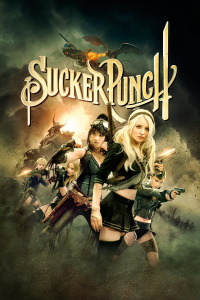
Make no mistake, Sucker Punch is constructed thematically and narratively as a case study of feminist resistance to the malevolent dominance of the patriarchy. The basic skeleton of the story involves the attempts of a young woman with the infantilizing moniker of Babydoll (the schoolgirlish Emily Browning) to escape a mental institution in Vermont that her cruel stepfather (Gerard Plunkett) has committed her to after the death of her mother and younger sister, hopefully before a lobotomist arrives to scramble her frontal lobe. Stacked onto this basic frame is a fantasy layer of sisterly solidarity between Babydoll and four other women (played by Abbie Cornish, Jena Malone, Vanessa Hudgens, and Jamie Chung) in a burlesque club and brothel whose Moulin Rouge gilding and lacing seems to be draped only loosely onto the decaying asylum that they all actually seem to be locked up in. Bursting out of this layer are fantastical action sequences of the kind that have turned Snyder into one of Hollywood's most notable geek-blockbuster auteurs (he's helming a new Superman film next), baroque visual mashups that visualize the quest of Babydoll and her collaborators to acquire the mundane objects (a map, a lighter, a knife, a key) that will allow them to break out of their prison.
This prison, mind you, is never merely literal. It is a metaphoric figuration of the larger prison of patriarchy that locks up these women against their will (the outside world, when briefly glimpsed at the start and end of the film, seems firmly 1950s in appearance and character). The personification of this exploitative, objectifying patriarchal authority is Blue (Oscar Isaac), imagined as a manipulative lead orderly in the mental hospital and a smarmy pimp in the house of ill repute. He embodies and verbalizes the restrictive assumptions of the male power structure, the focal point of the objectifying gaze that insists on its mission of benevolent protection of supposedly helpless women while limiting their freedom through threats and violence, and imposing its sexualized desire upon their bodies and their minds. Sucker Punch views feminine agency as fundamentally incommensurate with masculine will, which runs ever towards dominance and must therefore be violently turned away (Babydoll's final act of provocative resistance is, of course, a swift kick to the junk).
How is the resistance enacted by Babydoll and her fellow insurgents generally imagined, then? As a raw dance of exaggerated sexuality that transfixes sweaty men in suits and is celebrated by her fellow oppressed women, but that the audience never sees (snatches of a dance production number are glimpsed over the end credits). What we see instead is the dance of stylized hyper-violence, the commando object-retrieval missions to Oriental temples, steampunky WWI trenches, medieval castles, and breakneck futuristic trains.
Although Snyder short-circuits the traditional basis of objectification by choosing not to show Babydoll's apparently mesmeric gyrations, he unleashes the objects of desire of the male geek gaze with glee. The action sequences unveil his five female leads dispatching hordes of robot soldiers, dragons and orcs, and steam-powered zombie Germans with guns and bombs and swords, their midriffs and thighs and cleavage spilling out of leather cossetting as they slice and blast away at their faceless male drone foes. For a purported vision of feminist liberation, it all seems rather like the fevered, self-negating masturbatory fantasies of a teenage boy (especially when one of those fantasy action figures is Disney Channel ingenue Hudgens, who has gone from mooning over Zac Efron to strafing dragons with machine guns).
The question posed by Sucker Punch, however, is whether this vision of feminism is a mere failure of Snyder's metaphorical imagination or if it's a sweeping indictment of what Snyder may see as contemporary feminism's own confused muddle of ideological imperatives. Sucker Punch celebrates independent agency while simultaneously embracing the terms of patriarchal objectification and trying to appropriate them as symbols of liberation. Is this a cartoonish rendering of feminist tropes, or is it an accurately hyperbolic representation of where the discourse of feminist action stands at our present juncture? The performance of female sexuality for male audiences (through the privileged trope of male entertainment that is stylized violence) is not only the content of the film, it is also the path to freedom in the narrative of the film itself, although then only through considerable sacrifice akin to martyrdom. What, ultimately, is Snyder saying about feminism with Sucker Punch? He's saying, I think, that it's in the eye of the beheld as much as it is in the eye of the beholder. And that it's often difficult to tell the difference between the two.
This review of Sucker Punch (2011) was written by Ross L on 02 Dec 2012.
Sucker Punch has generally received mixed reviews.
Was this review helpful?