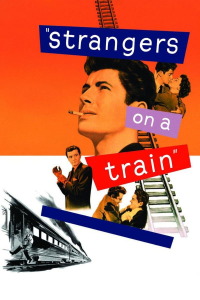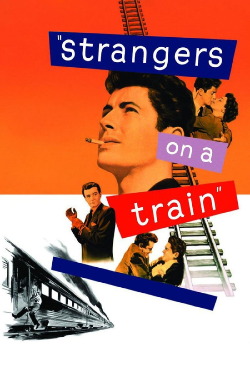
Review of Strangers on a Train (1951) by Ricardo O — 17 Apr 2010
"I beg your pardon, but aren't you Guy Haines?".
Strangers On a Train, based on the novel of the same name by Patricia Highsmith, starts with two men arriving at a train station in totally separate cars at different times. The camera is constantly on the feet of the two men as they make their way to their train. As one of the men sits down in a seat, his foot crosses another man's while he crosses his legs. The man who sits down is an amateur tennis star named Guy Haines, played by Farley Granger. Guy wants to divorce his vulgar and unfaithful wife Miriam, played by Kasey Rogers, so he will be able to marry the woman he is really in love with, the elegant, beautiful and rich Anne Morton, played by Ruth Roman, the daughter of a senator, played by Leo G. Carroll who appeared in many other Hitchcock films. The man Guy bumps into is Bruno Anthony, played by Robert Walker. Bruno almost immediately recognizes Guy knows quite a bit about Guy's marital problems from newspapers. Bruno then proceeds on telling Guy about his idea for a perfect murder. He will kill Miriam, in exchange Guy will kill Bruno's father. Nobody would suspect either of them of the crime because they are both strangers. Guy acts a bit nervous about all this but doesn't take it seriously although Bruno is very much serious about it and when Guy eventually leaves the compartment, Bruno thinks Guy had agreed to the deal. Guy leaves his cigarette lighter behind on the table and instead of trying to go after him to give it back, Bruno keeps it. When Guy arrives in his hometown, he confronts Miriam in a music store where Miriam tells him that she does not want the divorce and instead plans to live off Guy's money. Guy is furious about this especially since she is carrying another man's baby. The fight eventually escalates and are asked to stop and Guy runs out while Miriam yells at him continuing to make a scene out of it. Guy then phones Anne telling her that Miriam does not want to divorce him after all and tells her that he wishes he could just strangle her.
"I certainly admire people who do things.".
After a scene at Brunos large home where he talks with his mother, who is extremely naive about her son, and a small confrontation with his father, Bruno soon heads to Guy's hometown. He locates where she lives and follows them to an amusement park on the bus. He follows Miriam, who is there with two other men, throughout the fair from the merry-go-round to the tunnel of love and finally onto the little island that the boats stop at for a sort of "lovers lane" type of experience. While Miriam is playfully hiding from the two men, she bumps into Bruno who, after asking if her name is Miriam with Guy's lighter in his hand right in front of her face, strangles her to death. He then takes her broken glasses and the dropped cigarette lighter and gets on the little boat to get off the island and leave the amusement park. Guy later arrives at his home where he is seen by Bruno, who is hiding in the shadows, and tells him that he has done his part of the plan and that he is due to go through with his part of the plan but Guy refuses and goes back into his home where the phone ringing. Guy picks up the phone with Anne on the other line who tells him to go to her home as soon as possible. Guy arrives to her house where she, her father and her sister Barbara, played by Hitchcock's daughter Patricia, are waiting. Anne tells him the news that his wife has been murdered and that the police have suspected him of being the killer as he has the most obvious motive. Luckily he has an alibi, he had briefly talked to an older gentleman who is a professor at a college on the train on the way back from his hometown. But his alibi isn't enough because as it it turns out the man was drunk and doesn't have any recollection of Guy. A man named Hennessey is hired to constantly follow Guy wherever he goes in case anything suspicious occurs that might make him guilty.
"Wanna hear one of my ideas for a perfect murder?".
Bruno starts making increasingly more intrusive appearances in Guy's life including a famous scene where Guy looks out to the crowd of spectators during the match and the whole crowd is following the ball back and forth but Bruno's face is constantly looking straight at Guy the whole time. Afterward, Bruno is introduced to Guy by Guy's beau Anne and a French woman. When Anne's sister Barbara is introduced to Bruno, he stares at her because she reminds him of Miriam because both were attractive and wore glasses. Later on Bruno invites himself to a party being held by Anne's father and sparks a conversation with an older woman about the subject of murder. After what they think they would probably do, he then explains his idea of strangling someone to death and practices on the woman. But as he is practicing on her he catches a glimpse of Barbara and Bruno starts to really strangle the woman and he eventually passes out and is later kicked out of the party.
"Everyone has somebody they want to put out of the way.".
Bruno continues to forcibly remind Guy that he is now obliged to kill Bruno's father and gives Guy the key to his house and a map to his father's room. Guy sneaks into the house and tries to warn Bruno's father and as he is telling the man who he thinks is Bruno's father in bed, Bruno turns on the light revealing it's actually him. But proceeds on telling Guy that his father had left for the night. Now feeling betrayed by Guy who will not kill his father, he tells Guy that he will frame him for the murder of Miriam, he doesn't know what he will do just be ensures him that he is clever fellow. Eventually Guy tells Anne about Bruno and she visits his house. After having a conversation with Bruno's, still naive, mother Bruno comes into the room and lets her know that he has Guy's lighter and can plant it at the scene of the crime during the night to implicate Guy. Anne tells Guy all of this and they come up with a plan for Guy to get to the scene of the crime before Bruno can after he finishes his tennis match.
"My theory is that everyone is a potential murderer.".
The tennis match takes longer than Guy had hoped and Guy leaves in a taxi to the train station to hopefully get to the fair before Bruno. Guy ends up at the fair around the same time as Bruno as Bruno had had a few minor setbacks. Bruno is later recognized by a worker of the boats that head to the tunnel of love and the little island the crime had happened. Bruno then leaves the line leading to the boats and is then recognized by Guy who has been followed police. The men end up on the merry-go-round and they have a big struggle as one of the cops shoots the man working the merry-go-round which causes it to faster. It eventually spins out of control and crashes and causes Bruno to be mortally wounded, but still tells the police that Guy had committed the crime. Before they can put Guy in handcuffs, they find the lighter in Brunos hand after he dies, which frees Guy from any charges. The man working the line for the boats confirms that Bruno is in fact the murderer. In the final scene, Guy and Anne are seen on a train home where there is finally some hope for their future. A strange man asks Guy if he is Guy Haines, but as Guy is about to answer rather happily, he and Anne quickly get up and leave the compartment as this was identical to how he and Bruno had met and the man is left stunned.
"Criss-cross.".
Strangers On a Train was penned by Whitfield Cook, Czenzi Ormonde, the famous crime novelist Raymond Chandler and the uncredited legendary screenwriter Ben Hecht. The screenplay is filled with memorable dialogue especially the lines delivered by Robert Walker's character Bruno Anthony. Alfred Hitchcock's direction is in full effect in this film and would continue to be with his next films that were released in the '50s. The suspense he creates throughout the film is match by only himself in many of his other films. What other director could make a tennis match as exciting and suspenseful as Hitch and who else could make something as innocent as a merry-go-round terrifying? Each actor portrays their character really well. Leo G. Carroll is very much believable as the senator; Hitchcock's own daughter Patricia shows a lot of talent as Anne's sister her is seriously scared of the character Bruno especially during the party; Ruth Roman gives off enough beauty and care for Guy; Farley Granger does a good job as the innocent looking amateur pro who is framed by Bruno; but it is Robert Walker who steals the show as the villainous Bruno. He portrays him brilliantly as a flirtatious, amoral man who in some ways could also be interpreted as a bit of a homosexual especially with the way Guy and Bruno first encounter each other on the train. The way he first talks to him is more like a pickup than a chance encounter.
There is a motif of crisscross, double-crossing and crossing one's double that runs throughout the film such as: the shots that start the film with Guy's and Bruno's feet moving into the train from opposite directions. Both of them are both well-dressed and handsome. Hitchcock makes his cameo with his own physical double, a double bass. Miriam is with two men on the night she is murdered. Bruno and Miriam are doubly reflected in her glasses when she is being strangled. Barbara reminds Bruno so much of Miriam that we nearly see him strangle the woman at the party, who is also a possible double of his naive mother. Even the editing uses the crossing motif such as when Guy is on the phone to Anne and tells her that he would like to strangle Miriam and then it fades to the hands of Bruno in a strangling position; also when Bruno looks at his watch on his way to the fair and then immediately cuts to Guy looking at his watch. I'm sure there are plenty of other "crossings" in the film one can analyze.
Strangers On a Train also has some of the most brilliant visuals Hitchcock has ever had in any of his films. Robert Burks' cinematography is just brilliant throughout. From the movement of the camera to the lighting. The angles in the film are often brilliant as well from some being crooked, like Carol Reed's The Third Man, to some low angles that remind me of Citizen Kane. There's a shot that uses deep focus where Bruno is talking on the phone with Guy in his house where Bruno is in the foreground and his parents are in the background and both planes are in focus; there's also the scene in the tunnel of love where the shadows of Miriam and the two men seem to be engulfed by Bruno's shadow coming from behind. But the most famous shot of all is of Miriam's murder which is reflected in Miriam's broken glasses on the ground which uses a low angle, a close up and a superimposing of the image of Bruno strangling Miriam.
Strangers On a Train is usually considered as one of Hitchcock's 5 best films although I would rank it after Vertigo, Pyscho, Rear Window, North By Northwest and Notorious with Rebecca, Shadow Of a Doubt, The Birds and The 39 Steps following it. It is one of Hitchcock's most exciting films that is brilliant from start to finish. It also contains what might be his best ending. Unlike many of his other endings, it does not feel abrupt at all. The final scene is fantastic! Great script, great direction and just a great film. A thriller that will draw you in and certainly one of the greatest films ever made. 10/10.
This review of Strangers on a Train (1951) was written by Ricardo O on 17 Apr 2010.
Strangers on a Train has generally received very positive reviews.
Was this review helpful?