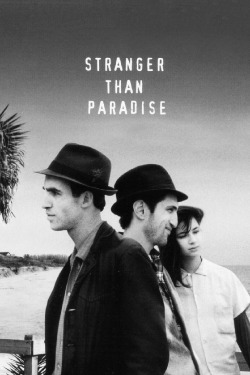
Review of Stranger Than Paradise (1984) by Harry W — 06 Apr 2014
Said to be the film that launched mysterious filmmaker Jim Jarmusch's career, Stranger than Paradise was a film I found myself drawn into watching.
Stranger than Paradise is one of the films that nailed Jim Jarmusch's signature film style very early on. It is a very different film from the usual Hollywood feature audiences would be accustomed to seeing, and the fact that it breaks so many conventions of standard filmmaking may leave some audiences alienated from it. Admittedly, I felt a lot of that because while I was fascinated with the film style that Stranger than Paradise was crafted from, I certainly didn't walk away from the film having learned too much from its plot or characters.
I guess that Stranger than Paradise is a film that really allows everything to naturally happen over the course of the journey that its characters take, but I found that the journey simply wasn't interesting. Stranger than Paradise follows three characters over the course of their journey into an international world and lets things happen naturally. And while the story feels genuine because of the natural realism in it and the dedicated efforts of the cast, it just didn't feel entertaining for me. I go to films to be entertained, and Stranger than Paradise simply failed to achieve that for me. I didn't walk away from Stranger than Paradise having learned all that much, although I did think about the nature of the characters and appreciate the realistic nature of them. But frankly, audiences that aren't ready for Jim Jarmusch's style of filmmaking aren't too likely to appreciate Stranger than Paradise unless they can feel what he is saying. I didn't feel it, I felt distant from Stranger than Paradise and that the film was a stranger to me.
I learned an appreciation for Jim Jarmusch's style of filmmaking from Stranger than Paradise though, because the way he goes against a lot of the more conventional filmmaking styles that a lot of Hollywood filmmakers follow is amiable. His cinematography is simple as it largely rests in a single position and lets the characters act everything out without a lot of emphasis on their facial expressions, instead keeping the distance so that viewers can experience it as if they are sitting in the room with characters and watching everything unfold. It is all edited very timely as well, and the fact that it was shot in black and white does help to enhance the storytelling style and how it depicts the world as a very black and white place which is largely composed of a lot of waiting. While I didn't enjoy waiting for things to happen in the film all that much, I appreciated the way that everything looked as it gradually unfolded over the course of its 89 minute running time.
The only Jim Jarmusch film I had seen prior to Stranger than Paradise was Ghost Dog: The Way of the Samurai which was a complicated character-driven film against the backdrop of a simple plot, yet I enjoyed it. The plot in Stranger than Paradise however simply did not have anything much interesting going on. While this defies the Hollywood conventions of fictionalised storytelling, the problem is that it is too much like the real world. I go on the bus when I want to wait somewhere to get somewhere but I go to movies to be entertained. With Stranger than Paradise, I simply was not entertained and would not find myself watching it again anytime soon. The film shows off Jim Jarmusch's film style, his ambition and what he can do with such a limited budget, but in terms of writing it only really reveals his skill at pitching dialogue and not so much his skill at creating a provocative story. And that combined with a slow pace and a lack of dramatic situations resulted in Stranger than Paradise feeling simply like a boring wait in a room for a friend to arrive or a wait on the bus to get somewhere. And that is not the kind of experience I tend to enjoy in a film.
Although while I didn't enjoy Stranger than Paradise overall and didn't find it to be all that funny, the script was very well written and was delivered with gusto by a strong cast. I didn't find that any actor really stood out because I didn't feel like what was happening in Stranger than Fiction was actually acting. The efforts of John Lurie, Eszter Balint and Richard Edson felt so real as if everything happened around them without them being told what to do. They let things unfold naturally and all had organic emotions and line delivery as they crossed into the long journey they take, and it made the feature a little more compelling. It isn't the best film, but thanks to the efforts of the cast and the view of the world they take thanks to Jim Jarmusch's handling of such material it is easy for viewers to likely find themselves connected to Stranger than Paradise in one way or another. The humanity in the film is gentle and subtle yet executed very finely so that it is one of the key themes in the atmosphere, and it ensures that the character driven intentions of the film are easily able to reach viewers and touch them which makes the lighthearted experience of Stranger than Fiction a little more fascinating. The cast of little-known actors all make a strong contribution to Stranger than Fiction, and they work very well with Jim Jarmusch.
So while I didn't enjoy Stranger than Paradise overall simply because of its dull plot and lack of drama or sufficient comedy, it displayed the iconic film style and writing skill of Jim Jarmusch which left me happily looking forward to his next effort as a filmmaker, so its more an ambitious experiment in independent cinema than a great final product. A lot of people will disagree with me, but in the end it just isn't the right cultural piece for me.
This review of Stranger Than Paradise (1984) was written by Harry W on 06 Apr 2014.
Stranger Than Paradise has generally received very positive reviews.
Was this review helpful?