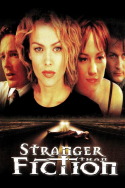
Review of Stranger Than Fiction (2000) by Han T — 13 Apr 2014
Stranger Than Fiction Film Critique.
Looking at life as a story is a view that you will experience after watching the movie "Stranger Than Fiction". The movie,written by Zach Helm and directed by Mark Forster, includes famous stars such as Will Ferrell, who plays Harold Crick, an Internal Revenue Services Agent. We are also introduced to other characters such as Ana Pascal, played by Maggie Gyllenhaal, who is a baker with strong views on where her tax money should go. Other characters that interact with Harold Crick are Karen Eiffel, played by Emma Thompson and Professor Jules, played by Dustin Hoffman. "Stranger Than Fiction" won awards for Best Screenplay in 2006 and 2007, as well as winning Best Casting Director of the Year in 2006. It was also nominated for awards such as Best Actor, Best Actress, Best Fantasy Film, and Best Motion Picture.
Stranger Than Fiction, which is set in New York City, is home to Harold Crick, who is an IRS agent that leads a very boring and calculated life. Harold Crick has a wrist watch that plays an important role in the development of this film. His watch keeps him on time and ultimately plays a life saving role in this movie. Early in the film we are introduced to a conflict that Harold finds himself in. He notices a voice in his head narrating his life. The voice doesn't go away no matter how mad Harold gets at it, and it eventually narrates that he will die. He believes he is absurd and seeks professional help to find out what is wrong with him. He is referred by a psychiatrist to seek the help of a Literature Professor, since it is believed he is living a story. Harold Crick then seeks the help of Professor Jules, a nutty professor who drinks a lot of coffee and licks his fingers too much. While Harold is trying to solve his conflict, he meets Ana pascal, the owner of a boho bakery that is famous to many locals, who he is intrigued by. Harold,who meets Ana while auditing her business, is in the process of determining whether his story, told by the narrator, is a comedy or tragedy. While we watch Harold fall in love with Ana and work with Professor Jules, we are transitioned into different scenes where we meet Karen Eiffel, a distraught author. Karen Eiffel, who suffers from writer's block in the movie, is the author of many well written novels in which each of her characters die in the end. Karen, whose face has lines of fatigue and who is often wearing pajamas and smoking, is accompanied by Penny Escher, who works for the publisher to help authors overcome their writer's block. As the movie switches back and forth, Harold eventually finds out that his narrator is Karen Eiffel. Even though Harold is told that Eiffel can't be found, he finds her after going through his auditing files. When he shows up in her apartment to inform her that she is going to kill him, Karen realizes she can't continue with her story as she is messing with a living, breathing human being. This plot, which includes conflict, and resolution, is one that also includes romance, comedy and ultimately an ending that can satisfy all of us.
An important element in this film that contributed to the overall plot of this film is the scene transitioning. Without the smooth transition of the scenes it wouldn't be an interesting movie. In this film, viewers are transitioned into different scenes containing different stories and characters. Harold Crick, who can be found in different scenes containing Professor Jules or Ana, is found in those scenes with those characters to build onto his changing story. In scenes with Professor Jules we see Harold trying to solve his conflict and in scenes with Ana we see that Harolds organized, ordinary life is unravelling into something bigger. In different scenes we find Karen Eiffel attempting to get over her writer's block with Penny. These scenes are very interesting as they show Karen trying to find a way for her main character to die by observing the happenings in emergency rooms or by imagining a car driving into a river These scenes also contain Karen's thoughts on how a novel should be written, but also how those thoughts can be applied to our story also known as our life. I think the effect of these scene transitions is to clearly create two different stories, but also to keep us from being uninterested in this movie. Also, as you watch the movie, you go through it thinking that Harold will never meet his narrator, who turns out to be Karen. It was intriguing how, near the end, we find Karen and Harold in a few scenes together. I believe that was effective because now the two stories that have been continuing throughout the movie have now joined to create a dramatic effect, but also to make their stories complete and to ultimately solve the conflict. Throughout the movie I was interested because even though the plot is foreshadowed, there are many twists and turns before you get there.
To make this movie complete, I believe special effects were added to the film to keep it light and to give us a picture of Harolds calculated life. The special effects in this film aren't the common ones that we think when we hear about special effects. Since Harold lives a very calculated life, the special effects of math equations, numbers, and pictures are put on the screen beside Harold to actually show us how calculated and precise Harold's life is. One example of the special effects found in this film is when we find Harold and Professor Jules in the washroom. Professor Jules is washing his hands and as Professor Jules goes for the soap, calculations appear on the screen telling us the volume of the soap in the dispenser, and after Professor Jules is finished washing his hands the volume of the soap is the same. The point of that special effect was to get us to actually see Harold's disgust in his facial reactions as well as the same soap volumes instead vocalizing this disgust. Another example of a special effect that was beneficial to the plot of this story is when Karen is picturing the death of a character by imagining a car avoiding a child on a bike, but as the car is avoiding the child, it ends up swerving off the road into the guardrails and crashing through them, ultimately ending up in the river. The special effect of the car falling into the river was to allow us to visualize with Karen. Every special effect in this film was to not only allow us to see but to also participate in the lives of these characters.
I would recommend this film to anyone who enjoys analyzing a plot and who enjoys doing a little thinking and exploring while they are watching movies. This movie touches at hard questions and asks viewers what their life would look like as a story. Even though the themes are very deep and strong, the movie is kept light by adding comedy and creativity through characters and special effects. At the beginning of the movie I was quite skeptical, and didn't know if I would enjoy it. However, as the plot continued I found myself deeply interested in what was going to happen next. At the end of the movie I was relieved but shocked at the same as the plot of the movie changed, for the better. Overall this movie was not only interesting but also gave me a new appreciation of life.
This review of Stranger Than Fiction (2000) was written by Han T on 13 Apr 2014.
Stranger Than Fiction has generally received positive reviews.
Was this review helpful?