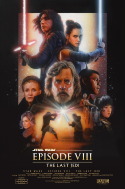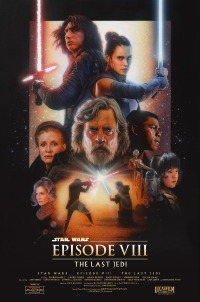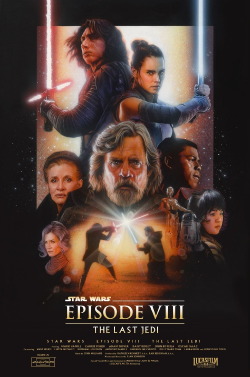
Review of Star Wars: The Last Jedi (2017) by Vic H — 29 Jan 2018
Let's get one thing clear: The Last Jedi's problems are primarily structural, not content or fandom based. Superfans, or whatever they're called, have almost completely dominated the discussion on this film, giving many casual observers the impression that the real issues relate to whether or not Leia should have 'force powers' and other -completely irrelevant- details.
The fact of the matter is that we live in troubled times with regards to filmmaking. Studios are producing films that eschew traditional pacing and storytelling guidelines in favor of high-volume, high-impact visuals and action sequences. B-films have always done this, but we typically don't expect much more from B films. While many traditional or classical filmmaking techniques have indeed become hackneyed, the trend among many newer big-budget action films doesn't offer us anything better. It doesn't really offer us anything at all.
The problem is not with the genre. Many older sci-fi, action, and comic book based films stand up surprisingly well as effective and memorable examples of storytelling. Films like 10 Cloverfield Lane and Get Out prove that solid, smart and nuanced sci-fi and horror thrillers, for example, can and do succeed in this world.
So what are the real problems with Jedi? First and foremost, the pacing is atrocious. I'm talking Suicide Squad bad. Scene structures and line delivery are basically in a 30-second commercial format, all the way through. This is something that most critics noted in their reviews, but then chose to forgive, for reasons that aren't entirely clear.
I, for one, have no problem with long runtimes. In fact, I like them, because they give many films the opportunity to properly develop their storylines. Sometimes a well-placed uncomfortable silence or lingering landscape shot makes all the difference. This is not the case with Jedi. Jedi wastes its ample runtime on multiple, muddled storylines that don't strongly relate to or build upon one another. This was also noted and dismissed by most critics.
Regarding the overall tone of the film, it neither fits in with the series, nor stands on its own. I don't mean to suggest that Jedi should have just 'fallen in line', as many successful film series' vary in tone throughout their entries. Army of Darkness made a fairly dramatic departure from the previous Evil Dead films, 10 Cloverfield Lane was practically a different genre from Cloverfield. Jedi just comes off like the product of a disrespectful and uninterested director, on the other hand. Considering that Rian Johnson was neither of these things, we can say that his failure was of a very serious nature.
When Luke takes the lightsaber and throws it over his shoulder, this is not shifting Star Wars into new territory with interesting and unexpected resonances, this is lowering the film to the level of a throw-away, emotionally uninvested and self-consciously ironic sitcom. When the spaceship turns out to be a clothes iron, it feels like Rian Johnson is playing with us. He's wasting our time with distracting experimental touches better left to high school film projects. In other words, Jedi is the Portlandia of the Star Wars series, an unneeded and unwelcome departure. The Force Awakens may have been overly predictable, but at least it took itself seriously.
Unfortunately, we don't improve our view by focusing on specific plot elements within the film, because, in a sense, nothing happens.
What are the major story arcs?
Luke Skywalker thinks that the Jedi Order needs to be destroyed. Good so far, this arouses our interest with an unexpected position. He advances some valid seeming critiques of the Order. Many in the audience, myself included, are at least partially convinced. This sort of surprising emotional engagement makes for a story that's both engaging and progressive: now we're getting somewhere that we hadn't predicted. BUT, as it turns out, Luke was just having commitment issues. He didn't want to take responsibility for some previous questionable decision making, and was evading the issue. Never mind his previous critiques, of course the Jedi need to continue. This doubling-back plot device isn't a bad one in and of itself, it's just executed poorly because, in the end, many of us in the audience lack the necessary emotional attachment to the Jedi to make the "of course the Jedi need to continue" argument self-evident. This device would work in a story where the equivalent institution was actually so self-evidently good that we felt guilty about having been convinced that it should be abolished, and then relieved when it wasn't. Instead, we are left feeling like Rian was just playing with us again, throwing out an interesting idea only to snatch it back in the name of... what? Convention? Oh and Luke dies, of exhaustion. Because he hologrammed too hard in order to buy the last remaining resistance members enough time to escape from a cave.
Rey is told that her parents are nobody. This is meant to be a plot twist, but she is told by someone who may have a motive to lie to her, so this might not be true. Nothing there either way.
Fin's relationship with Poe fails to develop. Rose, through no fault of Kelly Marie Tran, is a throw-away character, as evidenced by Rian's admission that the original plan was for Poe and Fin to go on the Casino adventure. How does Rose shape or influence the plot? What does she actually do? Chide Fin into not running away from the fight? That was the same internal character conflict as in the last film. Nothing new there.
Rey refines her magic skills so that, whereas before, she wasn't able to lift heavy rocks, now she is able to lift heavy rocks. Leia has magic powers... no problem there: she's Luke's sister.
Poe disobeys direct orders. A mutiny brews. Poe is defeated. The original plan goes through, so Poe's defeat is essentially a cynical plot device with little practical consequence and thus no emotional weight. Holdo sacrifices herself, but since we didn't really get to know who she was through character development-- oh wait hold up, a ship is exploding!!!
The Supreme Leader, after being given zero background development, is dispatched with a magic parlor trick.
Kylo Ren declares that the whole game is a farce and that he wants to destroy both the Empire and the Resistance, including the Jedi Order. Once again, an interesting proposition with the potential to move the storyline along in a dramatic and unexpected direction. Once again, this is a male character (almost) doing the real plot moving. The fact that his goal actually aligns with Luke's in significant ways (at first) is never really addressed, which seems like a missed opportunity. Kylo asks for Rey to join him in ruling the galaxy in some sort of nonpartisan or nondenominational dictatorship. We never find out if Kylo has more specific goals than simply ruling. Now, I agree with many that Kylo is an irredeemably bad man, and that he as an individual should fail in the long run. The thing is, Kylo's failure doesn't have to be the result of a simple, linear battle between obviously opposed forces. Stories tend to be stronger and more engaging when lines are blurred and trickery is introduced.
Imagine what the reaction would have been like if Luke had held on to his prior convictions and Rey had accepted Kylo's offer. We would have been left on the edge of our seats, dizzy with anticipation for the next film, desperately curious to see what the heck was going to happen! Would Rey use her new position as Kylo's supposed ally to secretly undermine his efforts? Would the Jedi and Sith reemerge of their own accord from the ashes of the old world, as it were, implying that they are just somehow integral components of the universe? Would entirely novel configurations arise? How would old series characters interact with this new world?
So what does that leave for actual, substantive plot progression? Kylo is now top dog. The resistance has lost its primary fighting forces. Luke will have to do things as a ghost from here on out. Am I missing anything? 2 out of 3 those of points that could have been summed up in a text crawl.
This review of Star Wars: The Last Jedi (2017) was written by Vic H on 29 Jan 2018.
Star Wars: The Last Jedi has generally received positive reviews.
Was this review helpful?