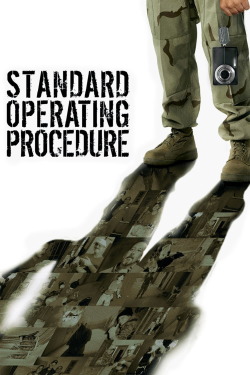
Review of Standard Operating Procedure (2008) by Marisol L — 20 Oct 2008
"...we thought it was unusual and weird and wrong, but when we first got there the example was already set. That's what we saw.".
-Lynndie England.
It is the nature of a photograph to suggest time and space beyond the moment and the frame. In other words, it is in the nature of a photograph to conceal, distort, and lie.
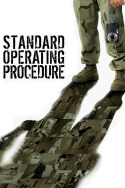
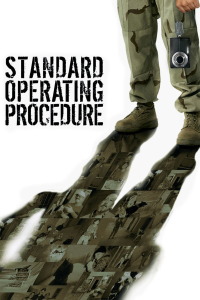
Errol Morris' new film on the Abu Ghraib photographs, Standard Operating Procedure, employs military personnel present at the events, who were captured in the photographs, in constructing the narrative that surrounds and informs the photographs' contents. No explicit information is ever expressed from the perspective of the film. The film consists of interviews, photographs, letters and primary documents, brief reenactments, and a few artistic flourishes, but is not itself investigative. It is contemplative.
It is revealed that systemic abuses were committed at Abu Ghraib. Often soldiers did not know who they were humiliating or abusing, what they were meant to be accused of. It "just seemed normal to deprive people..." One soldier remarks that many people were brought to the interrogation facility after having been rounded up indiscriminately at villages. All adult men were taken from their families and imprisoned, "taxi cab drivers," "bakers," whoever.
A story is related of a man brought to Abu Ghraib after being interrogated. He was held in a stress position for a long period, and the soldiers admit to making jokes about him. He did not move. It was not until blood began pouring from beneath the burlap sack over his face that they realized he had been dead the entire time. Detainees were sufficiently dehumanized that it was not immediately apparent the man was dead. Official reports say he died of a heart attack in the shower, but the photographs prove this untrue.
One interviewee is an experienced interrogator. He remarks on how the methods used were utterly inept and ineffectual. He remarks that the personnel were young, foolish, inexperienced, and ill equipped to make any decisions. They were intimidated by their superiors, and a grotesque culture developed in the prison that encouraged all manner of creative subjugation and humiliation.
Another interviewee is an investigator who constructed the timeline of photographs for the prosecution. Any time there was physical or sexual abuse, a crime was committed. When a soldier passively photographed a detainee beating his head against a wall, perhaps to commit suicide, it was a crime for dereliction of duty. However, handcuffing the arms of a detainee behind his back and having him hang from a window with women's underwear over his head, or having a sleep-deprived man stand on a box with wires hooked to his hands, which he was deceptively told were charged with electricity that would shock him if he left his perch, are deemed standard operating procedures. Telling of his time in Desert Storm, the investigator remarks "people that haven't been where I've been, I can't expect them to see the pictures in the same way.".
The events of Abu Ghraib recall Philip Zimbardo's Stanford Prison Experiment. However, we would hope that, having given into a culture of brutality, the reawakened, as it were, guards would feel a terrible remorse. It's unfortunate the lack of sufficient regret betrayed by the language and mannerisms of the soldiers that perpetrated these acts. Occasionally it is remarked that the actions were morally wrong, as if this is an intellectual but not relevant fact. It is more often remarked or implied that these men and women would be content if the events were never photographed, "beneath a rock," lost to history (at least, the history that matters, I suppose). That is disturbing, and makes the events further tragic and repugnant. The soldiers have the look of children caught in the act, but not sorry the act had taken place. I frequently felt they were truly horrible people who have not interrogated their own basic racism and bigotry.
Standard Operating Procedure is an incredibly accomplished film. It encourages searching beyond the frame that is given to find the context and the greater truth. The official story is that Abu Ghraib was full of bad apples. The barrel was out of frame.
No one above the rank of Staff Sergeant was prosecuted for the crimes of Abu Ghraib.
This review of Standard Operating Procedure (2008) was written by Marisol L on 20 Oct 2008.
Standard Operating Procedure has generally received positive reviews.
Was this review helpful?