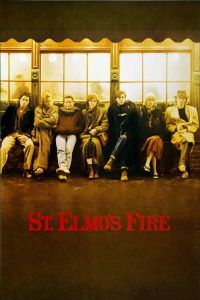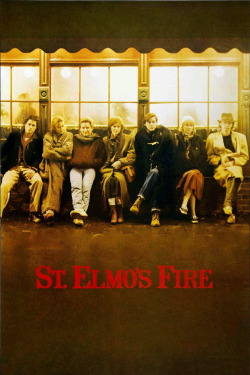
Review of St. Elmo's Fire (1985) by Grant H — 24 Oct 2014
Review In A Nutshell:
I never thought I would ever enjoy St. Elmo's Fire. When I watched this film during the height of my 80s/John Hughes obsession days; I felt this film lacked a certain punch or quality that made me fall in love with Hughes' films, stories and characters. I think what was missing back then in my initial experience was my ability to empathise and my lack of experience. It has been nearly six to seven years since my previous viewing, and during all that time I have learned so much about life and my self-awareness has improved dramatically, allowing me to pinpoint the flaws and strengths in my emotional and psychological physiology. I am currently two to three months from graduating from college or university, and so immediately seeing these set of characters first walk out of their campus lined up together, I was emotionally drawn.
St. Elmo's Fire is less about the story, but more about the themes it explores. It never at any point sets itself a goal for the audience to hook themselves onto; we are simply treated as viewers behind a screen, observing their daily lives and struggles, hoping to gain something from the experience. I was fortunately able to attach myself to the film's ideas of independence, personal growth and maturity, friendship, relationships, and obsessions. By the end of it, I was both afraid and excited for what life has to offer, once I step out of those college gates, hoping that I would have the resilience to survive even the direst of moments.
The film offers us a large set of characters to follow, but the film does not make it difficult for the audience to be invested in each one; it is usually a common tendency for films with a large and focused cast to have the majority of the player be lost in the shuffle, and prioritising only one or two of the pack. The film achieves this smooth spread through its editing, the film is compiled side by side with moments that are random but are connected by the film's slow character development. Audiences will find the film's appeal if they attempt to not analyse the story, but instead analyse and identify with the characters. Though if I could point out a flaw in the film's script and direction, it would be in regards to Emilio Estevez's predicament, as the emotional reactions and logic that came out of it felt ridiculous; as if one does not feel a tad bit frightened of his persistence, if you have seen the film, then you would know what I am talking about.
The element of the film that felt underwhelming was its technical aspects. Do not come into St. Elmo's Fire to find any style to its cinematography or a hard hitting musical score; though the latter was better executed than the former. The aspect of the film that should be praised is its performances. The cast of the film delivers neither overwhelming or underwhelming performances, displaying a sense of tightness and focus in their performances but also given enough room to express improvisation; there were just so many moments in this film that felt so unpredictable and ridiculous, that I find it hard to believe it was all scripted or handled with tight direction. This improvised quality allows their roles to breathe and become more than just types; we define these characters not by their career or interests, but by their reactions to a given moment.
St. Elmo's Fire is not the quintessential 80s or coming of age film, but it is a strong performance driven film, with approachable themes and ideas, and sometimes that's enough.
This review of St. Elmo's Fire (1985) was written by Grant H on 24 Oct 2014.
St. Elmo's Fire has generally received mixed reviews.
Was this review helpful?