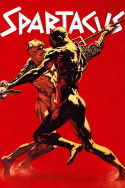
Review of Spartacus (1960) by Kendall I — 28 Dec 2011
As Stanley Kubrick's breakout film, Spartacus must have been seen as a remarkable accomplishment for the director at the time of his release. Moving from some good but small-scale noir dramas to a massively budgeted and sprawling historical epic must have seemed impressive at the time.
However, compared to some of his later films, Spartacus underwhelms as a well-made but overly conventional historical epic. It shares a lot of blood with the other epics of its time period, such as Ben-Hur or The Ten Commandments, and though it holds up well in comparison, it suffers from an inflated length and a rather simple moralistic view, in sharp contrast to the ambiguous genius of some of Kubrick's other work.
It also lacks that certain "something" that Kubrick brought to his hallmark work, mainly due to his lack of creative control over the movie. After all, he was only brought in as a replacement for Anthony Mann, and while Dalton Trumbo's script is impressive, it does not hold the same weight as Kubrick's auteur work.
Luckily, the film is remembered fondly, due to Kubrick's skilled direction and the strong performances from its actors. Kirk Douglas gives one of his most memorable performances as the eponymous gladiator, making Spartacus a memorable, likable, charismatic, and identifiable hero.
The legendary Laurence Olivier gives a strong and occasionally unsettling turn as the antagonistic Crassus, making the Roman consul a villain with depth, a man who fears the break Spartacus brings to the order of Rome, no matter how foul or flawed that order might be.
Peter Ustinov earns his Academy Award (the only acting Oscar for a Kubrick film, no less) as Batiatus, a character filled with charisma, cowardice, greed, and a lot of excellently written dialogue (some improvised by the actor himself).
Jean Simmons plainly succeeds at making herself the object of Spartacus' desire in Varinia, and Charles Laughton portrays quite a morally ambiguous character in Senator Gracchus. The only casting misstep (in my opinion) is Tony Curtis as Antoninus.
To me, he was a little too wide-eyed for the part, and his accent seemed out-of-place with the rest of the cast. A film that I believe shares quite a kinship with Spartacus is Ridley Scott's Gladiator.
I believe that Scott took the concept of Spartacus and streamlined it, making a better film in the process. Spartacus occasionally falls under its own weight, but it's still an emotional and intelligent epic, and worthy of the canon of its legendary director.
This review of Spartacus (1960) was written by Kendall I on 28 Dec 2011.
Spartacus has generally received very positive reviews.
Was this review helpful?