Review of Son of Saul (2015) by Mikael K — 24 Mar 2016
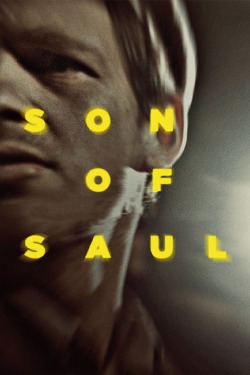
"Saul fia" is a unique, extremely powerful and potentially traumatizing cinematic masterpiece. A debut of Hungarian director László Nemes and co-writer Clara Royer, the film is a horribly realistic vision of Auschwitz-Birkenau in 1944. The unfathomable horrors of the concentration camp are shown from a singular perspective: the Hungarian protagonist Saul is a member of the Sonderkommando, a group of typically Jewish prisoners who were afforded extra rations and liberties for assisting in the mass extermination of their fellows. They were executed after their service which averaged around three months.
The film opens as a new shipment of prisoners arrives and is guided by Saul and his peers to the gas chambers. As members of the Sondercommando, their job is to get the prisoners into the chambers with no panic arising, collecting their goods for processing and cleaning up the chambers from signs of genocide by the next batch. They are in a hurry. The Allies are closing in, the amount of destruction is scaled up, just in case. The opening is sickening to watch and especially to listen to.
As Saul cleans the floors of the gas chamber he discovers one young boy has survived the gassing. He is taken to an autopsy after getting suffocated by the doctors. Saul realizes that the boy must be his son, and decides to do anything in order to give him a proper Jewish burial instead of the ovens. We follow Saul on a desperate quest to retrieve the boy's body and escape just long enough for a burial. He also roams the camp for a rabbi to perform Kaddish for burial.
Saul is played by New York -based poet Géza Röhrig. He hasn't acted in anything else for almost three decades and is completely brilliant in what must have been an incredibly painful role. He plays a hollow man, but his hollowness is a force of nature in and of itself. His dead eyes still haunt me.
The entire film is shot with virtually one take. Cinematographer Matyas Erdely's camera follows Saul intensely as he walks through the unfathomable inferno of Auschwitz for two days. Shallow focus shows Saul clearly while his surroundings remain blurry. The aspect ratio creates a claustrophobic box around him. We see all the horror but can't make it out in detail. We hear everything.
I'm not entirely sure about the suggestive approach; it's certainly better than showing everything in focus but in a reduced manner. A clear, realistic depiction of all that we know went on might simply be too much for any audience to bear. Also, one of the most chilling points achieved by the shallow focus is in conveying the complete sense of detachment Saul feels about the things he sees and must participate in. He exists beyond morality, even beyond survival until he reconstitutes through his son. But for his quest, he's already dead. This also shows us viewers how easily we all get detached. People become bodies become waste out of focus. Just like when psychological dehumanization takes effect.
At times the movie feels even tedious while it conveys absolutely incomprehensible cruelty in action. That tedium is intentional. Two hours is enough for one to turn apathetic in the face of genocide. A lesson frighteningly current. And not only in the film's homeland where antisemitism and general xenophobia seem to have emerged as the new normal but also all around Europe as well as the rest of the world. We are weak, fearful and passive, and because of that we can turn into vessels for acts of absolute evil.
"Saul fia" is one of those movies that I find powerful- even masterful- in the extreme but so traumatizing on so many levels that I can't directly recommend it to anyone. It exposes humanity at its weakest, darkest and most dangerously passive, just as it exposes every viewer.
This review of Son of Saul (2015) was written by Mikael K on 24 Mar 2016.
Son of Saul has generally received very positive reviews.
Was this review helpful?