Review of Somers Town (2008) by Ian D — 27 Aug 2008
Shane Meadow's has proven himself since the early 90s as a true British filmmaker. His films focus on British people in rural British areas, avoiding the problematic tag of realism, but existing as a gateway into the lives of their protagonists and the people around them. Often they are humorous but display a menacing undercurrent which comes to the fore towards the end of each film. 'Twentyfourseven' (1997) was arguably the film in which Meadows found his feet in terms of style and tone with 1999's 'A Room for Romeo Brass' very similar in these aspects. It was 2004's 'Dead Man's Shoes' however that really began to get peoples attention. A smart and unashamedly emotional journey of revenge which transposed a typically American narrative into a small unassuming Nottinghamshire village, the film won over critics and the modest audience that it reached. 2006 saw Meadows release the most eagerly anticipated film of his career, 'This Is England', a universally appraised picture which has made Meadows just about as big as he can be considering his modest approach to filmmaking.
Given the various limitations placed upon a British filmmaker who isn't willing to jump ship and ply his or her trade in Hollywood, it is hard to achieve a level of prolificacy. Meadows is one of the only filmmakers who is consistently awarded funding from the UK Film Council and he still has to find further sources of financial aid with Warp Films having recently invested in his projects. Unlike in the Hollywood film industry, there is no money ready and waiting to be pumped into British film. There is a lot of red tape and government involvement; independent investors are often the only viable way of raising the necessary money to fund a feature film. Unfortunately, Britain just isn't the right place for aspiring filmmakers and this is one of the reasons that Meadows is valued so highly by our critics. In some ways he is an anomaly, he has beaten the system whilst still being embroiled in it and 'Somers Town' is clear evidence of this.
The cynical have been all too quick to point out the fact that 'Somers Town' is little more than an elaborate advertisement. The film was commissioned and funded by an advertising agency called Mother, of which the European train service Eurostar is a client. As a result of this, Eurostar features in the film quite prominently (although not as prominently as you may have been led to believe) and one would assume that they are expecting to reap some benefits from their involvement in the project. I suppose there are two ways of looking at this; the first being that it doesn't really matter. Yes, the name is dropped once or twice, the company benefits from a character singing its praises and a sequence sees its services being used successfully, but the film is not about Eurostar. The film is about characters, their relationships and the journey that these relationships take them on. The second way of thinking is that Eurostar's involvement ruins the film completely, that Shane Meadows has sold his soul to a corporate company and that such a union between art and business sets a dangerous precedent. I'm afraid I don't have much time for those who belong to the second school of thought. Perhaps you should consider the aforementioned factors that may have forced Meadows into making such a decision. Perhaps you should also stop reading my review - I feel that your narrow-mindedness may prevent you from engaging in any active thought regarding this film.
Eurostar's involvement in this film is a factor only in its production; scarcely does it encroach on the film's artistic merit. Meadows doesn't compromise his style of filmmaking in the slightest, he provides a film that fits seamlessly into his already strong body of work. 'Somers Town' is a lighter affair than his previous efforts and there is perhaps room to suggest that Eurostar have influenced the film in this respect - it is unlikely that they would have been willing to enter into a joint venture with Meadows if the film had a darker edge. This is a minor detail however, as Meadows' films have often verged on comedies of their own kind, 2002's 'Once Upon A Time in the Midlands' being a prime example of this. I personally am quite glad to see Meadows embrace the light-hearted quality of his previous films. He has offered us plenty of gloom in the past; 'Dead Man's Shoes' is deliciously dark, so why not go the other way?
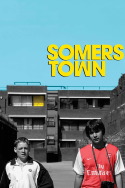
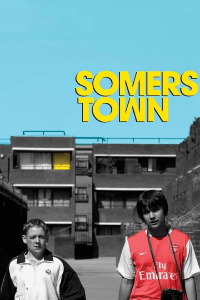
'Somers Town' has a very reductive feel to it. It evokes the work of Loach and Leigh in this respect, but stops short of achieving the same level of grit that these two champions of realism have delivered throughout their careers. Meadows is a sentimentalist, his films come across as nostalgic and heartfelt and this is why they cannot be considered as realist texts. One gets the impression that there is a little too much of Meadows himself in the mix for them to be considered impartial or detached enough to achieve realism. 'Somers Town' furthers this nostalgic trend in his filmmaking which is evident in his frequent choice of youthful protagonists; here we have Tommo, played by a slightly older Thomas Turgoose. The film, although contemporary to a degree, is not set in the present, a factor that is heightened by Meadows' use of black and white film stock. Meadows alluded to the autobiographical element of 'This Is England', a slightly worrying admission, and it is perfectly feasible that 'Somers Town' shares the same personal inspiration. Throughout the film's short but sweet running time (75 minutes) I got the sense that I was looking back at something dear to someone and it was a nice feeling.
The film tells (or recalls) the tale of a young boy from the Midlands who runs away to London for unspecific reasons. Upon his arrival he is mugged and beaten up by a group of local youths, leaving him with no way of getting home. Eventually he meets Marek, a Polish boy who is roughly the same age. As their youthfully volatile relationship blossoms, we see them fight for the attention of a beautiful French waitress named Maria and perform odd jobs for a local resident played by Perry Benson. The narrative is sparse, and that isn't for everyone but there is a certain charm to it. Meadows is best at invoking a mood, portraying characters when they are at their most normal. He does this through the use of lyrical montage sequences, often free of dialogue, which give an insight into a character that is somehow more in depth than the usual introduction methods.
The film's foremost dynamic is the relationship between Tommo and Marek, and this is sometimes hard to watch. Too soon I felt annoyance at the childish behaviour of Tommo's character and this blocked out much of the affection that I felt I was supposed to feel. Despite being older, Turgoose provides the same whiny performance that he does in 'This Is England' and this is no longer endearing. It isn't that I wished his character would act more grown up, rather I wish that he had delivered a performance that was different to the capacity in which he has already been seen. I believe that he has a small role in the upcoming British horror film 'Eden Lake' as part of a gang - but on face value alone I would assume that this will be more of the same. Meadows has given Turgoose a wonderful opportunity and I am not sure how many more he will get if he doesn't start to deliver varied performances. Now 16, I think that he will find that the offers will stop coming in if he doesn't diversify soon.
Despite the film's obvious focus on Tommo and Marek, the more interesting dynamic is between Marek and his father, Mariusz. In one of the film's subplots, the relationship between father and son and the reasons for their leaving Poland are subtly explored. There is a melancholy touch to this aspect of the story, clearly regret and remorse are feelings that Mariusz has to deal with both for personal reasons and the effect that his past actions are having on his son. I would have liked to have seen more made of this particular strand of narrative, possibly as a result of my dislike for Turgoose's character, but existing as a thoughtful aside it offers depth to both characters, enhancing their relationship with each other and the audience.
As with 'Dead Man's Shoes', Meadows crafts a world that is free of outside interference. 'Dead Man's Shoes' sees no police involvement, despite the numerous acts of murder committed in a small village setting where news spreads like wildfire. Similarly, at no point are we privy to the reaction of Tommo's parents that he has run away, there are no search parties or even any question that Tommo will return home. His and Marek's friendship is one that is not subject to the normal 'rules' of the world, rather they exist in a time and place where it is possible for a 15 year old boy to run away and build an entirely new life for himself with no stigma attached to his actions. There is a certain fairytale quality to the whole thing, there are no consequences and no worries only those that arise from the difficulties of living away from home at such a young age.
My favourite part of this film is the ending, which I feel in many ways makes the whole experience worthwhile. Shot in colour, and therefore in stark contrast to the rest of the film, the end sequence plays out like a dream in which both Tommo and Marek take a trip to Paris to meet up with Maria who leaves unexpectedly halfway through the film. The sequence itself is a montage structure about 3 minutes in length and is backlit by a trademark acoustic song, the type of which that Meadows frequently uses in this type of sequence. An adequate comparison would be the sequence in 'This Is England' where Shaun throws his Union Jack flag into the sea. Beautiful is but one word to describe it but there are many more. I found this sequence emotional for two reasons; first of all I was happy to see Tommo and Marek reunited with Maria and hopeful of the group's lasting friendship. Secondly, I was saddened by the realisation that the sequence's aesthetics and unrealistic narrative point towards the conclusion that it is not real. I was impressed by Meadows' ability to arouse these opposing emotions and was left thinking about it long after I left the cinema.
'Somers Town' may not be everything that Meadows' devoted fans wanted. They have come to expect violent and challenging scenes and this film offers none. A film can be criticised for what it lacks, but only if the present components justify this lack. 'Somers Town' is a film that is buoyed by its breeziness, to suggest that an audience is left wanting by its cheerful disposition is a bit short sighted - there is nothing wrong with a film that attempts to spread happiness. Whilst some of the aspects of this film are below par, chiefly the character of Tommo, there is still a great deal of things that are impressive and engaging. A brilliant soundtrack and distinctive look help to generate a positive experience for those who see it and although this film will not catapult Meadows to the next level (whatever that may be) it is certainly a welcome addition to his filmography.
It seems a little trite to again proclaim Shane Meadows as the saviour of British cinema, but faced with the inherent difficulties of making films in this country he is doing remarkably well at delivering consistently popular films. 'Somers Town' may not be his best to date, but it is certainly not a bad film and as long as he continues to get funding, from wherever it may come, the British film industry will be better for it.
This review of Somers Town (2008) was written by Ian D on 27 Aug 2008.
Somers Town has generally received positive reviews.
Was this review helpful?