Review of Solaris (2002) by Jody B — 21 Oct 2009
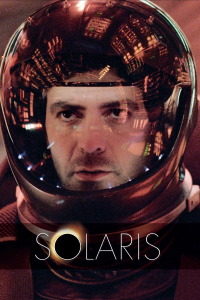
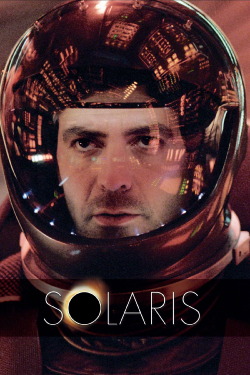
?How far will you go for a second chance?? is the question that Steven Soderbergh?s latest film Solaris pursues. The plot centers on psychologist Chris Kelvin (Clooney), who is sent as a last ditch effort to recover any survivors on a space station that is orbiting and studying the planet Solaris.
Kelvin arrives to find the commander mysteriously dead, another crewman missing, and two survivors that will not talk about what has happened. Snow (Jeremy Davies, Daniel Farady in "Lost") talks in circles (?I could tell you what happened, but you won?t understand until it happens to you. So there?s no point in telling you.?), while Gordon (TV actress Viola Davis) will not come out of her room.
Kelvin soon experiences what the others did when he wakes up next to his wife (McElhone) who has been dead for several years. However, time has not passed for her, and Kelvin has to revisit painful memories to make sense of what is reality and what is not.
Executive produced by James Cameron and based off the novel by Stanislaw Lem, Solaris is a good comeback from Soderbergh?s fiasco Full Frontal. It was beautifully filmed by Soderbergh himself (under his pseudonym Peter Andrews) with subtle overall tints of blue. The visual effects of the planet itself are simple but fabulous all the same. Every shot is long and very slow-moving, but that is not to say they are boring in any way. The pace of the film itself (as well as the characters in it) moves along in way that is never hurried, yet it is intense enough to keep the viewer anxious for the next scene.
However, it is not the visuals, but the sound (or quite frankly, the lack thereof) of the film that give Solaris its amazing sense of atmosphere. This is without a doubt one of the quietest movies Hollywood has produced. The lack of noise and sound effects in this film is much more effective than the usual explosions and roars that would be typical in other sci-fi films.
Ultimately where Solaris succeeds is the emotional (rather than physical) intensity it radiates. The characters, more often than not, are looking directly into the camera when speaking - a technique usually avoided by most directors because it greatly increases the intimacy between the character and the viewer. The only thing the film suffers from is the surprisingly poor acting by the entire cast except Clooney, who is marvelous in this film.
The film was initially rated R due to two scenes of Clooney?s nude rear end, but Soderbergh was able to argue the MPAA down to a PG-13. This is a very enjoyable sci-fi film as long as the viewer is prepared for drama rather than action and thrills.
This review of Solaris (2002) was written by Jody B on 21 Oct 2009.
Solaris has generally received positive reviews.
Was this review helpful?