Review of Solaris (2002) by Phil C — 30 Jan 2011
I've seen both filmed versions of Stanislaw Lem's book: They're about as different as chalk is from cheese, but they explore the ideas which lie at the heart of Lem's work in differing ways.
"Solaris" itself is a planetary-scale energy phenomenon which appears to be both sentient and concious: In an attempt to communicate and interact with whoever comes to observe (or possibly exploit) it, it's capable of creating perfect duplicates of "significant others" from the memories of participants - without realising the potential psychological damage this would cause if they're dead, possibly because it has no concept of mortality.
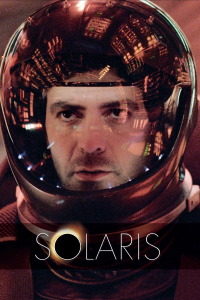
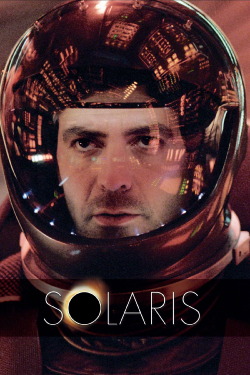
The way Stephen Soderburgh has envisioned his version is as a "haunted house" story which happens to be set in space; The interactions between George Clooney's Chris (sent to a remote space station in orbit to investigate why the crew are going missing or mad) and Natascha McElhone's Rheya are virtuoso acting performances which could happen anywhere where rooms exist, but the "extraterrestial intelligence" element gives her a chance to return from the dead (and completely upset Chris's applecart) without the film becoming "Ghost".
In their original life together, Rheya committed suicide as their relationship disintegrated: In this "second chance", she is abandoned in an escape pod by him and then drinks liquid oxygen to kill herself again, the unhappiness of their life together inevitably leading to events re-staging themselves.The main supporting character (I thought Jeremy Davies was simply playing himself!) is Viola Davis's bugged-out doctor, who constantly sounds warning notes about their resurrected relationship with such observations as "It's a mistake to become emotionally involved with one of them. She's not human!".
On the subject of Solaris itself, his friend Gibarian (who's been in the morgue the whole time) comes to him in a dream and chips in with "why does it have to want anything?". We're used to aliens either wanting to befriend us or obliterate us, always in a basically humanoid form - this is a "what if" with a much more intellectual and cerebral "take" on the possibilities, crossed with a gone-wrong love story which is finally resolved in a 2001-style series of godlike interventions by the planet.
Cliff Martinez's bleakly beautiful electronic soundtrack heightens the atmosphere and complements the experience of a film that isn't a barrel of laughs, but isn't meant to be - it's about the underpinnings of the forces that draw us together as humans, and the consequences that arise from them.
This review of Solaris (2002) was written by Phil C on 30 Jan 2011.
Solaris has generally received positive reviews.
Was this review helpful?