Review of Since Otar Left (2003) by V H — 04 Jul 2004
When I walked in to the lobby to purchase my ticket, the guy behind the counter greeted me with "Hey! It's my favorite customer!". At first I was taken aback. Do I really see that many movies? Does this guy think I'm some kind of obsessive movie freak? But then pragmatism kicked in. So what if he thinks I'm a freak; will he let me in for free from now on? We shall see.
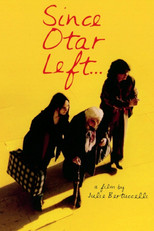
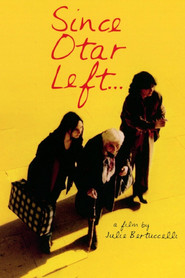
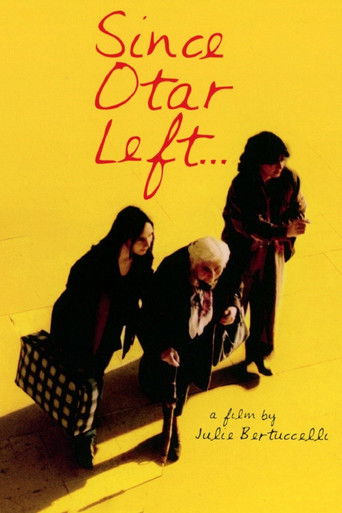
"Since Otar Left" is about three generations of women sharing an apartment together in the city of Tibilisi, Georgia, in the former Soviet Union. There's elderly grandmother, Eka, her middle aged daughter, Marina, and student granddaughter Ada.
Eka absolutely adores her son Otar, a doctor who several years earlier ran off to Paris as an illegal immigrant to try to find work. Eka lives for Otar's letters, which because of her failing eyesight, Ada must read to her. Sometimes Otar sends money to help the struggling family. Occasionally he calls. He is truly the light of Eka's life, though Ada is a close second. Naturally, this doesn't go over well with Marina, Otar's sister. Though she cares for Eka on a daily basis, the absent Otar is clearly the favored child and Marina resents him for this.
Everything changes one day when, while Eka is off at her country house, Marina gets a phone call saying that Otar has been killed in a construction accident. Knowing that this will break her mother's heart, Marina decides to keep the news from Eka, hoping that she'll die without ever learning the truth. She enlists her reluctant daughter Ada's help is perpetrating the ruse.
Though unconvinced that it's the right thing to do, Ada begins writing letters purportedly from Otar to Eva, embellishing them with news of a good job, friends, and trips to the opera. The letters contain excuses as to why Otar can no longer call, and Marina borrows money to include in the envelopes to make Eva think that he's still helping the family out.
All is going fairly well until Marina and Ada take a trip of their own to the country house. While they're away, Eka, whose health is failing, sells the family's treasured collection of French literary works to buy plane tickets and arrange visas for all three of them to visit Paris to see Otar one last time before she dies. Uh oh. Looks like the jig is up.
Then, just as the movie was approaching its dramatic climax, I fell asleep. For a really long time. When I opened my eyes the credits were rolling. Drat. As this was a mid-week late show screening, it was very sparsely attended. I staggered out of the theatre and as I stood there groggily unlocking my bike, I asked almost every non-scary looking person who exited if they'd just seen "Otar", hoping to ask about the ending. Unfortunately, "Coffee and Cigarettes" ended at almost the exact same time, and everyone I asked had seen that instead. Apparently, only the scary-looking people had seen Otar. Double-drat.
I decided to read reviews online to try to piece together the ending. Then I read the review by Andrew Sarris of the New York Observer which said this: "What happens next is so unexpected and so emotionally complex that I would be a cad to reveal it." Doh. I had no choice. I had to go back.
I returned to the theater the next night, carefully calculating the time when I should arrive to be sure to catch everything I'd slept through, yet not have to re-watch too much of what I'd already seen. I hoped the guy who called me his "favorite customer" would be there to let me in, but my plan was thwarted by locked theatre doors. I thought I saw a figure huddled behind the concession stand, so I pounded on the door until they heard me. The woman who came to the door seemed a bit befuddled by my request, but agreed to let me in. Unfortunately, I was a little too late. Though I saw the top-secret, blathering-cads-only ending, I missed some stuff leading up to it. Apparently, I was a sleep a bit longer than I'd thought.
So I'm giving this movie a rating of 8 based on how much I think I would've liked it if I'd actually watched it in a non-drowsy state from beginning to end. The 90-year-old actress who played Eka was outstanding and portrayed the character as a wonderfully strong yet sympathetic little old lady. She was a joy to watch. Although this movie had high sap potential, it never really succumbed. It's well worth seeing, but if you tend to fall asleep when you read, you might want to drink some strong coffee first.
This review of Since Otar Left (2003) was written by V H on 04 Jul 2004.
Since Otar Left has generally received very positive reviews.
Was this review helpful?