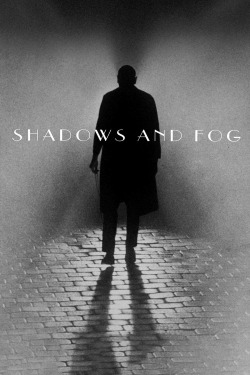
Review of Shadows and Fog (1991) by Caleb M — 07 Oct 2010
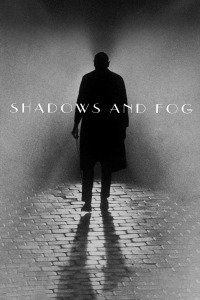
In Shadows and Fog, Woody Allen plays, well, the Woody Allen character, this time designated Max Kleinman. He is enlisted to help catch a serial strangler that?s on the loose in some unnamed city in the middle of the night. During the night, he encounters Mia Farrow?s sword swallowing character, fresh off dumping her clown boyfriend (John Malcovich) and accepting an offer from a young college student (John Cuzak) for an intimate hour of her time in exchange for an exorbitant sum of money. Together they wander the eerily foggy streets as Farrow attempts to help Kleinman grow a spine.
Just as Crimes and Misdemeanors and Match Point are love letters by Allen to Dostoevsky, Shadows and Fog is Allen uses Kafka as muse. Kleinman, like just about any main character in a Kafka novel is thrust into an inexplicable situation. Constantly, the bewildered Kleinman is reminded by his fellow citizens to follow the plan they established to catch the murderer. When he asks for his role in the plan, he is insulted for his incompetence by doctors, clergy, his boss (who Kleinman, in a bout of extreme nervousness, humorously refers to as ?Your Majesty?) and anyone else he encounters. Like in The Castle or The Trial, neither the viewer nor the main character understands why they find themselves in such circumstances, yet no other character will offer solace, though there clearly is a conscious plot going about the character.
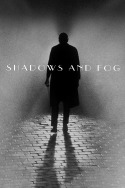
The film tends to be looked down upon by both fans and critics, and I?m at a loss for the rationale of this. While it definitely doesn?t rank among Allen?s best work, it certainly aspires to that level. All of Allen?s principal themes are present, be it religion (three different instances involve characters inquiring his views of divinity), marital promiscuity or general morality are examined. Extensive film quotations aren?t rare; the film itself is very reminiscent of the German Expressionist film movement in both content and look (Fritz Lang?s M immediately came to mind), Malcovich?s character bears a strong resemblance to the fiery, troubled clown in Bergman?s less than stellar Sawdust and Tinsel among other references. And yet, the film remains maligned for some inexplicable reason.
If I could lobby one complaint, the one issue that for me makes this a good later Allen film instead of simply a good Allen film, is the portrayal of Kleinman. While it?s essentially the same character that Woody Allen is always playing, he somehow seems to be even more sheepish than usual. Whereas his characters in films like Manhattan and Annie Hall were neurotic yet believable, here he just seems like a caricature of cowardice. It makes investing interest into his outcome somewhat difficult, when those surrounding him, such as Farrow and Cuzak?s characters feel real. They ponder on the nature of god and morality while Allen?s character obsesses over how tired he is. It seems as if Allen took his character from one of his short stories and the rest of the main characters from other films he directed, and the mob from Kafka. Allen?s short stories generally have the same humor as his film, but the premise and characters are always surreal in some manner, and that?s how he appears here.
That one issue aside, it?s a very enjoyable film. Like many of his films around this time, it?s not quite drama, and yet not exactly a comedy. It lies somewhere in between, and maybe loses something as a result, but I feel that it, along with Deconstructing Harry are the two best Allen films made between the early 90s and whenever Match Point came out.
This review of Shadows and Fog (1991) was written by Caleb M on 07 Oct 2010.
Shadows and Fog has generally received positive reviews.
Was this review helpful?