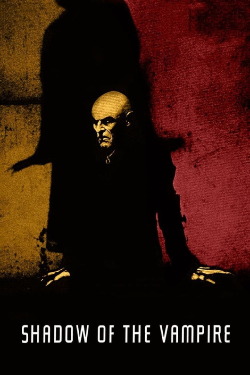
Review of Shadow of the Vampire (2000) by Frank H — 06 Sep 2007
And, without further ado, I continue the thread of the previous post.
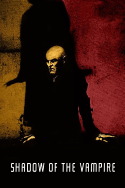
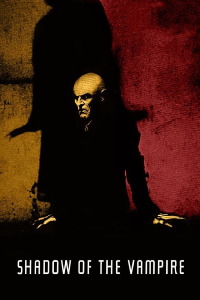
I just finished E. Elias Merhige's Shadow of the Vampire for what is technically the second time. The first time, though, I can't recall why I did not pay much attention.
In any case, if you are not familiar with the premise, it takes F.W. Murnau's silent vampiric masterpiece Nosferatu, eine Symphonie des Grauens (not to be confused with Werner Herzog's 1979 remake, Nosferatu: Phantom der Nacht with Klaus Kinski--though both are German films) and suggests that Max Schreck, who played Count Orlok, was in fact not really an actor at all (the idea coming from Schreck's lack of activity in film and thus lack of surface record of his existence oustide the film) but in fact a real vampire.
Willem DaFoe plays "Max Schreck" (who no longer remembers his origins, nor his real name) and John Malkovich plays Murnau. There are certainly other characters (including Catherine McCormack and her "wonderful bosom" as Greta/Mina).
Accents fly freely, Malkovich showing that he, rather surprisingly, is unbelievably awful with them. He can't maintain it when he raises his voice, nevermind that it is barely present anyway (we're talking Halle Berry's Storm accent style cringeworthy here). Willem has an extemely exaggerated Eastern European one, which he DOES maintain, but is ridiculous. However, for "Schreck," this works very well, because, despite his vampiric nature, he is intentionally humorous and slightly absurd (he's the one responsible for "wonderful bosom" in a really strange place). He turns in a nicely articulated (physically speaking, that is) performance, matching Schreck (the real one's) original stilted, eerie movements, and adding a few of his one little touches, disgusted snarls and clicking his lengthy fingernails like knives. He brings menace when he is supposed to, and manages to convey "Schreck's" confusion at this film-making scenario, and his lack of understanding for Murnau's obsession over film.
On the whole, it is a pretty darn solid film, with some performances marred only by poor accents (really that's just Malkovich, but he turns out such a well-made performance outside that, that it can be swallowed a bit).
Highlights also include (beyond my appreciation for Willem in almost anything) Eddie Izzard as an egotistical "artiste" of an actor and Udo Kier as an awesome producer--just generally being awesome.
Udo's German accent also sucked, by the way.
DVD Features: As per usual, I leave the commentary for later, but I did watch the two included interviews, a seven minute one with Merhige where he annoyingly says "subSEEkwently" a couple of times, and seems to occasionally grabs for words and concepts a little unconvincingly, giving an impression of false complexity on his part, but he does give some interesting trivia. Though he also makes the mistake of claiming Murnau's Nosferatu as the first vampire and first horror movie. This rang incorrectly with me, and so I checked my copy of The Vampire Book (thank you, John) and lo, Dracula alone had been filmed twice prior: in 1920, in Russia (which has not survived) and again in 1921 in Hungaria. It even mentions 1912's The Secrets of House No. 5 as the first (possibly) vampire movie ever--a full ten years prior to Nosferatu. Oops.
As far as horror, that subject is a little less clear, naturally, though Das Kabinett des Doktor Caligari is pretty reknowned as horror films go, and was made two years prior as well. And of course Paul Wegeners's 1915 Der Golem (and even 1917's Der Golem und die Tanzerin and 1920's Der Golem, wie er in die Welt kam, both also Wegener and the lot of them highly influential). So, good job, Merhige, it wouldn't be an issue except it's pretty relevant to your making such a film.
The other interview on the disc is with Willem, much shorter at only 3 minutes, but more interesting for Willem seems a bit more capable of using speech as a method of conveying ideas (Merhige certainly proved he could at least convey things quite well in film). He gives some idea of how he created his performance, the most interesting part of his interview.
All in all, it continues my satisfaction with my DVD purchases past and present as yet.
(It has also inspired me to finally go ahead and start looking at and for such German expressionist classics as its inspiration and the other films I mentioned).
This review of Shadow of the Vampire (2000) was written by Frank H on 06 Sep 2007.
Shadow of the Vampire has generally received positive reviews.
Was this review helpful?