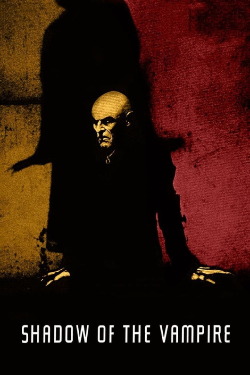
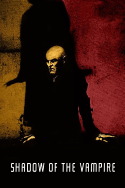
Review of Shadow of the Vampire (2000) by Van R — 19 Jul 2010
Bram Stokerâ??s widow Florence would spin in her grave if she knew about â??Shadow of the Vampire.â?? â??Begottenâ?? director E. Elias Mehrige's second film qualifies as an artsy fartsy retelling of the making of German filmmaker F.
W. Murnau's groundbreaking silent chiller "Nosferatuâ?? that was produced in 1922. No sooner had "Nosferatu" been shot than Florence Stoker sued Murnau and company for copyright infringement and the court issued a ruling that made the studio recall all copies and destroy them.
Happily, some copies escaped destruction and the artistic legacy of the Murnau film as well as its contribution to vampire films has survived. Mehrige helmed his last film â??Begottenâ?? about 10 years before he embarked on this witty but wry epic that pokes as much fun at â??Nosferatuâ?? as it praises Murnauâ??s artistry.
Basically, Murnau abhors the confines of the Berlin studio and decides to take advantage of on-location lensing in both Czechoslovakia and Poland away from the manufactured artistry of the studio. Although this isnâ??t an objective casework about â??Nosferatu,â?? Mehrige and scenarist Steve Katz never stoop to lowest common denominator elements in this somewhat pretentious 93-minute escapade.
Mind you, the performances, the majestic photography, and the settings distinguish what is really a one-note film. The idea here is that Murnau makes a Faustian deal with a real-life vampire to appear in his film in exchange for lunching on his cast and crew.
Ironically, Katz received the 2000 Bram Stoker Award as Best Screenwriter for â??Shadow of the Vampire.â?? The mercurial John Malkovich inhabits the role of the legendary German director who achieved greater fame and fortune in Hollywood before an automobile crash claimed his life in 1931.
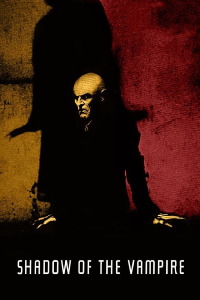
Meanwhile, Willem Dafoe impersonates one of the worldâ??s most mysterious and revolting looking real-life actors, Max Schreck. Little was known about Schreck and the role provided a challenge for Dafoe who settled on using the film as a means to guide his creation of Schreck.
According to Dafoe, "The most important research tool was the footage. The only thing I could find out about Max was that a biographer of Murnau said he was 'an actor of no distinction.' But the script was very strong, and we had the actual â??Nosferatuâ?? film as a kind of touchstone and base.
So much had to wait until I got into the prosthetic (the makeup). I didn't just have extreme makeup, but also a costume that was restricting. The shoes made me walk a particular way. The padding in the clothes also made me walk a particular way.
It was great because it's a huge mask which frees you up so much." Ultimately, Dafoe received an Oscar nomination for Best Supporting Actor for his portrayal of Schreck. Indeed, â??Shadow of a Vampireâ?? went on to win several cinematic awards.
Watching â??Shadow of a Vampireâ?? as a companion piece to â??Nosferatuâ?? will furnish viewers with some insights not only into the silent original but also the nature of the working conditions in the early film industry.
Mehrige supplies a commentary track with the DVD release that reveals certain things that occurred during the production of silent films that will enlighten moviegoers.
This review of Shadow of the Vampire (2000) was written by Van R on 19 Jul 2010.
Shadow of the Vampire has generally received positive reviews.
Was this review helpful?









![[REC] (2007)](https://cdn1.cinafilm.com/static/img/movie/5996792e/200/1-rec-2007.jpg)