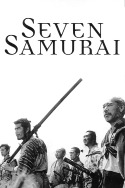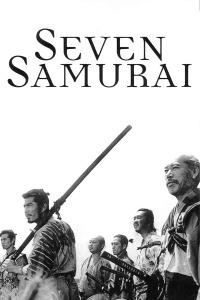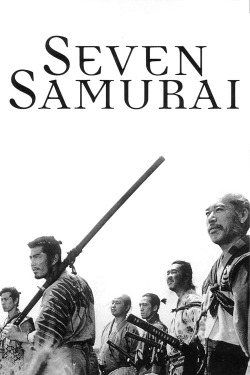
Review of Seven Samurai (1954) by Ben A — 03 Nov 2011
It's rare that a film this long can feel like it actually justifies it's length. Most films creeping over the 3 hour mark feel bloated and sprawling. Not so with Seven Samurai. Despite it's long run time Seven Samurai never once feels like a three and a half hour long movie.
Every single second is absolutely necessary to understand the samurai, the villagers, their motivations, plights, struggles, problems, fears, hopes, and to ultimately understand the nature of their victory.
There are masterpieces and then there are films like Seven Samurai that are able to transcend time, genre, and nationality to truly become classics and absolutely indispensable pieces to understanding the history of film.
If you've ever seen a western made after 1954 or a film where a team is assembled you've seen a movie influenced by Seven Samurai. Few films have ever been shot quite as beautifully as Seven Samurai.
Over it's run time Kurosawa uses every single trick and technique in his extensive repertoire. Though Kurosawa was heavily influenced by John Ford, an influence which most notably shows up in his long static and tracking shots, Kurosawa always retains an identity and style all his own.
Few men have ever filmed nature quite as beautifully as Kurosawa and nature almost always makes plainly visible an internal conflict or adds emphasis to an external conflict. The most obvious and well known example of this is the rain during the very final battle.
As in all of Kurosawa's films this downpour is torrential, it never sprinkles in Kurosawa's world. Kurosawa was also heavily influenced by silent film and frequently relies upon action and image to tell a story rather than sound or speaking.
Kurosawa was a master at telling a story through images rather than words. However, Kurosawa was not alone in making this film the masterpiece that it is. Toshiro Mifune gives a performance for the ages as Kikuchiyo.
Mifune's performance is spilling over with wild, manic energy and charisma. The man can dominate the screen absolutely like almost no one else. Of course it is impossible not to mention Takashi Shimura's Kambei.
Like Mifune, Shimura has a way of dominating the screen and demanding attention. He is, however, the polar opposite of brash Kikuchiyo. Kambei is wise, reserved, careful, and at first unwilling to even fight.
There is a quite dignity which permeates Kambei and makes him one of the most compelling leaders in any film ever. The rest of the cast is similarly excellent, not a weak performance is to be found anywhere in Seven Samurai.
Though it has been endlessly copied, borrowed, picked over, and stolen from Seven Samurai has outlived every single movie it has influenced. It never succumbs to the cliches or trends it spawned. It is and will always be one of the most enduring pieces of art ever created and a crown jewel of what mankind is capable of.
This review of Seven Samurai (1954) was written by Ben A on 03 Nov 2011.
Seven Samurai has generally received very positive reviews.
Was this review helpful?